




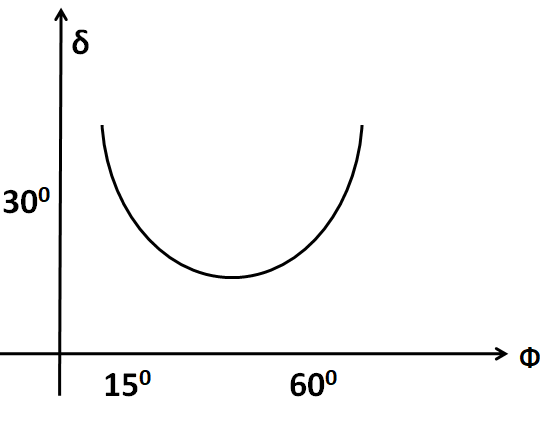
The figure shows the graph of deviation $'\delta '$ versus the angle of incidence $\varphi $ for a light ray striking a prism. The angle of the prism is:
A. ${30^ \circ }$
B. ${45^ \circ }$
C. ${60^ \circ }$
D. ${75^ \circ }$
Answer
 Verified
571.5k+ views
Hint: To solve this question, we need to use the formula of the angle of deviation for a light ray incident on a prism. Substituting the values of the two angles of incidence for the given value of the angle of deviation in that formula, we will get the required value of the angle of prism.
Formula used: The formula used to solve this question is given by
$\delta = i + e - A$, here $\delta $ is the angle of deviation for a light ray incident on a prism of angle $A$ at an angle of incidence of $i$, which leaves the prism with an angle of emergence of $e$.
Complete step by step answer: We know that the angle of deviation for a ray of light passing through a prism is given by the formula
$\delta = i + e - A$.
According to the figure given in the question, for the values of the angle of incidence of the ray of light equal to ${15^ \circ }$ and ${60^ \circ }$, we have the same angle of deviation equal to ${30^ \circ }$. Therefore, we can take one of the two angles like the angle of incidence, and the other to be equal to the angle of emergence.
Therefore, on substituting $i = {15^ \circ }$, $e = {60^ \circ }$, and $\delta = {30^ \circ }$ in the above formula, we get
${30^ \circ } = {15^ \circ } + {60^ \circ } - A$
$ \Rightarrow A = {15^ \circ } + {60^ \circ } - {30^ \circ }$
On solving, we finally get the value of the angle of prism as
$A = {45^ \circ }$
Thus, the value of the angle of prism is equal to ${45^ \circ }$.
Hence, the correct answer is option B.
Note: Do not be confused as to how could we take the angle of emergence to be equal to the angle of incidence. We can clearly see that the formula for the angle of deviation is symmetric with respect to the angle of incidence and the angle of emergence. This means that these values are exchangeable. In the other words, if the path of the emergent ray is reversed so that it is incident on the other face of the prism at the angle of emergence, then it would emerge from the first face of the prism making an angle equal to the angle of incidence.
Formula used: The formula used to solve this question is given by
$\delta = i + e - A$, here $\delta $ is the angle of deviation for a light ray incident on a prism of angle $A$ at an angle of incidence of $i$, which leaves the prism with an angle of emergence of $e$.
Complete step by step answer: We know that the angle of deviation for a ray of light passing through a prism is given by the formula
$\delta = i + e - A$.
According to the figure given in the question, for the values of the angle of incidence of the ray of light equal to ${15^ \circ }$ and ${60^ \circ }$, we have the same angle of deviation equal to ${30^ \circ }$. Therefore, we can take one of the two angles like the angle of incidence, and the other to be equal to the angle of emergence.
Therefore, on substituting $i = {15^ \circ }$, $e = {60^ \circ }$, and $\delta = {30^ \circ }$ in the above formula, we get
${30^ \circ } = {15^ \circ } + {60^ \circ } - A$
$ \Rightarrow A = {15^ \circ } + {60^ \circ } - {30^ \circ }$
On solving, we finally get the value of the angle of prism as
$A = {45^ \circ }$
Thus, the value of the angle of prism is equal to ${45^ \circ }$.
Hence, the correct answer is option B.
Note: Do not be confused as to how could we take the angle of emergence to be equal to the angle of incidence. We can clearly see that the formula for the angle of deviation is symmetric with respect to the angle of incidence and the angle of emergence. This means that these values are exchangeable. In the other words, if the path of the emergent ray is reversed so that it is incident on the other face of the prism at the angle of emergence, then it would emerge from the first face of the prism making an angle equal to the angle of incidence.
Recently Updated Pages
How is Abiogenesis Theory Disproved Experimentally?

In a plane electromagnetic wave the electric field class 12 physics CBSE
A plane electromagnetic wave travels in vacuum along class 12 physics CBSE
The branch of science which deals with nature and natural class 10 physics CBSE
Understanding the Sun's Density: Exploring the Mass Density of a Hot Plasma - FAQs and Data Analysis
Where is the Centre for Environmental Education Located?
Trending doubts
Which are the Top 10 Largest Countries of the World?
Draw a labelled sketch of the human eye class 12 physics CBSE
Which state in the country is at the forefront in controlling class 12 social science CBSE
Mention the role of cyanobacteria as a biofertiliz class 12 biology ICSE
Where is the largest hydroelectric power station located class 12 biology CBSE
An example of C4 plant is A Maize B Rice C Wheat D class 12 biology CBSE