




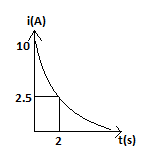
The figure shows the graph of a current in a discharging circuit of a capacitor through a resistor of resistance 10 ohm:
A. The initial potential difference across the capacitor is 100V.
B. The capacitance of the capacitor is $\dfrac{1}{{10\ln 2}}$ F.
C. The total heat produced in the circuit will be $\dfrac{{500}}{{\ln 2}}$ J.
D. All of the above.
Answer
 Verified
577.2k+ views
Hint: For solving the problem we will use the transient behaviour of the capacitor that the capacitor will have initial current and initial voltage zero after charging the capacitor will have zero current (as shown the decaying current of the graph) and maximum voltage.
Complete answer:
Let’s check each option one by one in order to mark the correct option:
A) Initial potential difference of the capacitor is 100V.Initial current of the capacitor is 10 as per graph and the resistance is 10 ohm therefore voltage will be V = I$ \times $ R. Multiplication of current and resistance will give us; 10 $ \times $ 10 =100 V.
B) Equation of current at time t is:
$i(t) = {i_0}{e^{ - \dfrac{t}{\tau }}}$ (Where i0 is the initial current t is the time and $\tau $is the time constant = RC).
i =2.5 at t = 2 from graph. Substituting the values of i and t>
$
\Rightarrow 2.5 = 10{e^{ - \dfrac{2}{{10C}}}} \\
\Rightarrow \dfrac{{2.5}}{{10}} = {e^{ - \dfrac{2}{{10C}}}} \\
$
Now we will remove the exponential term from both the sides of the equation by taking natural log.
$
\Rightarrow \ln .25 = \dfrac{{ - 2}}{{10C}} \\
\Rightarrow - 1.3863 = \dfrac{{ - 2}}{{10C}} \\
$ (ln.25 have value -1.3863)
$
\Rightarrow \dfrac{2}{{13.863}} = C \\
\Rightarrow C = 0.1443F \\
$ (Getting value of C from this equation)
Value of $\dfrac{1}{{10\ln 2}}$is also 0.1443 F.
C) Total heat produced in the circuit means energy.
Energy of capacitor is given by $\dfrac{1}{2}C{V^2}$
$
\Rightarrow \dfrac{1}{2} \times 0.1443 \times {(100)^2} \\
\Rightarrow 0.5 \times 0.1443 \times 10000 \\
\Rightarrow 721.500J \\
$ (Substituting all the values in the Formula used:)
Value of $\dfrac{{500}}{{\ln 2}}$ J. Is also equal to 721.500J
Therefore, option D is correct.
Note:
As the capacitor shows the transient behaviour, in the similar way the inductor too shows the transient behaviour. At the initial stage the inductor has zero current value and has voltage magnitude but at steady state voltage slows down to zero and current reaches a maximum level.
Complete answer:
Let’s check each option one by one in order to mark the correct option:
A) Initial potential difference of the capacitor is 100V.Initial current of the capacitor is 10 as per graph and the resistance is 10 ohm therefore voltage will be V = I$ \times $ R. Multiplication of current and resistance will give us; 10 $ \times $ 10 =100 V.
B) Equation of current at time t is:
$i(t) = {i_0}{e^{ - \dfrac{t}{\tau }}}$ (Where i0 is the initial current t is the time and $\tau $is the time constant = RC).
i =2.5 at t = 2 from graph. Substituting the values of i and t>
$
\Rightarrow 2.5 = 10{e^{ - \dfrac{2}{{10C}}}} \\
\Rightarrow \dfrac{{2.5}}{{10}} = {e^{ - \dfrac{2}{{10C}}}} \\
$
Now we will remove the exponential term from both the sides of the equation by taking natural log.
$
\Rightarrow \ln .25 = \dfrac{{ - 2}}{{10C}} \\
\Rightarrow - 1.3863 = \dfrac{{ - 2}}{{10C}} \\
$ (ln.25 have value -1.3863)
$
\Rightarrow \dfrac{2}{{13.863}} = C \\
\Rightarrow C = 0.1443F \\
$ (Getting value of C from this equation)
Value of $\dfrac{1}{{10\ln 2}}$is also 0.1443 F.
C) Total heat produced in the circuit means energy.
Energy of capacitor is given by $\dfrac{1}{2}C{V^2}$
$
\Rightarrow \dfrac{1}{2} \times 0.1443 \times {(100)^2} \\
\Rightarrow 0.5 \times 0.1443 \times 10000 \\
\Rightarrow 721.500J \\
$ (Substituting all the values in the Formula used:)
Value of $\dfrac{{500}}{{\ln 2}}$ J. Is also equal to 721.500J
Therefore, option D is correct.
Note:
As the capacitor shows the transient behaviour, in the similar way the inductor too shows the transient behaviour. At the initial stage the inductor has zero current value and has voltage magnitude but at steady state voltage slows down to zero and current reaches a maximum level.
Recently Updated Pages
Master Class 12 Economics: Engaging Questions & Answers for Success

Master Class 12 Physics: Engaging Questions & Answers for Success
Master Class 12 English: Engaging Questions & Answers for Success
Master Class 12 Social Science: Engaging Questions & Answers for Success
Master Class 12 Maths: Engaging Questions & Answers for Success
Master Class 12 Business Studies: Engaging Questions & Answers for Success
Trending doubts
Which are the Top 10 Largest Countries of the World?
What are the major means of transport Explain each class 12 social science CBSE
Draw a labelled sketch of the human eye class 12 physics CBSE
Why cannot DNA pass through cell membranes class 12 biology CBSE
Differentiate between insitu conservation and exsitu class 12 biology CBSE
Draw a neat and well labeled diagram of TS of ovary class 12 biology CBSE