




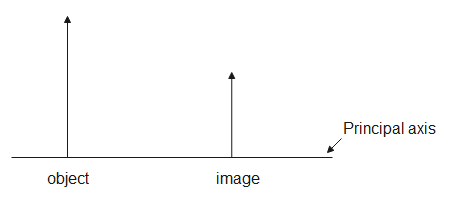
The figure shows object \[O\] and diminished image \[I\]. This is possible if-
(A). A convex mirror is placed to the right of \[I\]
(B). A convex mirror is placed between \[O\] and \[I\]
(C). A concave lens is placed to the right of \[I\]
(D). A concave lens is placed between \[O\] and \[I\]
Answer
 Verified
571.2k+ views
Hint: A concave mirror forms virtual and diminished images by reflection behind the mirror, while a concave lens forms virtual and diminished images by refraction on the same side as the object. We can find the correct position where the image formed coincides with \[I\]by observing the different positions of objects and corresponding image formations for the lens and mirrors.
Complete step-by-step solution
A convex mirror is curved outwards and forms a virtual diminished image, formed behind the lens for all positions of the object. According to sign convention, its focal length and radius of curvature, and image distance are taken as positive.
A concave lens is thinner in the center and thicker at the edges. It is called a diverging lens as the rays diverge after undergoing refraction. It forms a virtual, erect, and diminished image, formed on the same side of the lens as the object for all positions of the object. By convention, its focal length, the radius of curvature, and image distance are taken as negative.
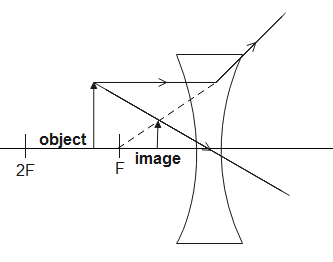
If we keep a concave lens in between \[O\] and \[I\], the image formed, \[I'\] by the lens will not coincide with \[I\] as \[I'\] will be formed on the same side as \[O\]. If we keep the concave lens to the right of \[I\], the image formed \[I'\] may coincide with \[I\]
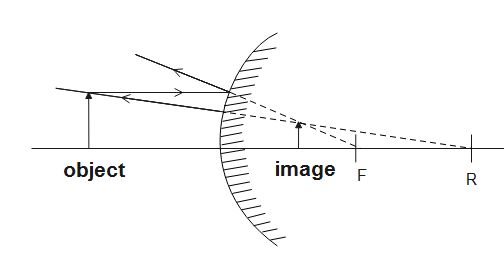
If we keep a convex mirror between \[O\] and \[I\], the image formed,\[I''\] may coincide with \[I\] as the image formed by the convex lens on the other side of the mirror. Whereas if the mirror was to be kept on the right side of \[I\], the image formed, \[I''\] would not coincide with \[I\].
As the situation is possible if we keep a concave lens to the right of \[I\] or a convex mirror between \[O\] and \[I\], the correct options are (B) and (C).
Note: By convention, all distances to the left are taken as negative and all distances to the right are taken as positive. A concave mirror forms real and inverted images for all positions except \[u< f\]. A convex lens always forms a real inverted image for all positions of an object except \[u< f\].
Complete step-by-step solution
A convex mirror is curved outwards and forms a virtual diminished image, formed behind the lens for all positions of the object. According to sign convention, its focal length and radius of curvature, and image distance are taken as positive.
A concave lens is thinner in the center and thicker at the edges. It is called a diverging lens as the rays diverge after undergoing refraction. It forms a virtual, erect, and diminished image, formed on the same side of the lens as the object for all positions of the object. By convention, its focal length, the radius of curvature, and image distance are taken as negative.
If we keep a concave lens in between \[O\] and \[I\], the image formed, \[I'\] by the lens will not coincide with \[I\] as \[I'\] will be formed on the same side as \[O\]. If we keep the concave lens to the right of \[I\], the image formed \[I'\] may coincide with \[I\]
If we keep a convex mirror between \[O\] and \[I\], the image formed,\[I''\] may coincide with \[I\] as the image formed by the convex lens on the other side of the mirror. Whereas if the mirror was to be kept on the right side of \[I\], the image formed, \[I''\] would not coincide with \[I\].
As the situation is possible if we keep a concave lens to the right of \[I\] or a convex mirror between \[O\] and \[I\], the correct options are (B) and (C).
Note: By convention, all distances to the left are taken as negative and all distances to the right are taken as positive. A concave mirror forms real and inverted images for all positions except \[u< f\]. A convex lens always forms a real inverted image for all positions of an object except \[u< f\].
Recently Updated Pages
Master Class 12 Economics: Engaging Questions & Answers for Success

Master Class 12 Physics: Engaging Questions & Answers for Success
Master Class 12 English: Engaging Questions & Answers for Success
Master Class 12 Social Science: Engaging Questions & Answers for Success
Master Class 12 Maths: Engaging Questions & Answers for Success
Master Class 12 Business Studies: Engaging Questions & Answers for Success
Trending doubts
Which are the Top 10 Largest Countries of the World?
What are the major means of transport Explain each class 12 social science CBSE
Draw a labelled sketch of the human eye class 12 physics CBSE
Why cannot DNA pass through cell membranes class 12 biology CBSE
Differentiate between insitu conservation and exsitu class 12 biology CBSE
Draw a neat and well labeled diagram of TS of ovary class 12 biology CBSE