




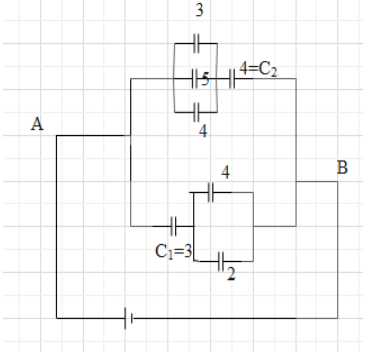
The figure shows a network of seven capacitors. If the charge on the 5μF capacitor is 10μC, the potential difference between the points A and C is given as \[\dfrac{x}{3}\].
Answer
 Verified
585.6k+ views
Hint: We should have knowledge about kirchhoff's law of capacitance for solving this circuit. Q=CV, we will deal with equivalent capacitance across two points. Charge conservation method should be kept in mind. We will find \[{{Q}_{eq}}\], \[{{C}_{eq}}\] and ${{V}_{AB}}$ and by using formula we will solve the question.
Formula used:
\[{{Q}_{eq}}={{C}_{eq}}{{V}_{AB}}\]
Complete answer:

Firstly we will find potential across 5 capacitor
Let the potential across the \[5\mu f\] capacitor be \[{{v}_{5}}\].
Potential across \[5\mu f\] is \[{{v}_{5}}=\dfrac{{{q}_{5}}}{{{c}_{5}}}\]
\[=\dfrac{10}{5}=2\]
As we can see that\[\left( 3\mu f,4\mu f,5\mu f \right)\] are in parallel in below given diagram
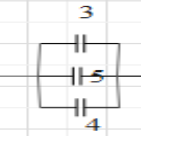
So now we will find charge on \[3\mu f\] and \[4\mu f\] capacitor voltage across both the capacitance will be the same as both are in parallel i.e =2volts.
Charge on \[3\mu f\] is \[{{Q}_{3}}=3\times 2=6\mu C\]
Charge on \[4\mu f\] is \[{{Q}_{4}}4\times 2=8\mu C\]
Charge on \[5\mu f\] is \[{{Q}_{5}}=5\times 2=10\mu C\]
Now we can see that \[{{C}_{2}}\] is in series with \[\left( 3\mu f,4\mu f,5\mu f \right)\]so charge on \[{{C}_{2}}\] and group \[\left( 3\mu f,4\mu f,5\mu f \right)\]are same.
So we can find the charge on \[{{C}_{2}}\] is \[{{Q}_{2}}=10+6+8=24\mu C\]
And potential across it \[{{V}_{2}}=\dfrac{24}{4}=6V\]
Thus we will now find potential across point A and B
\[{{V}_{AB}}={{V}_{5}}+{{V}_{2}}=2+6=8V\]
Now equivalent capacitance of lower branch of circuit is
\[{{C}_{eq}}=\dfrac{3\left( 4+2 \right)}{3+4+2}=2\mu f\] And;
Total equivalent charge\[{{Q}_{eq}}={{C}_{eq}}{{V}_{AB}}=2\left( 8 \right)=16\mu C\]
\[\therefore {{V}_{AC}}=\dfrac{{{Q}_{eq}}}{3}=\dfrac{16}{3}\]
Thus on comparing it with \[\dfrac{x}{3}\] we obtain x=16.
On solving the circuit by basic charge conservation method we obtain that x=16.
Note:
We have to apply charge conservation carefully properties of capacitor in series and parallel should be kept in mind
Formula to find the charge on capacitor is
q=CV
Where,
q=charge on capacitor
V= voltage applied across capacitor
C= Capacitance of capacitor
When voltage is applied across a parallel plate capacitor it produces positive charge on one plate and negative charge on another plate. Charge across the capacitor is directly proportional to voltage.
Formula used:
\[{{Q}_{eq}}={{C}_{eq}}{{V}_{AB}}\]
Complete answer:
Firstly we will find potential across 5 capacitor
Let the potential across the \[5\mu f\] capacitor be \[{{v}_{5}}\].
Potential across \[5\mu f\] is \[{{v}_{5}}=\dfrac{{{q}_{5}}}{{{c}_{5}}}\]
\[=\dfrac{10}{5}=2\]
As we can see that\[\left( 3\mu f,4\mu f,5\mu f \right)\] are in parallel in below given diagram
So now we will find charge on \[3\mu f\] and \[4\mu f\] capacitor voltage across both the capacitance will be the same as both are in parallel i.e =2volts.
Charge on \[3\mu f\] is \[{{Q}_{3}}=3\times 2=6\mu C\]
Charge on \[4\mu f\] is \[{{Q}_{4}}4\times 2=8\mu C\]
Charge on \[5\mu f\] is \[{{Q}_{5}}=5\times 2=10\mu C\]
Now we can see that \[{{C}_{2}}\] is in series with \[\left( 3\mu f,4\mu f,5\mu f \right)\]so charge on \[{{C}_{2}}\] and group \[\left( 3\mu f,4\mu f,5\mu f \right)\]are same.
So we can find the charge on \[{{C}_{2}}\] is \[{{Q}_{2}}=10+6+8=24\mu C\]
And potential across it \[{{V}_{2}}=\dfrac{24}{4}=6V\]
Thus we will now find potential across point A and B
\[{{V}_{AB}}={{V}_{5}}+{{V}_{2}}=2+6=8V\]
Now equivalent capacitance of lower branch of circuit is
\[{{C}_{eq}}=\dfrac{3\left( 4+2 \right)}{3+4+2}=2\mu f\] And;
Total equivalent charge\[{{Q}_{eq}}={{C}_{eq}}{{V}_{AB}}=2\left( 8 \right)=16\mu C\]
\[\therefore {{V}_{AC}}=\dfrac{{{Q}_{eq}}}{3}=\dfrac{16}{3}\]
Thus on comparing it with \[\dfrac{x}{3}\] we obtain x=16.
On solving the circuit by basic charge conservation method we obtain that x=16.
Note:
We have to apply charge conservation carefully properties of capacitor in series and parallel should be kept in mind
Formula to find the charge on capacitor is
q=CV
Where,
q=charge on capacitor
V= voltage applied across capacitor
C= Capacitance of capacitor
When voltage is applied across a parallel plate capacitor it produces positive charge on one plate and negative charge on another plate. Charge across the capacitor is directly proportional to voltage.
Recently Updated Pages
Master Class 12 Economics: Engaging Questions & Answers for Success

Master Class 12 Physics: Engaging Questions & Answers for Success
Master Class 12 English: Engaging Questions & Answers for Success
Master Class 12 Social Science: Engaging Questions & Answers for Success
Master Class 12 Maths: Engaging Questions & Answers for Success
Master Class 12 Business Studies: Engaging Questions & Answers for Success
Trending doubts
Which are the Top 10 Largest Countries of the World?
What are the major means of transport Explain each class 12 social science CBSE
Draw a labelled sketch of the human eye class 12 physics CBSE
Why cannot DNA pass through cell membranes class 12 biology CBSE
Differentiate between insitu conservation and exsitu class 12 biology CBSE
Draw a neat and well labeled diagram of TS of ovary class 12 biology CBSE