




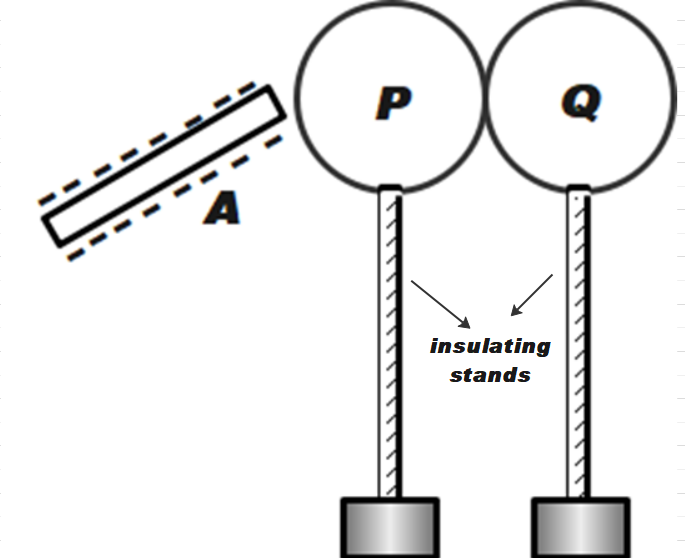
The figure shows a negatively charged ebonite rod A which is brought near an uncharged metal sphere P touching the other uncharged metal sphere Q. Both the spheres stand P and Q stand on separate insulating stands. Keeping rod A in position, sphere Q is removed by holding the insulating stand of it. State the kind of charge on sphere P and Q. Give a reason for your answer
A. spheres Q and P have a positive charge
B. spheres Q and P have a negative charge
C. sphere Q has negative and sphere P has a positive charge
D. spheres P and Q have no charge
Answer
 Verified
621.3k+ views
Hint: In the given question we have been asked to find the charge on the sphere P and sphere Q. It is given that the spheres P and Q are uncharged at touching each other. A negatively charged rod is brought near the sphere P. Now, we know that like charges repel each other and unlike charges attract each other. Therefore, we shall answer the given question, using this concept of the flow of charges.
Complete answer:
In the given figure, it is shown that the negatively charged rod is brought close to the sphere P. It is also given that both the spheres P and Q are initially uncharged. This means that the number of positively charged particles is the same as the number of negatively charged particles. Therefore, when the rod is brought closer to the sphere P, the positively charged particles from the sphere Q will also be attracted toward the negatively charged rod A through sphere P. This makes the sphere Q negatively charged, and the sphere P positively charged.
Now, when the sphere Q is removed from the system by using an insulated stand, the sphere P and Q retain the charge accumulated due to the electrostatic induction by rod A. Therefore, sphere Q has a negative charge and sphere P has a positive charge.
Therefore, the correct answer is option C.
Note: The electrostatic induction is a process, which is used to generate static electricity in a material. This is done by bringing an electrically charged object near the material. This leads to the distribution of charges in the material. One side has an excess of positive charge and the other has a negative charge. Since a point charge has no dimension, charges can not be distributed. Therefore, electrostatic induction can not be done with point charges.
Complete answer:
In the given figure, it is shown that the negatively charged rod is brought close to the sphere P. It is also given that both the spheres P and Q are initially uncharged. This means that the number of positively charged particles is the same as the number of negatively charged particles. Therefore, when the rod is brought closer to the sphere P, the positively charged particles from the sphere Q will also be attracted toward the negatively charged rod A through sphere P. This makes the sphere Q negatively charged, and the sphere P positively charged.
Now, when the sphere Q is removed from the system by using an insulated stand, the sphere P and Q retain the charge accumulated due to the electrostatic induction by rod A. Therefore, sphere Q has a negative charge and sphere P has a positive charge.
Therefore, the correct answer is option C.
Note: The electrostatic induction is a process, which is used to generate static electricity in a material. This is done by bringing an electrically charged object near the material. This leads to the distribution of charges in the material. One side has an excess of positive charge and the other has a negative charge. Since a point charge has no dimension, charges can not be distributed. Therefore, electrostatic induction can not be done with point charges.
Recently Updated Pages
Master Class 10 Computer Science: Engaging Questions & Answers for Success

Master Class 10 Social Science: Engaging Questions & Answers for Success
Master Class 10 Science: Engaging Questions & Answers for Success
Class 10 Question and Answer - Your Ultimate Solutions Guide
Master Class 10 Maths: Engaging Questions & Answers for Success
Master Class 10 English: Engaging Questions & Answers for Success
Trending doubts
Which are the Top 10 Largest Countries of the World?
Draw a labelled sketch of the human eye class 12 physics CBSE
Why is the cell called the structural and functional class 12 biology CBSE
Draw ray diagrams each showing i myopic eye and ii class 12 physics CBSE
Differentiate between homogeneous and heterogeneous class 12 chemistry CBSE
Which is the correct genotypic ratio of mendel dihybrid class 12 biology CBSE