




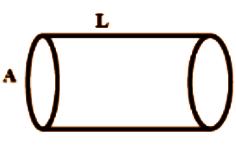
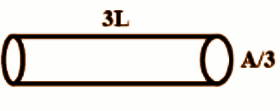
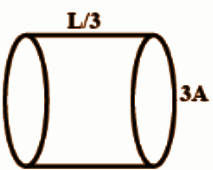
The figure below shows three cylindrical copper conductors along with their face areas and lengths. Compare the resistance and the resistivity of the three conductors. Justify your answer.
A.
B.
C.
Answer
 Verified
565k+ views
Hint: Electrical resistivity is the opposite of electrical conductivity. It is the measure of a material's ability to oppose the flow of current.
Formula used: We will use the following formula to solve this question
\[{\text{R}} = \rho \dfrac{L}{A}\]
Where
${\text{R}}$ is the resistance of the material
$\rho $ is the resistivity of the material
${\text{L}}$ is the length of the material
${\text{A}}$ is the cross sectional area of the material
Complete step by step answer:
For the figure (A.), we have been provided with the following information:
Length of the cylinder \[ = L\]
Cross sectional area of the cylinder \[ = A\]
Now we will simply put these values in the formula to find out resistance
So, we get
\[{R_A} = \rho \dfrac{L}{A}\]
For the figure (B.), we have been provided with the following information:
Length of the cylinder \[ = 3L\]
Cross sectional area of the cylinder \[ = \dfrac{A}{3}\]
Now we will simply put these values in the formula to find out resistance
So, we get
\[{R_B} = \rho \dfrac{{3L}}{{\left( {\dfrac{A}{3}} \right)}}\]
We can rewrite this equation as
\[{R_B} = \rho \dfrac{{9L}}{A}\]
For the figure (C.), we have been provided with the following information:
Length of the cylinder \[ = \dfrac{L}{3}\]
Cross sectional area of the cylinder \[ = 3A\]
Now we will simply put these values in the formula to find out resistance
So, we get
\[{R_C} = \rho \dfrac{{\left( {\dfrac{L}{3}} \right)}}{{3A}}\]
We can rewrite this equation as
\[{R_C} = \dfrac{1}{9}\left( {\rho \dfrac{L}{A}} \right)\]
Comparing \[{R_A}\], \[{R_B}\], and \[{R_C}\], we can observe that
\[{R_B} = 9{R_A}\]
And
\[{R_C} = \dfrac{1}{9}{R_A}\]
Therefore, we can arrange the resistances in the following order \[{R_B} > {R_A} > {R_C}\]
Note: Metals are fine electricity conductors. They, therefore, have low resistivity. In comparison with metallic conductors, insulators such as rubber, glass, graphite, plastics, etc. have very high resistivity. The third form is the semiconductor that comes between the insulators and the conductors. With the rise in temperature, their resistivity decreases and is also affected by the presence of impurities in them.
Formula used: We will use the following formula to solve this question
\[{\text{R}} = \rho \dfrac{L}{A}\]
Where
${\text{R}}$ is the resistance of the material
$\rho $ is the resistivity of the material
${\text{L}}$ is the length of the material
${\text{A}}$ is the cross sectional area of the material
Complete step by step answer:
For the figure (A.), we have been provided with the following information:
Length of the cylinder \[ = L\]
Cross sectional area of the cylinder \[ = A\]
Now we will simply put these values in the formula to find out resistance
So, we get
\[{R_A} = \rho \dfrac{L}{A}\]
For the figure (B.), we have been provided with the following information:
Length of the cylinder \[ = 3L\]
Cross sectional area of the cylinder \[ = \dfrac{A}{3}\]
Now we will simply put these values in the formula to find out resistance
So, we get
\[{R_B} = \rho \dfrac{{3L}}{{\left( {\dfrac{A}{3}} \right)}}\]
We can rewrite this equation as
\[{R_B} = \rho \dfrac{{9L}}{A}\]
For the figure (C.), we have been provided with the following information:
Length of the cylinder \[ = \dfrac{L}{3}\]
Cross sectional area of the cylinder \[ = 3A\]
Now we will simply put these values in the formula to find out resistance
So, we get
\[{R_C} = \rho \dfrac{{\left( {\dfrac{L}{3}} \right)}}{{3A}}\]
We can rewrite this equation as
\[{R_C} = \dfrac{1}{9}\left( {\rho \dfrac{L}{A}} \right)\]
Comparing \[{R_A}\], \[{R_B}\], and \[{R_C}\], we can observe that
\[{R_B} = 9{R_A}\]
And
\[{R_C} = \dfrac{1}{9}{R_A}\]
Therefore, we can arrange the resistances in the following order \[{R_B} > {R_A} > {R_C}\]
Note: Metals are fine electricity conductors. They, therefore, have low resistivity. In comparison with metallic conductors, insulators such as rubber, glass, graphite, plastics, etc. have very high resistivity. The third form is the semiconductor that comes between the insulators and the conductors. With the rise in temperature, their resistivity decreases and is also affected by the presence of impurities in them.
Recently Updated Pages
Master Class 12 Business Studies: Engaging Questions & Answers for Success

Master Class 12 Chemistry: Engaging Questions & Answers for Success
Master Class 12 Biology: Engaging Questions & Answers for Success
Class 12 Question and Answer - Your Ultimate Solutions Guide
Master Class 11 English: Engaging Questions & Answers for Success
Master Class 11 Social Science: Engaging Questions & Answers for Success
Trending doubts
Which are the Top 10 Largest Countries of the World?
Draw a labelled sketch of the human eye class 12 physics CBSE
Differentiate between homogeneous and heterogeneous class 12 chemistry CBSE
Differentiate between Pyramid of energy and pyramid class 12 biology CBSE
Why is the cell called the structural and functional class 12 biology CBSE
Draw the diagram of the pyramid of energy Explain In class 12 biology CBSE