




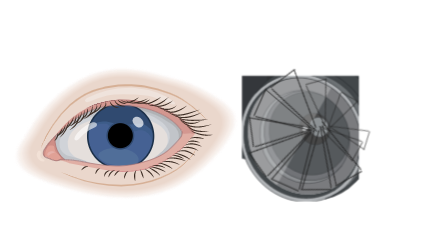
The figure below compares a part of our eye with a part of a photographic camera.
(a) Name the corresponding parts of the eye and the camera shown here that are comparable in function.
(b) Explain the mode of working and the functions of the parts of the eye mentioned above.
Answer
 Verified
561k+ views
Hint:The eye is a sensory organ that helps with sensory transduction, transmission, integration, and reaction when light is focused on the lens. It is a photoreceptor type of electromagnetic stimulus located in the rods and cones of the retina.
Complete answer:
Both the camera lens and the human eye focus on the image that is real and inverted, and the incoming light is focused on humans on the retina and the camera's sensor chips in the camera. Both the eye and the camera monitor the amount of light that enters, control the iris in the eye, and control the camera by changing the opening. Both the eye and the camera can focus on a single object, and both can focus on a wide range. Both the eye and the camera have a limited scope, so by adjusting the focal length, the scope of the camera can be changed, but the scope of the eye is fixed. Both the eye and the camera lens are convex; however, they are biconvex in the eye, and both allow for different colors of light.
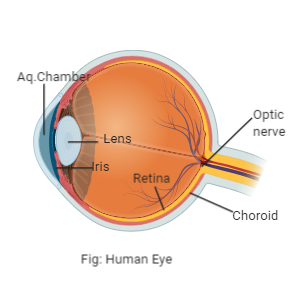
(a) The cornea is similar to the lens cover of the camera, as the cornea is the "cap" of the eye, and is translucent in nature, and lies at the front of the eye. It also has a spherical curvature, that covers the iris, the pupil, and the anterior chamber and provides much of the optical power to the eye. The camera lens is also translucent and lies at the front of the camera body and retains a spherical curvature.
(b) Iris is similar to the camera's opening, since the aperture determines the amount of light entering the camera, the iris controls how much light reaches the eye by adjusting the size of the pupil.
Note: Since cats have a high concentration of rod receptors, the vision of a cat is much better than that of a human. Fine items can be seen by the cat, and it can also see in the dark. The Eagle has the best range of eyesight because of the distance through which they can see. A color receptor is the strongest difference between human vision and the vision of other species, and only humans can see different shades of color.
Complete answer:
Both the camera lens and the human eye focus on the image that is real and inverted, and the incoming light is focused on humans on the retina and the camera's sensor chips in the camera. Both the eye and the camera monitor the amount of light that enters, control the iris in the eye, and control the camera by changing the opening. Both the eye and the camera can focus on a single object, and both can focus on a wide range. Both the eye and the camera have a limited scope, so by adjusting the focal length, the scope of the camera can be changed, but the scope of the eye is fixed. Both the eye and the camera lens are convex; however, they are biconvex in the eye, and both allow for different colors of light.
(a) The cornea is similar to the lens cover of the camera, as the cornea is the "cap" of the eye, and is translucent in nature, and lies at the front of the eye. It also has a spherical curvature, that covers the iris, the pupil, and the anterior chamber and provides much of the optical power to the eye. The camera lens is also translucent and lies at the front of the camera body and retains a spherical curvature.
(b) Iris is similar to the camera's opening, since the aperture determines the amount of light entering the camera, the iris controls how much light reaches the eye by adjusting the size of the pupil.
Note: Since cats have a high concentration of rod receptors, the vision of a cat is much better than that of a human. Fine items can be seen by the cat, and it can also see in the dark. The Eagle has the best range of eyesight because of the distance through which they can see. A color receptor is the strongest difference between human vision and the vision of other species, and only humans can see different shades of color.
Recently Updated Pages
Master Class 11 Computer Science: Engaging Questions & Answers for Success

Master Class 11 Business Studies: Engaging Questions & Answers for Success
Master Class 11 Economics: Engaging Questions & Answers for Success
Master Class 11 English: Engaging Questions & Answers for Success
Master Class 11 Maths: Engaging Questions & Answers for Success
Master Class 11 Biology: Engaging Questions & Answers for Success
Trending doubts
There are 720 permutations of the digits 1 2 3 4 5 class 11 maths CBSE
Discuss the various forms of bacteria class 11 biology CBSE
Draw a diagram of a plant cell and label at least eight class 11 biology CBSE
Explain zero factorial class 11 maths CBSE
What organs are located on the left side of your body class 11 biology CBSE
Draw a diagram of nephron and explain its structur class 11 biology CBSE