




The fermentation of glucose by yeast normally yields
A.Lactic acid, $C{O_2}$ and $2ATP$
B.Alcohol, $C{O_2}$ and $36ATP$
C.Alcohol, $C{O_2}$ and $2ATP$
D.$C{O_2}$, ${H_2}O$ and $36ATP$
Answer
 Verified
561k+ views
Hint: Glucose is a type of carbohydrate, it is made up of carbon, hydrogen and oxygen atoms.
Fermentation is defined as the incomplete oxidation of glucose carried out in the absence of oxygen known as anaerobic condition.
Complete answer:
Fermentation of glucose is a type of metabolic reaction which involves many prokaryotic organisms and unicellular eukaryotes like yeast.
Anaerobic conditions are required for the fermentation process to complete because presence of oxygen causes complete oxidation of glucose and yields different products like pyruvate and energy.
Glucose molecules undergo a 9 step reaction to form pyruvate as in the case of glycolysis to and $2ATP$.
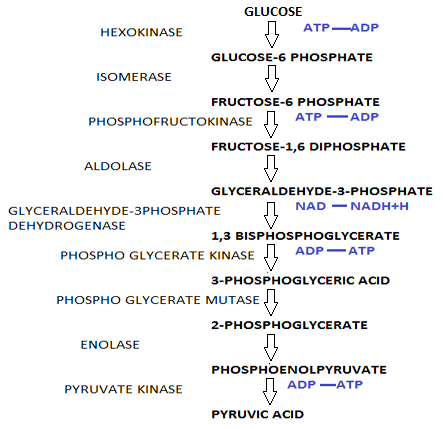
After glycolysis each molecule of glucose produced two molecules of pyruvate, $2ATP$ and $2NADH$.
After the formation of pyruvate, fermentation enzymes act on it to yield different products in the absence of oxygen.
Pyruvate molecule undergoes decarboxylation process in the presence of pyruvate decarboxylase to yield two molecules of acetaldehyde, two molecules of carbon dioxide and $NADH$.
$2{C_3}{H_4}{O_3}\underrightarrow {ez}2C{H_3}CHO + 2C{O_2} + 2NADH$
Where ${C_3}{H_4}{O_3}$ is pyruvate
$C{H_3}CHO$ Is acetaldehyde molecule
$C{O_2}$ Is carbon dioxide
$NADH$Energy molecule
$\left( {ez} \right)$ Is enzyme pyruvate decarboxylase
Acetaldehyde form in the step further undergoes chemical reaction in the presence of enzyme acetaldehyde dehydrogenase to finally form two molecules of ethanol by utilizing the energy formed in earlier step.
$2C{H_3}CHO\underrightarrow {ez}2C{H_2}OH + 2NA{D^ + }$
Where $\left( {ez} \right)$ is an enzyme acetaldehyde dehydrogenase
${C_2}{H_5}OH$ Is ethanol or alcohol
Hence, after completion of fermentation process one glucose molecule finally forms Alcohol, $C{O_2}$ and $2ATP$ so option (D) is correct .
During fermentation a very small amount of energy $\left( { < 7\% } \right)$is released from one molecule of glucose.
Note:
Glucose is commonly known as sugar because of its sweet taste. Glucose comes under the category of monosaccharide because it can not be further hydrolyzed to yield a smaller unit.
Yeast present in the reaction during fermentation undergoes self-death when concentration of alcohol reaches $\left( {13\% } \right)$
Fermentation is defined as the incomplete oxidation of glucose carried out in the absence of oxygen known as anaerobic condition.
Complete answer:
Fermentation of glucose is a type of metabolic reaction which involves many prokaryotic organisms and unicellular eukaryotes like yeast.
Anaerobic conditions are required for the fermentation process to complete because presence of oxygen causes complete oxidation of glucose and yields different products like pyruvate and energy.
Glucose molecules undergo a 9 step reaction to form pyruvate as in the case of glycolysis to and $2ATP$.
After glycolysis each molecule of glucose produced two molecules of pyruvate, $2ATP$ and $2NADH$.
After the formation of pyruvate, fermentation enzymes act on it to yield different products in the absence of oxygen.
Pyruvate molecule undergoes decarboxylation process in the presence of pyruvate decarboxylase to yield two molecules of acetaldehyde, two molecules of carbon dioxide and $NADH$.
$2{C_3}{H_4}{O_3}\underrightarrow {ez}2C{H_3}CHO + 2C{O_2} + 2NADH$
Where ${C_3}{H_4}{O_3}$ is pyruvate
$C{H_3}CHO$ Is acetaldehyde molecule
$C{O_2}$ Is carbon dioxide
$NADH$Energy molecule
$\left( {ez} \right)$ Is enzyme pyruvate decarboxylase
Acetaldehyde form in the step further undergoes chemical reaction in the presence of enzyme acetaldehyde dehydrogenase to finally form two molecules of ethanol by utilizing the energy formed in earlier step.
$2C{H_3}CHO\underrightarrow {ez}2C{H_2}OH + 2NA{D^ + }$
Where $\left( {ez} \right)$ is an enzyme acetaldehyde dehydrogenase
${C_2}{H_5}OH$ Is ethanol or alcohol
Hence, after completion of fermentation process one glucose molecule finally forms Alcohol, $C{O_2}$ and $2ATP$ so option (D) is correct .
During fermentation a very small amount of energy $\left( { < 7\% } \right)$is released from one molecule of glucose.
Note:
Glucose is commonly known as sugar because of its sweet taste. Glucose comes under the category of monosaccharide because it can not be further hydrolyzed to yield a smaller unit.
Yeast present in the reaction during fermentation undergoes self-death when concentration of alcohol reaches $\left( {13\% } \right)$
Recently Updated Pages
Which of the following graphs shows the variation of class 12 physics CBSE

Draw a labelled diagram of the human male reproductive class 12 biology CBSE
Describe the experiment to compare the emf of two cells class 12 physics CBSE
What is standard hydrogen electrode
What is conventional current and electric current class 12 physics CBSE
2Bromopentane is treated with an alcoholic KOH solution class 12 chemistry CBSE
Trending doubts
Draw a labelled sketch of the human eye class 12 physics CBSE
Which are the Top 10 Largest Countries of the World?
Differentiate between homogeneous and heterogeneous class 12 chemistry CBSE
Draw ray diagrams each showing i myopic eye and ii class 12 physics CBSE
Which is the correct genotypic ratio of mendel dihybrid class 12 biology CBSE
What is the Full Form of PVC, PET, HDPE, LDPE, PP and PS ?