




The female reproductive organs in a flower is
A. Sepals
B. Petals
C. Stamens
D. Carpels
Answer
 Verified
636k+ views
Hint:The female reproductive portion of the plant, consisting of an ovary, stigma, and style, is divided into three distinct sections and helps in the fertilization process. Each of the units is classified as megasporophyll or carpel.
Complete answer:
The gynoecium is seen on whorl number four. The unit is classified as megasporophyll or carpel. It is made up of ovaries, stigma, and style. It is the flower's female reproductive organ. The ovary is an expanded basal part that can be found above or below the base of the petals and sepals or at the point of junction with them. A locule is a chamber that produces the ovules in it. The style is a pillar-like stalk from which the ovary is penetrated by pollen tubes.
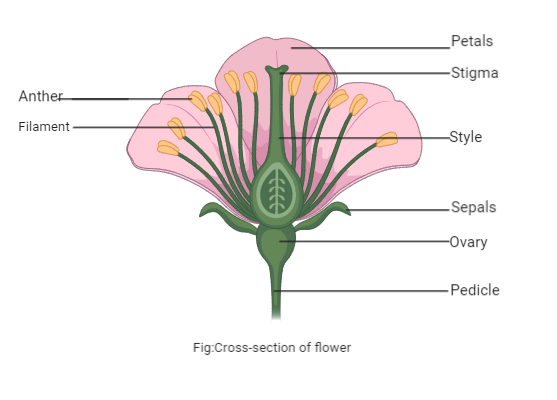
Some flowers do not have a distinct form, such as tulips, and the stigma sits directly on the ovary. Whereas the style is a hollow tube in some plants such as lilies or has transmitting tissues from which the pollen tubes emerge. Stigma is normally located at the tip of the style that receives pollen or gametophytes from men. They are sticky to trap pollen or are feathery. The stigma is a carpel's top and sticky part. It is a pollination site. The carpel type is a long tube connecting the stigma to the ovary. The lowermost portion of the carpel is the ovary and includes the ovules.
Hence the correct answer is option D-Carpels.
Note: A megasporophyll is a megasporangia-like structure. Each pistil is composed of one or more enrolled carpels, each containing one or more ovules. A single megasporophyll is a carpel. There are separate pistils (and thus separate carpels) in an apocarpous flower, whereas a syncarpous flower comprises a single pistil with two or more united carpels, referred to as syncarpous.
Complete answer:
The gynoecium is seen on whorl number four. The unit is classified as megasporophyll or carpel. It is made up of ovaries, stigma, and style. It is the flower's female reproductive organ. The ovary is an expanded basal part that can be found above or below the base of the petals and sepals or at the point of junction with them. A locule is a chamber that produces the ovules in it. The style is a pillar-like stalk from which the ovary is penetrated by pollen tubes.
Some flowers do not have a distinct form, such as tulips, and the stigma sits directly on the ovary. Whereas the style is a hollow tube in some plants such as lilies or has transmitting tissues from which the pollen tubes emerge. Stigma is normally located at the tip of the style that receives pollen or gametophytes from men. They are sticky to trap pollen or are feathery. The stigma is a carpel's top and sticky part. It is a pollination site. The carpel type is a long tube connecting the stigma to the ovary. The lowermost portion of the carpel is the ovary and includes the ovules.
Hence the correct answer is option D-Carpels.
Note: A megasporophyll is a megasporangia-like structure. Each pistil is composed of one or more enrolled carpels, each containing one or more ovules. A single megasporophyll is a carpel. There are separate pistils (and thus separate carpels) in an apocarpous flower, whereas a syncarpous flower comprises a single pistil with two or more united carpels, referred to as syncarpous.
Recently Updated Pages
If x a + bt + ct2 where x is in meters and t is in class 11 physics CBSE

A car covers the first half distance between two places class 11 physics CBSE
The resultant of two vectors overrightarrow P and overrightarrow class 11 physics CBSE
Find the value of cos 135 class 11 maths CBSE
A mass M is held in place by an applied force F and class 11 physics CBSE
A solution of glucose in water is labelled as 10 dfracwv class 11 chemistry CBSE
Trending doubts
One Metric ton is equal to kg A 10000 B 1000 C 100 class 11 physics CBSE
Find the value of the expression given below sin 30circ class 11 maths CBSE
What do you mean by retardation What is its SI uni class 11 physics CBSE
Draw a diagram of nephron and explain its structur class 11 biology CBSE
10 examples of friction in our daily life
Difference between physical and chemical change class 11 chemistry CBSE