




The experimental proof for semiconservative replication of DNA was first shown in
A. Plant
B. Fungus
C. Virus
D. Bacterium
Answer
 Verified
606.6k+ views
Hint: DNA replication is semiconservative and this was first proven experimentally by Meselson and Stahl on E.coli. Later many more experiments were conducted by the different scientists on different organisms.
Step by step answer:Semi conservative mode of DNA replication was first proposed by Watson and Crick. And then it was proved by Meselson and Stahl(1958) while working on bacteria E.coli and also by Taylor while working on plant Vicia faba(1958). To prove this, Taylor used a radioactive technique in which radioisotopes(tritiated thymidine) were used.
Meselson and Stahl used a heavy isotope of nitrogen and Cairns(1963) used radioactive thymidine.
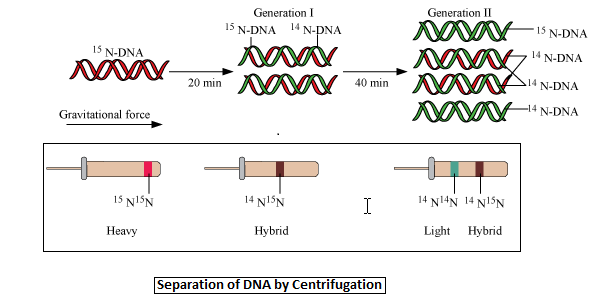
Meselson and Stahl grew many generations of bacteria in a medium having a heavy isotope of nitrogen. This labeled DNA was transferred to a normal medium( ie. having light nitrogen). The generation obtained was hybrid, the second generation has 50% hybrid and 50% light type DNA. This result is possible only if at each replication one strand is conserved in the daughter while the second is freshly synthesized.
As the first experiment to prove the semiconservative nature of DNA replicated was done on E.coli, which is a bacteria, so the correct option is D.Bacterium
Note: DNA replication is a bidirectional process that occurs during the S-phase of the cell cycle.DNA replication occurs in all living organisms. DNA is the only molecule capable of self-replication or duplication, so it is also termed as a living molecule.
Step by step answer:Semi conservative mode of DNA replication was first proposed by Watson and Crick. And then it was proved by Meselson and Stahl(1958) while working on bacteria E.coli and also by Taylor while working on plant Vicia faba(1958). To prove this, Taylor used a radioactive technique in which radioisotopes(tritiated thymidine) were used.
Meselson and Stahl used a heavy isotope of nitrogen and Cairns(1963) used radioactive thymidine.
Meselson and Stahl grew many generations of bacteria in a medium having a heavy isotope of nitrogen. This labeled DNA was transferred to a normal medium( ie. having light nitrogen). The generation obtained was hybrid, the second generation has 50% hybrid and 50% light type DNA. This result is possible only if at each replication one strand is conserved in the daughter while the second is freshly synthesized.
As the first experiment to prove the semiconservative nature of DNA replicated was done on E.coli, which is a bacteria, so the correct option is D.Bacterium
Note: DNA replication is a bidirectional process that occurs during the S-phase of the cell cycle.DNA replication occurs in all living organisms. DNA is the only molecule capable of self-replication or duplication, so it is also termed as a living molecule.
Recently Updated Pages
Master Class 12 Business Studies: Engaging Questions & Answers for Success

Master Class 12 Chemistry: Engaging Questions & Answers for Success
Master Class 12 Biology: Engaging Questions & Answers for Success
Class 12 Question and Answer - Your Ultimate Solutions Guide
Master Class 11 English: Engaging Questions & Answers for Success
Master Class 11 Maths: Engaging Questions & Answers for Success
Trending doubts
Which is more stable and why class 12 chemistry CBSE
Which are the Top 10 Largest Countries of the World?
Draw a labelled sketch of the human eye class 12 physics CBSE
Differentiate between homogeneous and heterogeneous class 12 chemistry CBSE
What are the major means of transport Explain each class 12 social science CBSE
Sulphuric acid is known as the king of acids State class 12 chemistry CBSE