




The example of non-ohmic conductor is:
A.)Copper wire
B.)Aluminum wire
C.)Diode
D.)Silver wire
Answer
 Verified
612.3k+ views
Hint: To follow ohmic conductor property, the graph of V v/s I of that particular material must have passed through origin and must be straight. Graphs of copper wire, aluminum wire and silver wire do possess this property. Graphs of diodes are not straight and do not pass through origin.
Complete step by step solution:
The relationship between current through a conductor and applied potential difference was first discovered by German scientists George simon for home in 1828. This relationship is known as Ohm's law.
As long as a physical state (material, dimensions and temperature) of a conductor remains the same, the electric current flowing through a given conductor is directly proportional to the potential difference applied across it.
$\begin{align}
& I\alpha V \\
& I=\dfrac{V}{R} \\
& V=IR \\
\end{align}$
$R=\dfrac{V}{I}$-----(1)
Equation one is valid only when the graph of resistance will be straight line.
Where they are in constant proportion. It represents the opposition to flow of current and is known as reduced and the graph of current versus potential difference across a conductor is straight line.
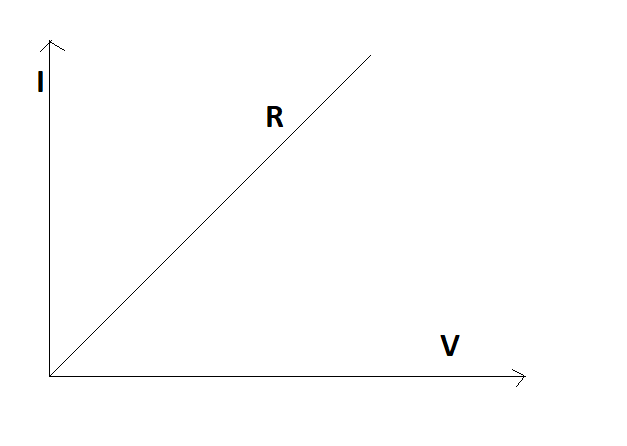
So
All the examples given in options follow ohmic law except Diode.
Diode follows a non-ohmic conductor whose graph is not a straight line.
In general resistance is given by the rate ratio of applied potential across the conductor to the resulting current through it.
Complete step by step solution:
The relationship between current through a conductor and applied potential difference was first discovered by German scientists George simon for home in 1828. This relationship is known as Ohm's law.
As long as a physical state (material, dimensions and temperature) of a conductor remains the same, the electric current flowing through a given conductor is directly proportional to the potential difference applied across it.
$\begin{align}
& I\alpha V \\
& I=\dfrac{V}{R} \\
& V=IR \\
\end{align}$
$R=\dfrac{V}{I}$-----(1)
Equation one is valid only when the graph of resistance will be straight line.
Where they are in constant proportion. It represents the opposition to flow of current and is known as reduced and the graph of current versus potential difference across a conductor is straight line.
So
All the examples given in options follow ohmic law except Diode.
Diode follows a non-ohmic conductor whose graph is not a straight line.
In general resistance is given by the rate ratio of applied potential across the conductor to the resulting current through it.
Recently Updated Pages
Master Class 12 Social Science: Engaging Questions & Answers for Success

Master Class 12 Physics: Engaging Questions & Answers for Success
Master Class 12 Maths: Engaging Questions & Answers for Success
Master Class 12 Economics: Engaging Questions & Answers for Success
Master Class 12 Chemistry: Engaging Questions & Answers for Success
Master Class 12 Business Studies: Engaging Questions & Answers for Success
Trending doubts
Which are the Top 10 Largest Countries of the World?
Draw a labelled sketch of the human eye class 12 physics CBSE
Explain the structure of megasporangium class 12 biology CBSE
What are the major means of transport Explain each class 12 social science CBSE
How many chromosomes are found in human ovum a 46 b class 12 biology CBSE
The diagram of the section of a maize grain is given class 12 biology CBSE