




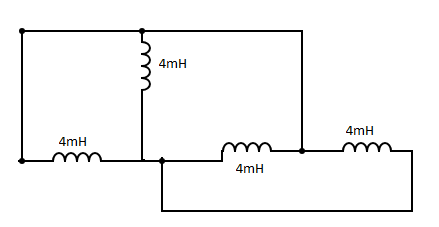
The equivalent inductance between A and B is
( A ) 1 H
( B ) 4 H
( C )0.8H
( D )16 H
Answer
 Verified
619.5k+ views
Hint : An inductor is an energy storage device which is used to keep current flowing in the circuit during the off switching periods. Here, we have a combination of inductors. The inductors which are connected end to end are said to be in series and which have common end and starting points are said to be in parallel.in this problem we have to mainly rearrange the inductors and recognise which inductors are in parallel are which are in series.
Complete step by step solution:
Since two points connected by means of a wire without any element in between, the two points will have the same potential. So, such two points can be considered as the same.
This shows that all the inductors are connected in parallel.
First we need to find out the value of equivalent inductance of the combination of L1, L2, L3 and L4.
Voltage across any conductor is given by:
$V = L\dfrac{{di}}{{dt}}$……………(1)
For parallel combination:
From Kirchhoff’s current law: $i = {i_1} + {i_{_2}} + {i_3}$……………………..(2)
So from (2) we get for n branches
$\dfrac{{di}}{{dt}} = \dfrac{{d{i_1}}}{{dt}} + \dfrac{{d{i_2}}}{{dt}} + \dfrac{{d{i_3}}}{{dt}}$+…upto n
Now from (1) since across parallel inductors the voltage remains the same so the above equation can be written as
$\dfrac{V}{{{L_{eq}}}} = \dfrac{V}{{{L_1}}} + \dfrac{V}{{{L_2}}} + \dfrac{V}{{{L_3}}}$+….
Therefore
$\dfrac{1}{{{L_{eq}}}} = \dfrac{1}{{{L_1}}} + \dfrac{1}{{{L_2}}} + \dfrac{1}{{{L_3}}}$+…
So the equivalent of the three inductors on substituting the value for four inductors each of value 4H comes out to be
$\eqalign{
& \dfrac{1}{{{L_{eq}}}} = \dfrac{1}{{L1}} + \dfrac{1}{{L2}} + \dfrac{1}{{L3}} + \dfrac{1}{{L4}} \cr
& \Rightarrow \dfrac{1}{{{L_{eq}}}} = \dfrac{1}{4} + \dfrac{1}{4} + \dfrac{1}{4} + \dfrac{1}{4} \cr
& \Rightarrow {L_{eq}} = 1H \cr} $
Therefore, the equivalent inductance between two points A and B is 1H.
Additional information: If the inductors are connected in series the value of equivalent inductance comes out to be greater than the individual inductance.
Note:
As we see above if the inductors are connected in parallel, the value of net inductance decreases. Similarly, if four 4H inductors are connected in parallel, the equivalent inductance comes out to be 1H which is a smaller value.
Complete step by step solution:
Since two points connected by means of a wire without any element in between, the two points will have the same potential. So, such two points can be considered as the same.
This shows that all the inductors are connected in parallel.
First we need to find out the value of equivalent inductance of the combination of L1, L2, L3 and L4.
Voltage across any conductor is given by:
$V = L\dfrac{{di}}{{dt}}$……………(1)
For parallel combination:
From Kirchhoff’s current law: $i = {i_1} + {i_{_2}} + {i_3}$……………………..(2)
So from (2) we get for n branches
$\dfrac{{di}}{{dt}} = \dfrac{{d{i_1}}}{{dt}} + \dfrac{{d{i_2}}}{{dt}} + \dfrac{{d{i_3}}}{{dt}}$+…upto n
Now from (1) since across parallel inductors the voltage remains the same so the above equation can be written as
$\dfrac{V}{{{L_{eq}}}} = \dfrac{V}{{{L_1}}} + \dfrac{V}{{{L_2}}} + \dfrac{V}{{{L_3}}}$+….
Therefore
$\dfrac{1}{{{L_{eq}}}} = \dfrac{1}{{{L_1}}} + \dfrac{1}{{{L_2}}} + \dfrac{1}{{{L_3}}}$+…
So the equivalent of the three inductors on substituting the value for four inductors each of value 4H comes out to be
$\eqalign{
& \dfrac{1}{{{L_{eq}}}} = \dfrac{1}{{L1}} + \dfrac{1}{{L2}} + \dfrac{1}{{L3}} + \dfrac{1}{{L4}} \cr
& \Rightarrow \dfrac{1}{{{L_{eq}}}} = \dfrac{1}{4} + \dfrac{1}{4} + \dfrac{1}{4} + \dfrac{1}{4} \cr
& \Rightarrow {L_{eq}} = 1H \cr} $
Therefore, the equivalent inductance between two points A and B is 1H.
Additional information: If the inductors are connected in series the value of equivalent inductance comes out to be greater than the individual inductance.
Note:
As we see above if the inductors are connected in parallel, the value of net inductance decreases. Similarly, if four 4H inductors are connected in parallel, the equivalent inductance comes out to be 1H which is a smaller value.
Recently Updated Pages
Which of the following graphs shows the variation of class 12 physics CBSE

Draw a labelled diagram of the human male reproductive class 12 biology CBSE
Describe the experiment to compare the emf of two cells class 12 physics CBSE
What is standard hydrogen electrode
What is conventional current and electric current class 12 physics CBSE
2Bromopentane is treated with an alcoholic KOH solution class 12 chemistry CBSE
Trending doubts
Draw a labelled sketch of the human eye class 12 physics CBSE
Which are the Top 10 Largest Countries of the World?
Differentiate between homogeneous and heterogeneous class 12 chemistry CBSE
Draw ray diagrams each showing i myopic eye and ii class 12 physics CBSE
Which is the correct genotypic ratio of mendel dihybrid class 12 biology CBSE
What is the Full Form of PVC, PET, HDPE, LDPE, PP and PS ?