




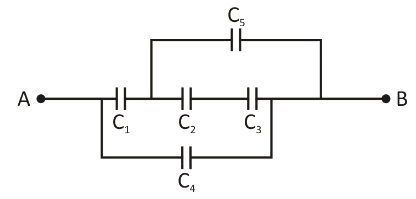
The equivalent capacity between A and B in the given circuit is (\[{{\text{C}}_{\text{1}}} = 4 \mu F \], \[{{\text{C}}_{\text{2}}} = 12 \mu F \], \[{{\text{C}}_{\text{3}}} = 8 \mu F \], \[{{\text{C}}_{\text{4}}} = 4 \mu F \], \[{{\text{C}}_{\text{5}}} = 8 \mu F \])
A. \[24\mu F\]
B. \[36\mu F\]
C. \[\dfrac{{16}}{3}\mu F\]
D. \[\dfrac{8}{3}\mu F\]
Answer
 Verified
609.3k+ views
Hint: In this question, the given figure can be represented or drawn as the balance wheatstone bridge. Find the capacitance of the upper arm and the lower arm of the circuit then by using both capacitance find the equivalent capacitance of the circuit.
Complete step by step answer:
The given figure can be redrawn into equivalent circuit as shown:
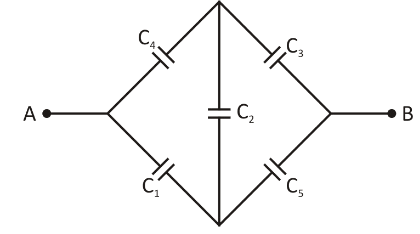
Here, the wheatstone bridge is balanced. So,\[12\mu F\] becomes ineffective. Capacitance of the upper arm and \[{C_3}\] are in series, \[\dfrac{1}{{{C_U}}} = \dfrac{1}{{{C_4}}} + \dfrac{1}{{{C_3}}}\]
Where ${C_U}$ is the upper arm capacitance and
\[{{\text{C}}_{\text{1}}} = 4 \mu F\] , \[{{\text{C}}_{\text{2}}} =12 \mu F\],
\[{{\text{C}}_{\text{3}}} = 8 \mu F\], \[{{\text{C}}_{\text{4}}} = 4 \mu F \], \[{{\text{C}}_{\text{5}}} = 8 \mu F \]
\[\dfrac{1}{{{C_U}}} = \dfrac{1}{4} + \dfrac{1}{8} \\
\Rightarrow\dfrac{1}{{{C_U}}} = \dfrac{{2 + 1}}{8}\\
\Rightarrow\dfrac{1}{{{C_U}}} = \dfrac{3}{8}\mu F\]
\[\Rightarrow {C_U} = \dfrac{8}{3}\mu F\]
Capacitance of the lower arm is \[{C_1}\] and \[C{}_5\] are in series,
\[\dfrac{1}{{{C_L}}} = \dfrac{1}{{{C_1}}} + \dfrac{1}{{{C_5}}}\]
\[\Rightarrow\dfrac{1}{{{C_L}}} = \dfrac{1}{4} + \dfrac{1}{8} \\
\Rightarrow\dfrac{1}{{{C_L}}} = \dfrac{{2 + 1}}{8}\\
\Rightarrow\dfrac{1}{{{C_L}}} = \dfrac{3}{8}\mu F\]
\[\Rightarrow{C_L} = \dfrac{8}{3}\mu F\]
${C_L}$ is the lower arm capacitance. Now, \[{C_U}\] and \[{C_L}\] are in parallel.
The equivalent capacitance ${C_{eq}}$ between points A and B is
\[{C_{eq}} = {C_U} + {C_L}\]
\[\Rightarrow{C_{eq}} = \dfrac{8}{3} + \dfrac{8}{3} \\
\therefore{C_{eq}}= \dfrac{{16}}{3}\mu F\]
Hence, option C is correct.
Note:In this question we are asked to find the equivalent capacitance of the given circuit. Here, we redraw the figure as a balance wheatstone bridge and solve the question step by step and first try to find capacitance of upper arm then lower arm. So, we are able to find out the total equivalent capacitance of the circuit. Without finding the upper arm and lower arm capacitance we cannot find the equivalent capacitance.
Complete step by step answer:
The given figure can be redrawn into equivalent circuit as shown:
Here, the wheatstone bridge is balanced. So,\[12\mu F\] becomes ineffective. Capacitance of the upper arm and \[{C_3}\] are in series, \[\dfrac{1}{{{C_U}}} = \dfrac{1}{{{C_4}}} + \dfrac{1}{{{C_3}}}\]
Where ${C_U}$ is the upper arm capacitance and
\[{{\text{C}}_{\text{1}}} = 4 \mu F\] , \[{{\text{C}}_{\text{2}}} =12 \mu F\],
\[{{\text{C}}_{\text{3}}} = 8 \mu F\], \[{{\text{C}}_{\text{4}}} = 4 \mu F \], \[{{\text{C}}_{\text{5}}} = 8 \mu F \]
\[\dfrac{1}{{{C_U}}} = \dfrac{1}{4} + \dfrac{1}{8} \\
\Rightarrow\dfrac{1}{{{C_U}}} = \dfrac{{2 + 1}}{8}\\
\Rightarrow\dfrac{1}{{{C_U}}} = \dfrac{3}{8}\mu F\]
\[\Rightarrow {C_U} = \dfrac{8}{3}\mu F\]
Capacitance of the lower arm is \[{C_1}\] and \[C{}_5\] are in series,
\[\dfrac{1}{{{C_L}}} = \dfrac{1}{{{C_1}}} + \dfrac{1}{{{C_5}}}\]
\[\Rightarrow\dfrac{1}{{{C_L}}} = \dfrac{1}{4} + \dfrac{1}{8} \\
\Rightarrow\dfrac{1}{{{C_L}}} = \dfrac{{2 + 1}}{8}\\
\Rightarrow\dfrac{1}{{{C_L}}} = \dfrac{3}{8}\mu F\]
\[\Rightarrow{C_L} = \dfrac{8}{3}\mu F\]
${C_L}$ is the lower arm capacitance. Now, \[{C_U}\] and \[{C_L}\] are in parallel.
The equivalent capacitance ${C_{eq}}$ between points A and B is
\[{C_{eq}} = {C_U} + {C_L}\]
\[\Rightarrow{C_{eq}} = \dfrac{8}{3} + \dfrac{8}{3} \\
\therefore{C_{eq}}= \dfrac{{16}}{3}\mu F\]
Hence, option C is correct.
Note:In this question we are asked to find the equivalent capacitance of the given circuit. Here, we redraw the figure as a balance wheatstone bridge and solve the question step by step and first try to find capacitance of upper arm then lower arm. So, we are able to find out the total equivalent capacitance of the circuit. Without finding the upper arm and lower arm capacitance we cannot find the equivalent capacitance.
Recently Updated Pages
Class 5 Question and Answer - Your Ultimate Solutions Guide

Master Class 5 Maths: Engaging Questions & Answers for Success
Master Class 5 English: Engaging Questions & Answers for Success
Master Class 5 Science: Engaging Questions & Answers for Success
Master Class 5 Social Science: Engaging Questions & Answers for Success
Master Class 9 General Knowledge: Engaging Questions & Answers for Success
Trending doubts
Which are the Top 10 Largest Countries of the World?
The total number of vertebrae in man is a30 b31 c32 class 12 biology CBSE
Draw a labelled sketch of the human eye class 12 physics CBSE
The number of cranial nerves in a frog is A 10 pairs class 12 biology CBSE
Differentiate between homogeneous and heterogeneous class 12 chemistry CBSE
Differentiate between Pyramid of energy and pyramid class 12 biology CBSE