




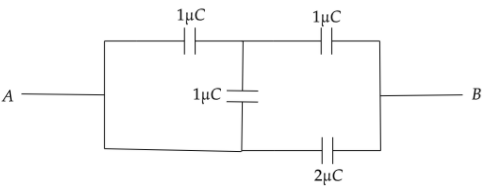
The equivalent capacitance between A and B is
$\left( A \right)1\mu C$
$\left( B \right)\dfrac{8}{3}\mu C$
$\left( C \right)\dfrac{9}{8}\mu C$
$\left( D \right)\dfrac{{11}}{6}\mu C$
Answer
 Verified
521.7k+ views
Hint: Here we need to find the equivalent capacitance which we can say is the total capacitance across AB. In every step we have to make the total capacitance in each branch at every step. So as to find the solution without any mistake, first we will name each branch then find total capacitance in each branch which further solves the total capacitance across AB.
Complete step by step solution:
As per the problem we have four capacitors having capacitance $1\mu C,1\mu C,2\mu C\,{\text{and}}\,1\mu C$.
Where some are connected in series while some are connected in parallel.
Now on drawing the given figure we can see,
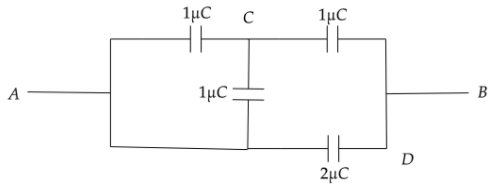
In branch CD the two capacitors are connected in series with each other.
Hence the total resistance of the branch CD we will get,
${C_{CD}} = \dfrac{{{C_1} \times {C_2}}}{{{C_1} + {C_2}}}$
Where,
${C_{CD}}$ is the total capacitance.
${C_1}$ and ${C_2}$ are conned in series capacitance equal to $1\mu C$ and $2\mu C$ respectively.
Now putting the known values in the above equation we will get,
${C_{CD}} = \dfrac{{1\mu C \times 2\mu C}}{{1\mu C + 2\mu C}} = \dfrac{2}{3}\mu C$
Now the circuit will look like,
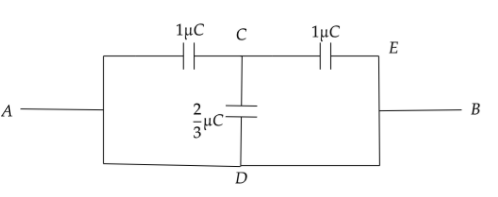
Now on solving the total capacitance of the branch DCE we will get,
Two capacitor $1\mu C$ and $\dfrac{2}{3}\mu C$ are connected parallel to each other hence,
${C_{DCE}} = {C_1} + {C_{\dfrac{2}{3}}}$
Where,
${C_{DCE}}$ is the total capacitance.
${C_1}$ and ${C_{\dfrac{2}{3}}}$ are conned in parallel, capacitance equal to $1\mu C$ and $\dfrac{2}{3}\mu C$ respectively.
Now putting the known values in the above equation we will get,
${C_{DCE}} = 1\mu C + \dfrac{2}{3}\mu C = \dfrac{5}{3}\mu C$
Now the circuit will look like,
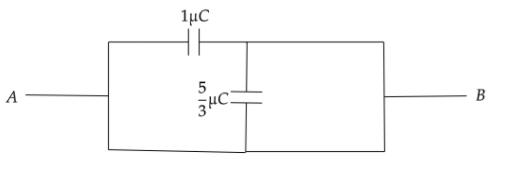
Now this two capacitor are in parallel to each other hence the total capacitance across AB is,
${C_{AB}} = {C_1} + {C_{\dfrac{5}{3}}}$
Where,
${C_{AB}}$ is the equivalent capacitance.
${C_1}$ and ${C_{\dfrac{5}{3}}}$ are conned in series capacitance equal to $1\mu C$ and $\dfrac{5}{3}\mu C$ respectively.
${C_{AB}} = 1\mu C + \dfrac{5}{3}\mu C = \dfrac{8}{3}\mu C$
Therefore the correct option is (B).
Note:
Remember that the total resistance of a circuit is calculated just opposite to the total capacitance. The formula used to find the total resistance in parallel is similar to the total capacitance in series and vice versa. Note that a capacitor is an electrical device that stores energy in the form of electrical charges.
Complete step by step solution:
As per the problem we have four capacitors having capacitance $1\mu C,1\mu C,2\mu C\,{\text{and}}\,1\mu C$.
Where some are connected in series while some are connected in parallel.
Now on drawing the given figure we can see,
In branch CD the two capacitors are connected in series with each other.
Hence the total resistance of the branch CD we will get,
${C_{CD}} = \dfrac{{{C_1} \times {C_2}}}{{{C_1} + {C_2}}}$
Where,
${C_{CD}}$ is the total capacitance.
${C_1}$ and ${C_2}$ are conned in series capacitance equal to $1\mu C$ and $2\mu C$ respectively.
Now putting the known values in the above equation we will get,
${C_{CD}} = \dfrac{{1\mu C \times 2\mu C}}{{1\mu C + 2\mu C}} = \dfrac{2}{3}\mu C$
Now the circuit will look like,
Now on solving the total capacitance of the branch DCE we will get,
Two capacitor $1\mu C$ and $\dfrac{2}{3}\mu C$ are connected parallel to each other hence,
${C_{DCE}} = {C_1} + {C_{\dfrac{2}{3}}}$
Where,
${C_{DCE}}$ is the total capacitance.
${C_1}$ and ${C_{\dfrac{2}{3}}}$ are conned in parallel, capacitance equal to $1\mu C$ and $\dfrac{2}{3}\mu C$ respectively.
Now putting the known values in the above equation we will get,
${C_{DCE}} = 1\mu C + \dfrac{2}{3}\mu C = \dfrac{5}{3}\mu C$
Now the circuit will look like,
Now this two capacitor are in parallel to each other hence the total capacitance across AB is,
${C_{AB}} = {C_1} + {C_{\dfrac{5}{3}}}$
Where,
${C_{AB}}$ is the equivalent capacitance.
${C_1}$ and ${C_{\dfrac{5}{3}}}$ are conned in series capacitance equal to $1\mu C$ and $\dfrac{5}{3}\mu C$ respectively.
${C_{AB}} = 1\mu C + \dfrac{5}{3}\mu C = \dfrac{8}{3}\mu C$
Therefore the correct option is (B).
Note:
Remember that the total resistance of a circuit is calculated just opposite to the total capacitance. The formula used to find the total resistance in parallel is similar to the total capacitance in series and vice versa. Note that a capacitor is an electrical device that stores energy in the form of electrical charges.
Recently Updated Pages
Master Class 12 Economics: Engaging Questions & Answers for Success

Master Class 12 English: Engaging Questions & Answers for Success
Master Class 12 Social Science: Engaging Questions & Answers for Success
Master Class 12 Maths: Engaging Questions & Answers for Success
Master Class 12 Physics: Engaging Questions & Answers for Success
Master Class 9 General Knowledge: Engaging Questions & Answers for Success
Trending doubts
Which are the Top 10 Largest Countries of the World?
Draw a labelled sketch of the human eye class 12 physics CBSE
Differentiate between homogeneous and heterogeneous class 12 chemistry CBSE
Sulphuric acid is known as the king of acids State class 12 chemistry CBSE
Why is the cell called the structural and functional class 12 biology CBSE
Draw ray diagrams each showing i myopic eye and ii class 12 physics CBSE