




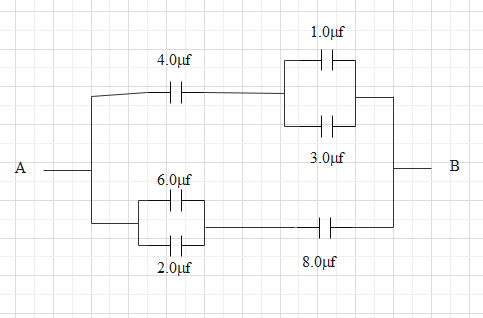
The equivalent capacitance between A and B for the combination of capacitors shown in figure, where all capacitances are in microfarad is
Answer
 Verified
658.2k+ views
Hint: Express the mathematical formula to find the equivalent capacitance of more than one capacitor connected in series and parallel to each other. Simplify the circuit starting from the smallest loop and at last we will find our answer.
Complete step by step answer:
We can find the equivalent capacitance of more than one capacitor depending on the connection of the capacitors.
If two capacitors ${{C}_{1}}\And {{C}_{2}}$ are connected in series than the equivalent capacitance C can be found out as,
$\dfrac{1}{C}=\dfrac{1}{{{C}_{1}}}+\dfrac{1}{{{C}_{2}}}$
If two capacitors ${{C}_{1}}\And {{C}_{2}}$ are connected in parallel than the equivalent capacitance will be,
$C={{C}_{1}}+{{C}_{2}}$
Now, looking at the given circuit,
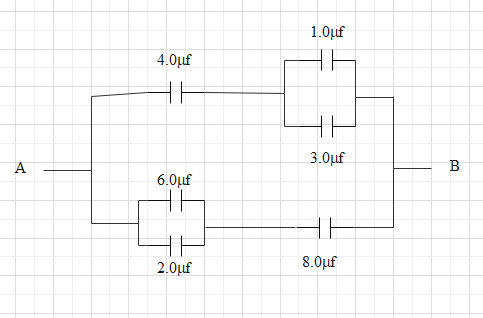
In the top part of the circuit we have a $1\mu F$ and one $3\mu F$ capacitor in parallel.
Let the equivalent capacitance will be ${{C}_{1}}$
So,
$\begin{align}
& {{C}_{1}}=1\mu F+3\mu F \\
& {{C}_{1}}=4\mu F \\
\end{align}$
Again, at the bottom of the circuit we have one $6\mu F$ and one $2\mu F$ capacitor connected in parallel.
Let the equivalent capacitance is ${{C}_{2}}$
So,
$\begin{align}
& {{C}_{2}}=6\mu F+2\mu F \\
& {{C}_{2}}=8\mu F \\
\end{align}$
So, the equivalent circuit becomes,
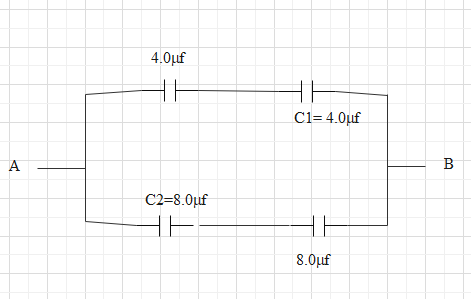
Now, at the top of the circuit we have one $4\mu F$ and one $4\mu F$ capacitor connected in series.
Let the equivalent capacitance is ${{C}_{3}}$
So,
$\begin{align}
& \dfrac{1}{{{C}_{3}}}=\dfrac{1}{4\mu F}+\dfrac{1}{4\mu F} \\
& \dfrac{1}{{{C}_{3}}}=\dfrac{2}{4\mu F} \\
& {{C}_{3}}=2\mu F \\
\end{align}$
Again, at the bottom of the circuit we have one $8\mu F$ and one $8\mu F$ capacitor connected in series.
Let the equivalent capacitance is ${{C}_{4}}$.
So,
$\begin{align}
& \dfrac{1}{{{C}_{4}}}=\dfrac{1}{8\mu F}+\dfrac{1}{8\mu F} \\
& \dfrac{1}{{{C}_{4}}}=\dfrac{2}{8\mu F} \\
& {{C}_{4}}=4\mu F \\
\end{align}$
So, the equivalent circuit becomes
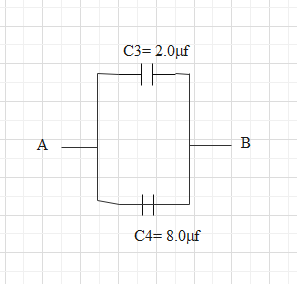
Now we have one $4\mu F$ and one $2\mu F$ capacitor in parallel. Let the equivalent capacitance is C.
So,
$\begin{align}
& C=4\mu F+2\mu F \\
& C=6\mu F \\
\end{align}$
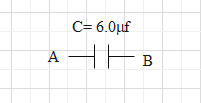
So, the equivalent capacitance of the circuit is $6\mu F$.
Note: Capacitor is a device which stores electrical energy in presence of an electric field. Capacitors in series are the same as resistance in parallel while resistors in series are the same as capacitors in parallel.
Complete step by step answer:
We can find the equivalent capacitance of more than one capacitor depending on the connection of the capacitors.
If two capacitors ${{C}_{1}}\And {{C}_{2}}$ are connected in series than the equivalent capacitance C can be found out as,
$\dfrac{1}{C}=\dfrac{1}{{{C}_{1}}}+\dfrac{1}{{{C}_{2}}}$
If two capacitors ${{C}_{1}}\And {{C}_{2}}$ are connected in parallel than the equivalent capacitance will be,
$C={{C}_{1}}+{{C}_{2}}$
Now, looking at the given circuit,
In the top part of the circuit we have a $1\mu F$ and one $3\mu F$ capacitor in parallel.
Let the equivalent capacitance will be ${{C}_{1}}$
So,
$\begin{align}
& {{C}_{1}}=1\mu F+3\mu F \\
& {{C}_{1}}=4\mu F \\
\end{align}$
Again, at the bottom of the circuit we have one $6\mu F$ and one $2\mu F$ capacitor connected in parallel.
Let the equivalent capacitance is ${{C}_{2}}$
So,
$\begin{align}
& {{C}_{2}}=6\mu F+2\mu F \\
& {{C}_{2}}=8\mu F \\
\end{align}$
So, the equivalent circuit becomes,
Now, at the top of the circuit we have one $4\mu F$ and one $4\mu F$ capacitor connected in series.
Let the equivalent capacitance is ${{C}_{3}}$
So,
$\begin{align}
& \dfrac{1}{{{C}_{3}}}=\dfrac{1}{4\mu F}+\dfrac{1}{4\mu F} \\
& \dfrac{1}{{{C}_{3}}}=\dfrac{2}{4\mu F} \\
& {{C}_{3}}=2\mu F \\
\end{align}$
Again, at the bottom of the circuit we have one $8\mu F$ and one $8\mu F$ capacitor connected in series.
Let the equivalent capacitance is ${{C}_{4}}$.
So,
$\begin{align}
& \dfrac{1}{{{C}_{4}}}=\dfrac{1}{8\mu F}+\dfrac{1}{8\mu F} \\
& \dfrac{1}{{{C}_{4}}}=\dfrac{2}{8\mu F} \\
& {{C}_{4}}=4\mu F \\
\end{align}$
So, the equivalent circuit becomes
Now we have one $4\mu F$ and one $2\mu F$ capacitor in parallel. Let the equivalent capacitance is C.
So,
$\begin{align}
& C=4\mu F+2\mu F \\
& C=6\mu F \\
\end{align}$
So, the equivalent capacitance of the circuit is $6\mu F$.
Note: Capacitor is a device which stores electrical energy in presence of an electric field. Capacitors in series are the same as resistance in parallel while resistors in series are the same as capacitors in parallel.
Recently Updated Pages
Master Class 12 Economics: Engaging Questions & Answers for Success

Master Class 12 Social Science: Engaging Questions & Answers for Success
Master Class 12 English: Engaging Questions & Answers for Success
Master Class 12 Maths: Engaging Questions & Answers for Success
Master Class 12 Physics: Engaging Questions & Answers for Success
Master Class 12 Biology: Engaging Questions & Answers for Success
Trending doubts
Draw a labelled sketch of the human eye class 12 physics CBSE
Which are the Top 10 Largest Countries of the World?
Draw ray diagrams each showing i myopic eye and ii class 12 physics CBSE
Which is the correct genotypic ratio of mendel dihybrid class 12 biology CBSE
Differentiate between homogeneous and heterogeneous class 12 chemistry CBSE
Which animal never drinks water in its entire life class 12 biology CBSE