




The equation of the straight line passing through the origin and perpendicular to the lines $\dfrac{x+1}{-3}=\dfrac{y-2}{2}=\dfrac{z}{1}$ and $\dfrac{x-1}{1}=\dfrac{y}{-3}=\dfrac{z+1}{2}$has the equation. \[\]
A. $x=y=z$\[\]
B. $\dfrac{x}{4}=\dfrac{y}{3}=\dfrac{z}{6}$\[\]
C. $\dfrac{x}{3}=\dfrac{y}{1}=\dfrac{z}{0}$\[\]
D. None of these \[\]
Answer
 Verified
576k+ views
Hint: We convert the given equation of line in component vector form$\overrightarrow{{{r}_{1}}},\overrightarrow{{{r}_{2}}}$. We find the vector perpendicular to $\overrightarrow{{{r}_{1}}},\overrightarrow{{{r}_{2}}}$ by taking the cross product of them that is$\overrightarrow{r}=\overrightarrow{{{r}_{1}}}\times \overrightarrow{{{r}_{2}}}$. We find the direction ratio from the vector $\left( a,b,c \right)$ and then use equation line in a space passing through a point $\left( {{x}_{1}},{{y}_{1}},{{z}_{1}} \right)$ as $\dfrac{x-{{x}_{1}}}{a}=\dfrac{y-{{y}_{1}}}{b}=\dfrac{z-{{z}_{1}}}{c}$.\[\]
Complete step-by-step answer:
We know that the direction ratios are any three numbers which are proportional to direction cosines. The equation of any line passing through a point $\left( {{x}_{1}},{{y}_{1}},{{z}_{1}} \right)$ and direction ratios $\left( a,b,c \right)$ is given by
\[\dfrac{x-{{x}_{1}}}{a}=\dfrac{y-{{y}_{1}}}{b}=\dfrac{z-{{z}_{1}}}{c}\]
We can convert any line in above form to the component vector form say $\overrightarrow{r}$ as
\[\overrightarrow{r}=a\hat{i}+b\hat{j}+c\hat{k}\]
Here $\hat{i},\hat{j},\hat{k}$ are orthogonal unit vectors and $ka,kb,kc$ are called components for any integer$k$. We know that if two vectors $\overrightarrow{{{r}_{1}}}={{a}_{1}}\hat{i}+{{b}_{1}}\hat{j}+{{c}_{1}}\hat{k}$ and $\overrightarrow{{{r}_{2}}}={{a}_{2}}\hat{i}+{{b}_{2}}\hat{j}+{{c}_{2}}\hat{k}$ lie on one plane then the vector perpendicular to both of them is given by the cross product of $\overrightarrow{{{r}_{1}}},\overrightarrow{{{r}_{2}}}$ that is
\[\overrightarrow{{{r}_{1}}}\times \overrightarrow{{{r}_{2}}}=\left| \begin{matrix}
{\hat{i}} & {\hat{j}} & {\hat{k}} \\
{{a}_{1}} & {{b}_{1}} & {{c}_{1}} \\
{{a}_{2}} & {{b}_{2}} & {{c}_{2}} \\
\end{matrix} \right|\]
We are given in the question two equations of lines as
\[\begin{align}
& \dfrac{x+1}{-3}=\dfrac{y-2}{2}=\dfrac{z}{1}....\left( 1 \right) \\
& \dfrac{x-1}{1}=\dfrac{y}{-3}=\dfrac{z+1}{2}.....\left( 2 \right) \\
\end{align}\]
Let us convert line (1) and (2) to the corresponding component vector forms denoted by $\overrightarrow{{{r}_{1}}},\overrightarrow{{{r}_{2}}}$ as
\[\begin{align}
& \overrightarrow{{{r}_{1}}}=-3\hat{i}+2\hat{j}+\hat{k} \\
& \overrightarrow{{{r}_{2}}}=\hat{i}-3\hat{j}+2\hat{k} \\
\end{align}\]
We are going to find the vector perpendicular to the vectors $\overrightarrow{{{r}_{1}}},\overrightarrow{{{r}_{2}}}$ denoted by $\overrightarrow{r}$ using the determinant for cross product as
\[\begin{align}
& \overrightarrow{r}=\overrightarrow{{{r}_{1}}}\times \overrightarrow{{{r}_{2}}} \\
& \Rightarrow \overrightarrow{r}=\left| \begin{matrix}
{\hat{i}} & {\hat{j}} & {\hat{k}} \\
-3 & 2 & 1 \\
1 & -3 & 2 \\
\end{matrix} \right| \\
\end{align}\]
We expand by the first row and have,
\[\begin{align}
& \Rightarrow \overrightarrow{r}=\hat{i}\left( 4-\left( -3 \right) \right)-\hat{j}\left( -6-1 \right)+\hat{k}\left( 9-2 \right) \\
& \Rightarrow \overrightarrow{r}=7\hat{i}+7\hat{j}+7\hat{k} \\
\end{align}\]
We divide the components by 7 and find the direction of the line perpendicular to both the line (1) and (2) as $\left( 1,1,1 \right)$ since all direction ratios of a line are proportional to each other. We are also given that the perpendicular line passes through the origin. So we have the equation of perpendicular line origin $\left( 0,0,0 \right)$as the point and direction ratios $\left( 1,1,1 \right)$ as
\[\begin{align}
& \dfrac{x-0}{1}=\dfrac{y-0}{1}=\dfrac{z-0}{1} \\
& \Rightarrow x=y=z \\
\end{align}\]
So the correct option is A. The rough figure of the problem is drawn below. \[\]
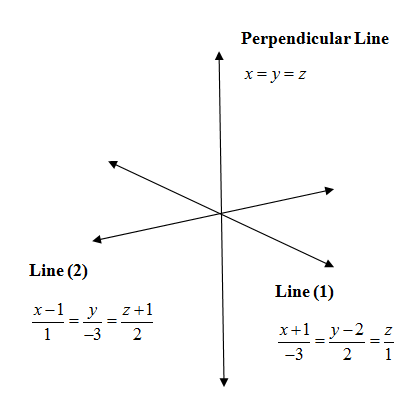
So, the correct answer is “Option A”.
Note: We note that the direction of the vector $\overrightarrow{r}$ is determined by right hand thumb rule and line does not have any direction. All the lines parallel to a line with direction ratios $\left( a,b,c \right)$ will have direction ratio $\left( ka,kb,kc \right)$ for some non-zero integer$k$. We can alternatively solve using the relation between direction ratios of two perpendicular lines that is ${{a}_{1}}{{a}_{2}}+{{b}_{1}}{{b}_{2}}+{{c}_{1}}{{c}_{2}}=0$.
Complete step-by-step answer:
We know that the direction ratios are any three numbers which are proportional to direction cosines. The equation of any line passing through a point $\left( {{x}_{1}},{{y}_{1}},{{z}_{1}} \right)$ and direction ratios $\left( a,b,c \right)$ is given by
\[\dfrac{x-{{x}_{1}}}{a}=\dfrac{y-{{y}_{1}}}{b}=\dfrac{z-{{z}_{1}}}{c}\]
We can convert any line in above form to the component vector form say $\overrightarrow{r}$ as
\[\overrightarrow{r}=a\hat{i}+b\hat{j}+c\hat{k}\]
Here $\hat{i},\hat{j},\hat{k}$ are orthogonal unit vectors and $ka,kb,kc$ are called components for any integer$k$. We know that if two vectors $\overrightarrow{{{r}_{1}}}={{a}_{1}}\hat{i}+{{b}_{1}}\hat{j}+{{c}_{1}}\hat{k}$ and $\overrightarrow{{{r}_{2}}}={{a}_{2}}\hat{i}+{{b}_{2}}\hat{j}+{{c}_{2}}\hat{k}$ lie on one plane then the vector perpendicular to both of them is given by the cross product of $\overrightarrow{{{r}_{1}}},\overrightarrow{{{r}_{2}}}$ that is
\[\overrightarrow{{{r}_{1}}}\times \overrightarrow{{{r}_{2}}}=\left| \begin{matrix}
{\hat{i}} & {\hat{j}} & {\hat{k}} \\
{{a}_{1}} & {{b}_{1}} & {{c}_{1}} \\
{{a}_{2}} & {{b}_{2}} & {{c}_{2}} \\
\end{matrix} \right|\]
We are given in the question two equations of lines as
\[\begin{align}
& \dfrac{x+1}{-3}=\dfrac{y-2}{2}=\dfrac{z}{1}....\left( 1 \right) \\
& \dfrac{x-1}{1}=\dfrac{y}{-3}=\dfrac{z+1}{2}.....\left( 2 \right) \\
\end{align}\]
Let us convert line (1) and (2) to the corresponding component vector forms denoted by $\overrightarrow{{{r}_{1}}},\overrightarrow{{{r}_{2}}}$ as
\[\begin{align}
& \overrightarrow{{{r}_{1}}}=-3\hat{i}+2\hat{j}+\hat{k} \\
& \overrightarrow{{{r}_{2}}}=\hat{i}-3\hat{j}+2\hat{k} \\
\end{align}\]
We are going to find the vector perpendicular to the vectors $\overrightarrow{{{r}_{1}}},\overrightarrow{{{r}_{2}}}$ denoted by $\overrightarrow{r}$ using the determinant for cross product as
\[\begin{align}
& \overrightarrow{r}=\overrightarrow{{{r}_{1}}}\times \overrightarrow{{{r}_{2}}} \\
& \Rightarrow \overrightarrow{r}=\left| \begin{matrix}
{\hat{i}} & {\hat{j}} & {\hat{k}} \\
-3 & 2 & 1 \\
1 & -3 & 2 \\
\end{matrix} \right| \\
\end{align}\]
We expand by the first row and have,
\[\begin{align}
& \Rightarrow \overrightarrow{r}=\hat{i}\left( 4-\left( -3 \right) \right)-\hat{j}\left( -6-1 \right)+\hat{k}\left( 9-2 \right) \\
& \Rightarrow \overrightarrow{r}=7\hat{i}+7\hat{j}+7\hat{k} \\
\end{align}\]
We divide the components by 7 and find the direction of the line perpendicular to both the line (1) and (2) as $\left( 1,1,1 \right)$ since all direction ratios of a line are proportional to each other. We are also given that the perpendicular line passes through the origin. So we have the equation of perpendicular line origin $\left( 0,0,0 \right)$as the point and direction ratios $\left( 1,1,1 \right)$ as
\[\begin{align}
& \dfrac{x-0}{1}=\dfrac{y-0}{1}=\dfrac{z-0}{1} \\
& \Rightarrow x=y=z \\
\end{align}\]
So the correct option is A. The rough figure of the problem is drawn below. \[\]
So, the correct answer is “Option A”.
Note: We note that the direction of the vector $\overrightarrow{r}$ is determined by right hand thumb rule and line does not have any direction. All the lines parallel to a line with direction ratios $\left( a,b,c \right)$ will have direction ratio $\left( ka,kb,kc \right)$ for some non-zero integer$k$. We can alternatively solve using the relation between direction ratios of two perpendicular lines that is ${{a}_{1}}{{a}_{2}}+{{b}_{1}}{{b}_{2}}+{{c}_{1}}{{c}_{2}}=0$.
Recently Updated Pages
Master Class 12 Economics: Engaging Questions & Answers for Success

Master Class 12 Physics: Engaging Questions & Answers for Success
Master Class 12 English: Engaging Questions & Answers for Success
Master Class 12 Social Science: Engaging Questions & Answers for Success
Master Class 12 Maths: Engaging Questions & Answers for Success
Master Class 12 Business Studies: Engaging Questions & Answers for Success
Trending doubts
Which are the Top 10 Largest Countries of the World?
What are the major means of transport Explain each class 12 social science CBSE
Draw a labelled sketch of the human eye class 12 physics CBSE
Why cannot DNA pass through cell membranes class 12 biology CBSE
Differentiate between insitu conservation and exsitu class 12 biology CBSE
Draw a neat and well labeled diagram of TS of ovary class 12 biology CBSE