




The ellipse \[{{\text{E}}_1}:\dfrac{{{x^2}}}{9} + \dfrac{{{y^2}}}{4} = 1\] is inscribed in a rectangle R whose sides are parallel to the coordinate axis. Another ellipse ${{\text{E}}_2}$ is passing through the point (0, 4) circumscribing the rectangle R. The eccentricity of the rectangle ${{\text{E}}_2}$ is
A. $\dfrac{{\sqrt 2 }}{2}$
B. $\dfrac{{\sqrt 3 }}{2}$
C. $\dfrac{1}{2}$
D. $\dfrac{3}{4}$
Answer
 Verified
617.4k+ views
Hint: Here, first find the vertices of the ellipse \[{{\text{E}}_1}\] by comparing it with the standard equation. So you will get vertices of the rectangle. Assume the equation of ellipse ${{\text{E}}_2}$ and this ellipse must satisfy the point of the rectangle. Using points of the rectangle in second, find the values of its vertices and then apply formula to find eccentricity.
Complete step-by-step answer:
Given equation of ellipse \[{{\text{E}}_1}:\dfrac{{{x^2}}}{9} + \dfrac{{{y^2}}}{4} = 1\]
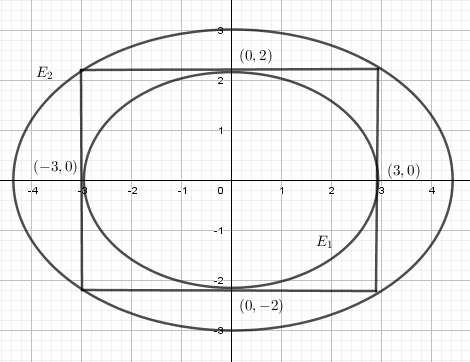
By comparing this equation as standard equation of ellipse i.e., \[\dfrac{{{x^2}}}{{{a^2}}} + \dfrac{{{y^2}}}{{{b^2}}} = 1\] in which ellipse touches (± a,0) and y axis at (0,± b).
Therefore, the ellipse ${{\text{E}}_1}$ touches x-axis at (± 3,0) and y axis at (0,± 2).
Also given that the ellipse is inscribed in rectangle R whose sides are parallel to the coordinate axis, then the vertices of the rectangle are (±3,±2).
Let the equation of ellipse \[{{\text{E}}_2}:\dfrac{{{x^2}}}{{{a^2}}} + \dfrac{{{y^2}}}{{{b^2}}} = 1\]
The ellipse circumscribes the rectangle R, so the vertices of rectangle lie on ellipse ${{\text{E}}_2}$
Therefore we get \[\dfrac{9}{{{a^2}}} + \dfrac{4}{{{b^2}}} = 1\]
Given that, the ellipse ${{\text{E}}_2}$ passes through the point (0, 4).
So we get b = 4 and ${a^2} = 12$
For ellipse, we know that${a^2} = {b^2}(1 - {e^2})$, where e is the eccentricity of the ellipse.
⇒ $
12 = 16(1 - {e^2}) \\
\Rightarrow 1 - {e^2} = \dfrac{3}{4} \Rightarrow {e^2} = \dfrac{1}{4} \Rightarrow e = \dfrac{1}{2} \\
$
Therefore, the eccentricity of the rectangle ${{\text{E}}_2}$ is $\dfrac{1}{2}$.
Note: In these types of questions, first draw the clear diagram to see the given statement geometrically. Also all intersection points should be clearly visible. Always compare the given equation of ellipse with the standard equation and also assume any equation of ellipse as in the form of the standard equation. Also if any point is on the ellipse then it must satisfy the equation of ellipse use this fact to solve the problem.
Complete step-by-step answer:
Given equation of ellipse \[{{\text{E}}_1}:\dfrac{{{x^2}}}{9} + \dfrac{{{y^2}}}{4} = 1\]
By comparing this equation as standard equation of ellipse i.e., \[\dfrac{{{x^2}}}{{{a^2}}} + \dfrac{{{y^2}}}{{{b^2}}} = 1\] in which ellipse touches (± a,0) and y axis at (0,± b).
Therefore, the ellipse ${{\text{E}}_1}$ touches x-axis at (± 3,0) and y axis at (0,± 2).
Also given that the ellipse is inscribed in rectangle R whose sides are parallel to the coordinate axis, then the vertices of the rectangle are (±3,±2).
Let the equation of ellipse \[{{\text{E}}_2}:\dfrac{{{x^2}}}{{{a^2}}} + \dfrac{{{y^2}}}{{{b^2}}} = 1\]
The ellipse circumscribes the rectangle R, so the vertices of rectangle lie on ellipse ${{\text{E}}_2}$
Therefore we get \[\dfrac{9}{{{a^2}}} + \dfrac{4}{{{b^2}}} = 1\]
Given that, the ellipse ${{\text{E}}_2}$ passes through the point (0, 4).
So we get b = 4 and ${a^2} = 12$
For ellipse, we know that${a^2} = {b^2}(1 - {e^2})$, where e is the eccentricity of the ellipse.
⇒ $
12 = 16(1 - {e^2}) \\
\Rightarrow 1 - {e^2} = \dfrac{3}{4} \Rightarrow {e^2} = \dfrac{1}{4} \Rightarrow e = \dfrac{1}{2} \\
$
Therefore, the eccentricity of the rectangle ${{\text{E}}_2}$ is $\dfrac{1}{2}$.
Note: In these types of questions, first draw the clear diagram to see the given statement geometrically. Also all intersection points should be clearly visible. Always compare the given equation of ellipse with the standard equation and also assume any equation of ellipse as in the form of the standard equation. Also if any point is on the ellipse then it must satisfy the equation of ellipse use this fact to solve the problem.
Recently Updated Pages
Master Class 12 Business Studies: Engaging Questions & Answers for Success

Master Class 12 Biology: Engaging Questions & Answers for Success
Master Class 12 Chemistry: Engaging Questions & Answers for Success
Class 12 Question and Answer - Your Ultimate Solutions Guide
Master Class 11 Social Science: Engaging Questions & Answers for Success
Master Class 11 English: Engaging Questions & Answers for Success
Trending doubts
Which are the Top 10 Largest Countries of the World?
Draw a labelled sketch of the human eye class 12 physics CBSE
Differentiate between homogeneous and heterogeneous class 12 chemistry CBSE
Sulphuric acid is known as the king of acids State class 12 chemistry CBSE
Why is the cell called the structural and functional class 12 biology CBSE
Which is the correct genotypic ratio of mendel dihybrid class 12 biology CBSE