




The electrical potential of the earth is taken as
A.)Zero
B.)Infinity
C.)Unity
D.)None of these
Answer
 Verified
669.9k+ views
Hint: The earth’s surface is said to be a pool of infinite negative charges. While the atmosphere of the earth consists mainly of positive ions. So there must be a potential gradient set up between the atmosphere and the surface of the earth. So the charge distribution over the whole of earth is zero.
Complete step by step answer:
The earth’s surface is considered as an infinite pool of negative charges, we can determine this by placing a metal plate slightly above the surface of the earth and grounding it to the ground. After some time, the plate acquires a negative surface charge density, which shows there are negative ions or charges present on the surface of the earth.
So, What about the positive charges in the atmosphere? These positive charges are mainly formed due to the cosmic rays that arrive at earth at each moment. These cosmic rays interact with the molecules in the atmosphere, and ions are produced in the process. These ionization increases as we go from the surface of the earth to the exosphere. So the positive charges will be accumulated more in the higher altitudes as compared with lower altitudes.
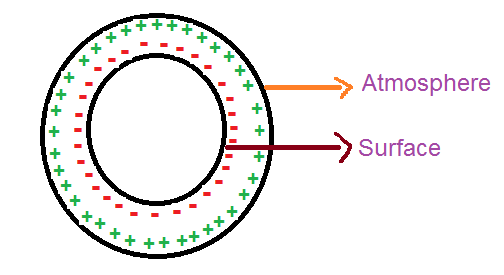
Since there is a potential gradient existing between the negative charges on the earth and the positive charges in the atmosphere, a current can flow from the atmosphere to the surface of the earth which neutralises the negative charges on the earth.
So simply we can say that the total amount of charge enclosed by the earth is zero. So the potential associated with the earth is taken as zero.
So the answer to the question is option (A)-zero.
Note:
If the charges are neutralised, how do the infinite negative charges on earth exist or be maintained. This can be attributed to lightning, which brings back negative charges onto the earth’s surface.
Lightning’s are occurring all around the world at the rate of 40,000 thunderstorms per day, and on an average, these thunderstorms contribute over 1800 amperes of negative charge to the earth’s surface, which compensates for the charge neutralisation.
Complete step by step answer:
The earth’s surface is considered as an infinite pool of negative charges, we can determine this by placing a metal plate slightly above the surface of the earth and grounding it to the ground. After some time, the plate acquires a negative surface charge density, which shows there are negative ions or charges present on the surface of the earth.
So, What about the positive charges in the atmosphere? These positive charges are mainly formed due to the cosmic rays that arrive at earth at each moment. These cosmic rays interact with the molecules in the atmosphere, and ions are produced in the process. These ionization increases as we go from the surface of the earth to the exosphere. So the positive charges will be accumulated more in the higher altitudes as compared with lower altitudes.
Since there is a potential gradient existing between the negative charges on the earth and the positive charges in the atmosphere, a current can flow from the atmosphere to the surface of the earth which neutralises the negative charges on the earth.
So simply we can say that the total amount of charge enclosed by the earth is zero. So the potential associated with the earth is taken as zero.
So the answer to the question is option (A)-zero.
Note:
If the charges are neutralised, how do the infinite negative charges on earth exist or be maintained. This can be attributed to lightning, which brings back negative charges onto the earth’s surface.
Lightning’s are occurring all around the world at the rate of 40,000 thunderstorms per day, and on an average, these thunderstorms contribute over 1800 amperes of negative charge to the earth’s surface, which compensates for the charge neutralisation.
Recently Updated Pages
What is BLO What is the full form of BLO class 8 social science CBSE

Explain the Treaty of Vienna of 1815 class 10 social science CBSE
10 examples of friction in our daily life
Draw a diagram of nephron and explain its structur class 11 biology CBSE
Write structures of the following compounds i 2 Chloro3methylpentane class 11 chemistry CBSE
A Paragraph on Pollution in about 100-150 Words
Trending doubts
Draw a labelled sketch of the human eye class 12 physics CBSE
Which are the Top 10 Largest Countries of the World?
Differentiate between homogeneous and heterogeneous class 12 chemistry CBSE
Draw ray diagrams each showing i myopic eye and ii class 12 physics CBSE
Materials which do not allow an electric current to class 12 physics CBSE
Which is the correct genotypic ratio of mendel dihybrid class 12 biology CBSE