




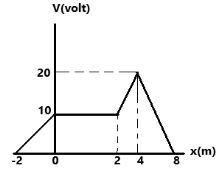
The electrical potential function for an electric field directed parallel to the x-axis is shown in Fig. The graph $ {E_x} $ versus $ x $ will be-
(A)
(B)
(C)
(D)
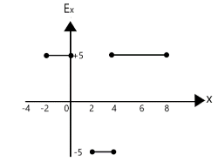
Answer
 Verified
606k+ views
Hint: The Electric field can also be defined as the gradient of potential which is the slope of a potential graph. The increase in potential gives a negative Electric field while the decrease in potential corresponds to a positive Electric field. So using this information we can find the graph for the electric field.
Formula used: In this solution we will be using the following formula;
$ {E_x} = - \dfrac{{\Delta V}}{{\Delta x}} $ where $ {E_x} $ is the electric field along x axis, $ \Delta V $ is the change in potential along the same axis, and $ \Delta x $ is the change in distance in the x axis.
Complete Step-by-Step Solution
In electrostatics, the electric field created by a charge can be regarded as the rate of change of the electric potential with distance, that is to say how fast the potential changes as we move away from the charge. Mathematically, it can be expressed as
$ {E_x} = - \dfrac{{\Delta V}}{{\Delta x}} $ where $ \Delta V $ is the change in potential along the same axis, and $ \Delta x $ is the change in distance in the $ x $ -axis. The negative sign implies that a positive gradient implies a negative electric field, i.e. if electric potential increases as we increase distance then electric field is negative, likewise, if it decreases with distance then electric field is positive.
We shall calculate the slope of the graph at every stop (joint in graph).
From $ x = - 2 $ to $ x = 0 $ ,
$ {E_x} = - \dfrac{{\Delta V}}{{\Delta x}} = - \dfrac{{(10 - 0)}}{{0 - \left( { - 2} \right)}} = - \dfrac{{10}}{2} = - 5 $
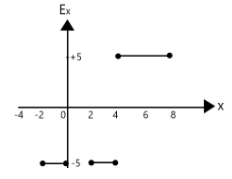
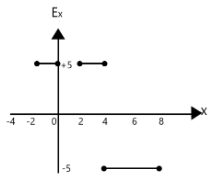
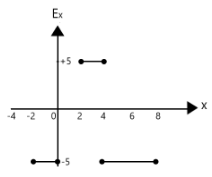
$ {E_x} = - 5N/C $ . Thus we can eliminate option B and D.
From $ x = 0 $ to $ x = 2 $ , we see that there is no change in potential. Thus $ \Delta V = 0 $ . So there is also no change in the electric field.
From $ x = 2 $ to $ x = 4 $
$ {E_x} = \dfrac{{\Delta V}}{{\Delta x}} = - \dfrac{{20 - 10}}{{4 - 2}} = - 5 $ . Hence, we can eliminate option C.
Hence option A is our answer.
Note
Alternatively, without going through lengthy calculations, we can say that since a positive slope corresponds to a negative Electric field, then:
From $ x = - 2 $ to $ x = 0 $ Electric field must be negative (a line moving upward from right to left is a positive slope), which eliminates B and D.
Similarly, from $ x = 2 $ to $ x = 4 $ also has a positive slope, hence Electric field must be negative too. This eliminates option C, and leaves us with A as our answer.
Formula used: In this solution we will be using the following formula;
$ {E_x} = - \dfrac{{\Delta V}}{{\Delta x}} $ where $ {E_x} $ is the electric field along x axis, $ \Delta V $ is the change in potential along the same axis, and $ \Delta x $ is the change in distance in the x axis.
Complete Step-by-Step Solution
In electrostatics, the electric field created by a charge can be regarded as the rate of change of the electric potential with distance, that is to say how fast the potential changes as we move away from the charge. Mathematically, it can be expressed as
$ {E_x} = - \dfrac{{\Delta V}}{{\Delta x}} $ where $ \Delta V $ is the change in potential along the same axis, and $ \Delta x $ is the change in distance in the $ x $ -axis. The negative sign implies that a positive gradient implies a negative electric field, i.e. if electric potential increases as we increase distance then electric field is negative, likewise, if it decreases with distance then electric field is positive.
We shall calculate the slope of the graph at every stop (joint in graph).
From $ x = - 2 $ to $ x = 0 $ ,
$ {E_x} = - \dfrac{{\Delta V}}{{\Delta x}} = - \dfrac{{(10 - 0)}}{{0 - \left( { - 2} \right)}} = - \dfrac{{10}}{2} = - 5 $
$ {E_x} = - 5N/C $ . Thus we can eliminate option B and D.
From $ x = 0 $ to $ x = 2 $ , we see that there is no change in potential. Thus $ \Delta V = 0 $ . So there is also no change in the electric field.
From $ x = 2 $ to $ x = 4 $
$ {E_x} = \dfrac{{\Delta V}}{{\Delta x}} = - \dfrac{{20 - 10}}{{4 - 2}} = - 5 $ . Hence, we can eliminate option C.
Hence option A is our answer.
Note
Alternatively, without going through lengthy calculations, we can say that since a positive slope corresponds to a negative Electric field, then:
From $ x = - 2 $ to $ x = 0 $ Electric field must be negative (a line moving upward from right to left is a positive slope), which eliminates B and D.
Similarly, from $ x = 2 $ to $ x = 4 $ also has a positive slope, hence Electric field must be negative too. This eliminates option C, and leaves us with A as our answer.
Recently Updated Pages
Master Class 12 Business Studies: Engaging Questions & Answers for Success

Master Class 12 Chemistry: Engaging Questions & Answers for Success
Master Class 12 Biology: Engaging Questions & Answers for Success
Class 12 Question and Answer - Your Ultimate Solutions Guide
Master Class 11 English: Engaging Questions & Answers for Success
Master Class 11 Social Science: Engaging Questions & Answers for Success
Trending doubts
Which are the Top 10 Largest Countries of the World?
Draw a labelled sketch of the human eye class 12 physics CBSE
Differentiate between homogeneous and heterogeneous class 12 chemistry CBSE
Differentiate between Pyramid of energy and pyramid class 12 biology CBSE
Why is the cell called the structural and functional class 12 biology CBSE
Draw the diagram of the pyramid of energy Explain In class 12 biology CBSE