




The electric potential energy of a uniformly charged thin spherical shell of radius R having total charge Q is
$\begin{align}
& a)\dfrac{K{{Q}^{2}}}{2R} \\
& b)\dfrac{K{{Q}^{2}}}{6R} \\
& c)\dfrac{K{{Q}^{2}}}{8R} \\
& d)\dfrac{K{{Q}^{2}}}{16R} \\
\end{align}$
Answer
 Verified
615.9k+ views
Hint: The electric potential energy of the above shell asked is basically the energy required to form the assembly of the charge total charge Q on the shell. To find the energy of the spherical shell we will bring small charge dq from infinity to the shell having initially some charge q. Further will integrate the work done in bringing the charge at the charge to the shell assuming the initial charge is zero.
Complete step-by-step answer:
To begin with let us consider a spherical shell of radius R and having charge q. hence the electrostatic potential on the shell is $V=\dfrac{Kq}{R}\text{,where K is the permittivity of free space}$
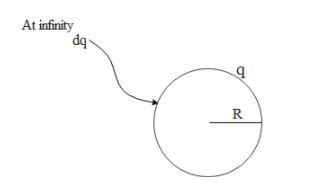
Now let us say we bring small charge dq from infinity such that the final charge on the thin spherical shell is Q. Hence the work done to form an assembly of such charge is given by,
$E=\int\limits_{{{Q}_{0}}}^{Q}{\dfrac{Kqdq}{R}}\text{,where }{{\text{Q}}_{\text{0}}}\text{ is the initial charge on the shell}$ .
We want to calculate the energy of formation of the shell from the beginning, hence the initial charge on the shell must be zero. Therefore we get the above equation as,
$\begin{align}
& W=\int\limits_{0}^{Q}{\dfrac{Kqdq}{R}}\text{since K and R are constant,} \\
& W=\dfrac{K}{R}\int\limits_{0}^{Q}{qdq} \\
& W=\dfrac{K}{R}\left[ \dfrac{{{q}^{2}}}{2} \right]_{0}^{Q} \\
& W=\dfrac{K{{Q}^{2}}}{2R} \\
\end{align}$
So, the correct answer is “Option a”.
Note: K is the permittivity of free space. Its value is given to be as $\dfrac{1}{4\pi {{\in }_{\circ }}}=9\times {{10}^{9}}Nm/{{C}^{2}}$. It is to be noted that the above scenario is taking place in vacuum. If the same had to happen in some other medium than the energy required would have been lesser than the value we obtained for work done in vacuum.
Complete step-by-step answer:
To begin with let us consider a spherical shell of radius R and having charge q. hence the electrostatic potential on the shell is $V=\dfrac{Kq}{R}\text{,where K is the permittivity of free space}$
Now let us say we bring small charge dq from infinity such that the final charge on the thin spherical shell is Q. Hence the work done to form an assembly of such charge is given by,
$E=\int\limits_{{{Q}_{0}}}^{Q}{\dfrac{Kqdq}{R}}\text{,where }{{\text{Q}}_{\text{0}}}\text{ is the initial charge on the shell}$ .
We want to calculate the energy of formation of the shell from the beginning, hence the initial charge on the shell must be zero. Therefore we get the above equation as,
$\begin{align}
& W=\int\limits_{0}^{Q}{\dfrac{Kqdq}{R}}\text{since K and R are constant,} \\
& W=\dfrac{K}{R}\int\limits_{0}^{Q}{qdq} \\
& W=\dfrac{K}{R}\left[ \dfrac{{{q}^{2}}}{2} \right]_{0}^{Q} \\
& W=\dfrac{K{{Q}^{2}}}{2R} \\
\end{align}$
So, the correct answer is “Option a”.
Note: K is the permittivity of free space. Its value is given to be as $\dfrac{1}{4\pi {{\in }_{\circ }}}=9\times {{10}^{9}}Nm/{{C}^{2}}$. It is to be noted that the above scenario is taking place in vacuum. If the same had to happen in some other medium than the energy required would have been lesser than the value we obtained for work done in vacuum.
Recently Updated Pages
Master Class 12 Economics: Engaging Questions & Answers for Success

Master Class 12 English: Engaging Questions & Answers for Success
Master Class 12 Social Science: Engaging Questions & Answers for Success
Master Class 12 Maths: Engaging Questions & Answers for Success
Master Class 12 Physics: Engaging Questions & Answers for Success
Master Class 9 General Knowledge: Engaging Questions & Answers for Success
Trending doubts
Which are the Top 10 Largest Countries of the World?
Draw a labelled sketch of the human eye class 12 physics CBSE
Differentiate between homogeneous and heterogeneous class 12 chemistry CBSE
Sulphuric acid is known as the king of acids State class 12 chemistry CBSE
Why is the cell called the structural and functional class 12 biology CBSE
A dentist uses a small mirror that gives a magnification class 12 physics CBSE