




The electric potential due to infinite uniformly charge of linear charge density $\lambda $ at a distance r from is given by is the reference point ${{r}_{o}}$
$\begin{align}
& a)\dfrac{\text{2 }\!\!\lambda\!\!\text{ }}{\text{4 }\!\!\pi\!\!\text{ }{{\in }_{\text{o}}}r} \\
& b)\dfrac{\text{2 }\!\!\lambda\!\!\text{ }}{\text{4 }\!\!\pi\!\!\text{ }{{\in }_{\text{o}}}{{r}_{0}}} \\
& c)\dfrac{\text{2 }\!\!\lambda\!\!\text{ }\left[ \ln {{r}_{o}}-\ln r \right]}{\text{4 }\!\!\pi\!\!\text{ }{{\in }_{\text{o}}}} \\
& d)\dfrac{\text{2 }\!\!\lambda\!\!\text{ (lnr)}}{\text{4 }\!\!\pi\!\!\text{ }{{\in }_{\text{o}}}r} \\
\end{align}$
Answer
 Verified
625.2k+ views
Hint: The electric field due to an infinitely charge distribution is given by, $\dfrac{\lambda }{2\pi {{\in }_{\circ }}r}$ where $\lambda $ is the linear charge density, ${{\in }_{\circ }}$ is the permittivity of free space and r is the perpendicular distance from the charge distribution. Hence taking ${{r}_{o}}$ as the reference point, the potential at the point which is at a distance r from the charge distribution from the expression i.e. $\dfrac{dV}{dr}=\dfrac{{{V}_{r}}-{{V}_{{{r}_{o}}}}}{dr}=-E...(1)$ where ${{V}_{r}}$ is the potential at point r, ${{V}_{{{r}_{o}}}}$ is the potential at the reference point and E is the electric field at point r.
Complete step-by-step answer:
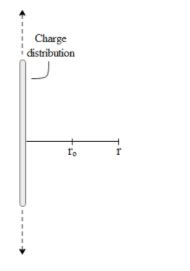
In the above figure we can see a charge distribution of linear charge density $\lambda $. Now we wish to calculate the potential at point r from the linear charge distribution. For that let us use equation 1 to determine the potential at point r with respect to the reference point ${{r}_{o}}$. Let us assume the distance between them is very small i.e. dr.
$\begin{align}
& \dfrac{{{V}_{r}}-{{V}_{{{r}_{o}}}}}{dr}=-E,\text{since }E=\dfrac{\lambda }{2\pi {{\in }_{\circ }}r} \\
& {{V}_{r}}-{{V}_{{{r}_{o}}}}=-\dfrac{\lambda }{2\pi {{\in }_{\circ }}r}dr \\
\end{align}$
Now let us integrate the above equation to find the potential at point r with respect to ${{r}_{o}}$.
$\begin{align}
& {{V}_{r}}-{{V}_{{{r}_{o}}}}=-\int\limits_{{{r}_{o}}}^{r}{\dfrac{\lambda }{2\pi {{\in }_{\circ }}r}dr} \\
& {{V}_{r}}-{{V}_{{{r}_{o}}}}=-\dfrac{\lambda }{2\pi {{\in }_{\circ }}}\int\limits_{{{r}_{o}}}^{r}{\dfrac{1}{_{\circ }r}dr} \\
& {{V}_{r}}-{{V}_{{{r}_{o}}}}=-\dfrac{\lambda }{2\pi {{\in }_{\circ }}}\left[ \ln r \right]_{{{r}_{o}}}^{r} \\
& {{V}_{r}}-{{V}_{{{r}_{o}}}}=-\dfrac{\lambda }{2\pi {{\in }_{\circ }}}\left[ \ln r-\ln {{r}_{o}} \right] \\
& {{V}_{r}}-{{V}_{{{r}_{o}}}}=\dfrac{\lambda }{2\pi {{\in }_{\circ }}}\left[ \ln {{r}_{o}}-\ln r \right] \\
\end{align}$
Hence from the above obtained result we can conclude that the potential at point r with respect to the reference point is given by,$\dfrac{\lambda }{2\pi {{\in }_{\circ }}}\left[ \ln {{r}_{o}}-\ln r \right]$ .
So, the correct answer is “Option C”.
Note: If we consider the above equation the potential keeps on decreasing as we move away from the reference point ${{r}_{o}}$. Hence we always take the electric field as a negative gradient of potential between the two points. The potential at a point always varies inversely with the distance.
Complete step-by-step answer:
In the above figure we can see a charge distribution of linear charge density $\lambda $. Now we wish to calculate the potential at point r from the linear charge distribution. For that let us use equation 1 to determine the potential at point r with respect to the reference point ${{r}_{o}}$. Let us assume the distance between them is very small i.e. dr.
$\begin{align}
& \dfrac{{{V}_{r}}-{{V}_{{{r}_{o}}}}}{dr}=-E,\text{since }E=\dfrac{\lambda }{2\pi {{\in }_{\circ }}r} \\
& {{V}_{r}}-{{V}_{{{r}_{o}}}}=-\dfrac{\lambda }{2\pi {{\in }_{\circ }}r}dr \\
\end{align}$
Now let us integrate the above equation to find the potential at point r with respect to ${{r}_{o}}$.
$\begin{align}
& {{V}_{r}}-{{V}_{{{r}_{o}}}}=-\int\limits_{{{r}_{o}}}^{r}{\dfrac{\lambda }{2\pi {{\in }_{\circ }}r}dr} \\
& {{V}_{r}}-{{V}_{{{r}_{o}}}}=-\dfrac{\lambda }{2\pi {{\in }_{\circ }}}\int\limits_{{{r}_{o}}}^{r}{\dfrac{1}{_{\circ }r}dr} \\
& {{V}_{r}}-{{V}_{{{r}_{o}}}}=-\dfrac{\lambda }{2\pi {{\in }_{\circ }}}\left[ \ln r \right]_{{{r}_{o}}}^{r} \\
& {{V}_{r}}-{{V}_{{{r}_{o}}}}=-\dfrac{\lambda }{2\pi {{\in }_{\circ }}}\left[ \ln r-\ln {{r}_{o}} \right] \\
& {{V}_{r}}-{{V}_{{{r}_{o}}}}=\dfrac{\lambda }{2\pi {{\in }_{\circ }}}\left[ \ln {{r}_{o}}-\ln r \right] \\
\end{align}$
Hence from the above obtained result we can conclude that the potential at point r with respect to the reference point is given by,$\dfrac{\lambda }{2\pi {{\in }_{\circ }}}\left[ \ln {{r}_{o}}-\ln r \right]$ .
So, the correct answer is “Option C”.
Note: If we consider the above equation the potential keeps on decreasing as we move away from the reference point ${{r}_{o}}$. Hence we always take the electric field as a negative gradient of potential between the two points. The potential at a point always varies inversely with the distance.
Recently Updated Pages
Master Class 12 Business Studies: Engaging Questions & Answers for Success

Master Class 12 Chemistry: Engaging Questions & Answers for Success
Master Class 12 Biology: Engaging Questions & Answers for Success
Class 12 Question and Answer - Your Ultimate Solutions Guide
Master Class 11 English: Engaging Questions & Answers for Success
Master Class 11 Social Science: Engaging Questions & Answers for Success
Trending doubts
Which are the Top 10 Largest Countries of the World?
Draw a labelled sketch of the human eye class 12 physics CBSE
Differentiate between homogeneous and heterogeneous class 12 chemistry CBSE
Differentiate between Pyramid of energy and pyramid class 12 biology CBSE
Why is the cell called the structural and functional class 12 biology CBSE
Draw the diagram of the pyramid of energy Explain In class 12 biology CBSE