




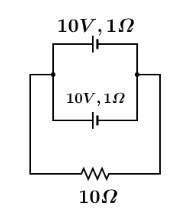
The electric current through the $10\Omega$ resistor in the circuit given below is ?
Answer
 Verified
537.9k+ views
Hint: In order to solve this question we need to understand Kirchhoff’s Law for loops. Kirchhoff’s law for junction states that no charges could accumulate at the junction so the net current entering at the junction must leave the junction by the same amount, this law is supported by the equation of continuity at the junction. And the second law states that in a closed loop or in a closed circuit the net potential difference would be zero.
Complete step by step answer:
Before solving let us first solve the loop in upper half containing two emf in same direction
So by applying formula for net emf we get,
$E = \dfrac{{{E_1}{r_1} + {E_2}{r_2}}}{{{r_1} + {r_2}}}$
Using ${E_1} = 10\,V$
${E_2} = 10\,V$
$\Rightarrow {r_1} = 1\Omega $
$\Rightarrow {r_2} = 1\Omega $
We get,
$E = \dfrac{{(10 \times 1) + (10 \times 1)}}{{1 + 1}} \\
\Rightarrow E= 10\,V$
For equivalent resistances in parallel combination using formula ${r_{eq}} = \dfrac{{{r_1}{r_2}}}{{{r_1} + {r_2}}}$ we get,
${r_1} = {r_2} = 1\Omega $
$\Rightarrow {r_{eq}} = \dfrac{{(1 \times 1)}}{{1 + 1}} = 0.5\Omega $
Now using Kirchhoff’s law in closed circuit we get
$E - i{r_{eq}} - iR = 0$
$\Rightarrow i = \dfrac{E}{{{r_{eq}} + R}}$
Using $R = 10\Omega $
And putting values in equation $i = \dfrac{E}{{{r_{eq}} + R}}$ we get
$i = \dfrac{{10}}{{0.5 + 10}} \\
\therefore i = 0.952A$
So the current through $10\Omega $ resistor is $0.952\,A$.
Note: It should be remembered that here the battery is non ideal and that’s why it has non zero internal resistance. If the battery is ideal then the internal resistance of the battery would be zero. Also we use general convention that if we move in a loop in the same direction as current the potential difference across resistance would be taken as negative and if we move in the opposite direction then potential difference across resistance would be taken as positive. Also when we start moving in a loop we first encounter the positive side of the battery so we have taken E as positive otherwise it would be negative.
Complete step by step answer:
Before solving let us first solve the loop in upper half containing two emf in same direction
So by applying formula for net emf we get,
$E = \dfrac{{{E_1}{r_1} + {E_2}{r_2}}}{{{r_1} + {r_2}}}$
Using ${E_1} = 10\,V$
${E_2} = 10\,V$
$\Rightarrow {r_1} = 1\Omega $
$\Rightarrow {r_2} = 1\Omega $
We get,
$E = \dfrac{{(10 \times 1) + (10 \times 1)}}{{1 + 1}} \\
\Rightarrow E= 10\,V$
For equivalent resistances in parallel combination using formula ${r_{eq}} = \dfrac{{{r_1}{r_2}}}{{{r_1} + {r_2}}}$ we get,
${r_1} = {r_2} = 1\Omega $
$\Rightarrow {r_{eq}} = \dfrac{{(1 \times 1)}}{{1 + 1}} = 0.5\Omega $
Now using Kirchhoff’s law in closed circuit we get
$E - i{r_{eq}} - iR = 0$
$\Rightarrow i = \dfrac{E}{{{r_{eq}} + R}}$
Using $R = 10\Omega $
And putting values in equation $i = \dfrac{E}{{{r_{eq}} + R}}$ we get
$i = \dfrac{{10}}{{0.5 + 10}} \\
\therefore i = 0.952A$
So the current through $10\Omega $ resistor is $0.952\,A$.
Note: It should be remembered that here the battery is non ideal and that’s why it has non zero internal resistance. If the battery is ideal then the internal resistance of the battery would be zero. Also we use general convention that if we move in a loop in the same direction as current the potential difference across resistance would be taken as negative and if we move in the opposite direction then potential difference across resistance would be taken as positive. Also when we start moving in a loop we first encounter the positive side of the battery so we have taken E as positive otherwise it would be negative.
Recently Updated Pages
Master Class 12 Business Studies: Engaging Questions & Answers for Success

Master Class 12 Chemistry: Engaging Questions & Answers for Success
Master Class 12 Biology: Engaging Questions & Answers for Success
Class 12 Question and Answer - Your Ultimate Solutions Guide
Master Class 9 General Knowledge: Engaging Questions & Answers for Success
Master Class 9 Maths: Engaging Questions & Answers for Success
Trending doubts
Which are the Top 10 Largest Countries of the World?
Draw a labelled sketch of the human eye class 12 physics CBSE
Name the crygenes that control cotton bollworm and class 12 biology CBSE
Differentiate between homogeneous and heterogeneous class 12 chemistry CBSE
In a transcription unit the promoter is said to be class 12 biology CBSE
Sulphuric acid is known as the king of acids State class 12 chemistry CBSE