




The electric charges are distributed in a small volume. The flux of the electric field through a spherical surface of a radius of $10cm$ surrounding the total charge is $20Vm$. The flux over a concentric sphere of radius $20cm$ will be
A. $20Vm$
B. $25Vm$
C. $40Vm$
D. $200Vm$
Answer
 Verified
637.5k+ views
Hint: In this question, we use gauss law. It states that total electric flux $\left( \phi \right)$ through any closed in free space is equal to $1/{ \in _o}$ times the total electric charge $\left( q \right)$ enclosed by the surface. Here electric flux means the total number of electric field lines passing through that surface.
Complete step by step answer:
According to the question we have,
Radius of spherical surface (r)$ = 10\;cm$
Total charge (q) =$20\; Vm$
Radius of second spherical surface (R) $ = 20\;cm$
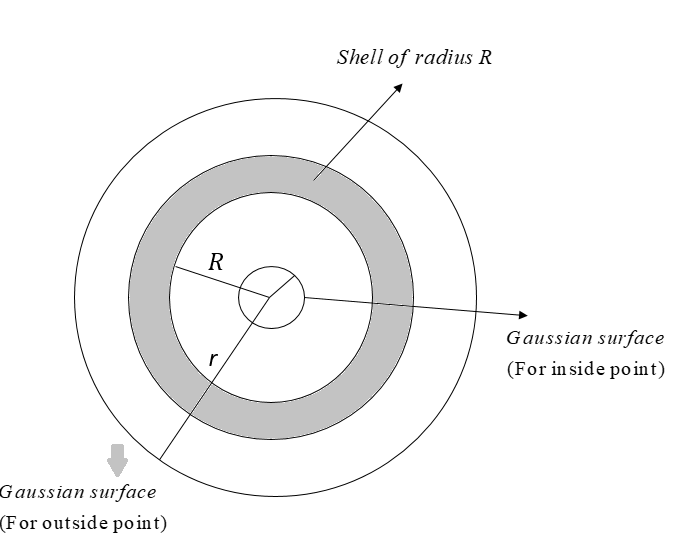
Consider two concentric spheres having different radii (r and R), but the total charge is the same for both the spheres.
Now by using Gauss' law, Flux for sphere having radius r ${\phi _{10}} = \dfrac{{{{\rm{q}}_{10}}}}{{{ \in _0}}}$
$ \Rightarrow {{\rm{q}}_{10}} = 20{ \in _0}$
Again Flux for second shere R ${\phi _{20}} = \dfrac{{{{\rm{q}}_{20}}}}{{{ \in _0}}}$
$ \Rightarrow {{\rm{q}}_{20}} = 20{ \in _0}$
Since the electric flux through a surface is independent of shape and size, it only depends upon the charge enclosed inside the volume. Thus charge enclosed by the sphere of radii 10cm and 20cm. So the flux remains the same for both spheres, i.e., $20{\rm{Vm}}$. Hence option (A) is correct.
Note:
The gaussian surface is in the form of a sphere at radius r > R, the electric field has the same magnitude at every point of the surface and is directed outward. The electric flux is then just the electric field times the area of the spherical surface. Here the Gaussian surface means an imaginary surface.
Complete step by step answer:
According to the question we have,
Radius of spherical surface (r)$ = 10\;cm$
Total charge (q) =$20\; Vm$
Radius of second spherical surface (R) $ = 20\;cm$
Consider two concentric spheres having different radii (r and R), but the total charge is the same for both the spheres.
Now by using Gauss' law, Flux for sphere having radius r ${\phi _{10}} = \dfrac{{{{\rm{q}}_{10}}}}{{{ \in _0}}}$
$ \Rightarrow {{\rm{q}}_{10}} = 20{ \in _0}$
Again Flux for second shere R ${\phi _{20}} = \dfrac{{{{\rm{q}}_{20}}}}{{{ \in _0}}}$
$ \Rightarrow {{\rm{q}}_{20}} = 20{ \in _0}$
Since the electric flux through a surface is independent of shape and size, it only depends upon the charge enclosed inside the volume. Thus charge enclosed by the sphere of radii 10cm and 20cm. So the flux remains the same for both spheres, i.e., $20{\rm{Vm}}$. Hence option (A) is correct.
Note:
The gaussian surface is in the form of a sphere at radius r > R, the electric field has the same magnitude at every point of the surface and is directed outward. The electric flux is then just the electric field times the area of the spherical surface. Here the Gaussian surface means an imaginary surface.
Recently Updated Pages
Basicity of sulphurous acid and sulphuric acid are

Master Class 12 Economics: Engaging Questions & Answers for Success
Master Class 12 Biology: Engaging Questions & Answers for Success
Master Class 11 English: Engaging Questions & Answers for Success
Master Class 11 Physics: Engaging Questions & Answers for Success
Master Class 11 Computer Science: Engaging Questions & Answers for Success
Trending doubts
Draw a labelled sketch of the human eye class 12 physics CBSE
The chemical formula of tear gas is A CO Cl 2 B C 10 class 12 chemistry CBSE
Draw ray diagrams each showing i myopic eye and ii class 12 physics CBSE
Which are the Top 10 Largest Countries of the World?
Differentiate between homogeneous and heterogeneous class 12 chemistry CBSE
Which is the correct genotypic ratio of mendel dihybrid class 12 biology CBSE