




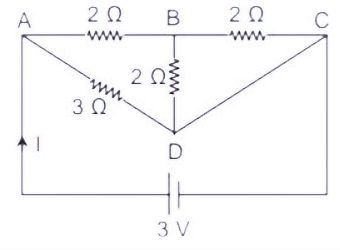
The effective resistance of the given circuit is:
A.1Ω
B.1.5Ω
C.2Ω
D.3Ω
Answer
 Verified
596.4k+ views
Hint: In order to solve this numerical we need to know how to solve the effective resistance. In order to find the effective resistance we consider the resistors which is connecting parallel to each other then we find the effective resistance of the circuit using parallel connection.
Complete step by step answer:
By using the series combination formula,
Between A and C, both the resistances connected in series
$\
{R_s} = {R_1} + {R_2} \\
\implies {R_s} = 2 + 1 \\
\implies {R_s} = 3\Omega \\
\ $
By using the parallel combination formula,
Between B and C, both the resistances connected in parallel,
$\
\dfrac{1}{{{R_p}}} = \dfrac{1}{{{R_1}}} + \dfrac{1}{{{R_2}}} \\
\implies \dfrac{1}{{{R_p}}} = \dfrac{1}{2} + \dfrac{1}{2} \\
\implies \dfrac{1}{{{R_p}}} = 2\left( {\dfrac{1}{2}} \right) \\
\implies {R_p} = 1\Omega \\
\ $
Now we calculate the effective resistance of the circuit
$\
\dfrac{1}{{{R_{{p_{total}}}}}} = \dfrac{1}{{{R_1}}} + \dfrac{1}{{{R_2}}} \\
\implies \dfrac{1}{{{R_p}}} = \dfrac{1}{3} + \dfrac{1}{3} \\
\implies \dfrac{1}{{{R_p}}} = \left( {\dfrac{2}{3}} \right) \\
\implies {R_p} = \left( {\dfrac{3}{2}} \right) \\
\implies {R_p} = 1.5\Omega \\
\ $
Note:
Commonly the Parallel circuit connection is more in use. Different electrical appliances we use in our daily life are usually connected in parallel such that electrical appliances can work independently. We can have control over the individual electrical appliances such that we need to be wired in parallel circuits.
Complete step by step answer:
By using the series combination formula,
Between A and C, both the resistances connected in series
$\
{R_s} = {R_1} + {R_2} \\
\implies {R_s} = 2 + 1 \\
\implies {R_s} = 3\Omega \\
\ $
By using the parallel combination formula,
Between B and C, both the resistances connected in parallel,
$\
\dfrac{1}{{{R_p}}} = \dfrac{1}{{{R_1}}} + \dfrac{1}{{{R_2}}} \\
\implies \dfrac{1}{{{R_p}}} = \dfrac{1}{2} + \dfrac{1}{2} \\
\implies \dfrac{1}{{{R_p}}} = 2\left( {\dfrac{1}{2}} \right) \\
\implies {R_p} = 1\Omega \\
\ $
Now we calculate the effective resistance of the circuit
$\
\dfrac{1}{{{R_{{p_{total}}}}}} = \dfrac{1}{{{R_1}}} + \dfrac{1}{{{R_2}}} \\
\implies \dfrac{1}{{{R_p}}} = \dfrac{1}{3} + \dfrac{1}{3} \\
\implies \dfrac{1}{{{R_p}}} = \left( {\dfrac{2}{3}} \right) \\
\implies {R_p} = \left( {\dfrac{3}{2}} \right) \\
\implies {R_p} = 1.5\Omega \\
\ $
Note:
Commonly the Parallel circuit connection is more in use. Different electrical appliances we use in our daily life are usually connected in parallel such that electrical appliances can work independently. We can have control over the individual electrical appliances such that we need to be wired in parallel circuits.
Recently Updated Pages
Master Class 12 Business Studies: Engaging Questions & Answers for Success

Master Class 12 Biology: Engaging Questions & Answers for Success
Master Class 12 Chemistry: Engaging Questions & Answers for Success
Class 12 Question and Answer - Your Ultimate Solutions Guide
Master Class 11 Social Science: Engaging Questions & Answers for Success
Master Class 11 English: Engaging Questions & Answers for Success
Trending doubts
Which are the Top 10 Largest Countries of the World?
Draw a labelled sketch of the human eye class 12 physics CBSE
Name the crygenes that control cotton bollworm and class 12 biology CBSE
Differentiate between homogeneous and heterogeneous class 12 chemistry CBSE
Ribosomal RNA is actively synthesised in A Nucleoplasm class 12 biology CBSE
How many molecules of ATP and NADPH are required information class 12 biology CBSE