




The distance between two charges $6\mu C$ and $15\mu C$ is $2m$ . At what point on the line joining the two, the intensity will be zero?
A. At a distance $1m$ from $6\mu C$
B. At a distance $1m$ from $15\mu C$
C. At a distance $0.77m$ from $6\mu C$
D. At a distance $0.77m$ from $15\mu C$
Answer
 Verified
500.4k+ views
Hint: In order to solve this question we need to understand electric field and electric force. So electric field lines or electric fields are defined as the region around a charge in which if any other charge is placed then it experiences an electrical force either attractive or repulsive. We will calculate the electric field due to both charges and will solve for the point where net electric field intensity is zero.
Complete step by step answer:
Value of first charge be, ${q_1}$ and it is equal to, ${q_1} = 6\mu C$
Value of second charge be, ${q_2}$ and it is equal to, ${q_2} = 15\mu C$
Let the distance between them be, $d$ and it is given as, $d = 2m$
Let at point P which is at a distance “x” from the first charge ${q_1}$ , the intensity of the net electric field would be zero, as shown in figure.
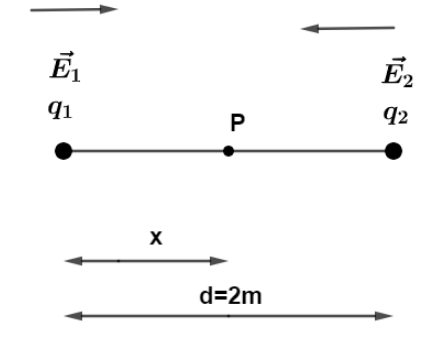
So electric field intensity from the first charge ${q_1}$ at point P be, ${\vec E_1} = \dfrac{{{q_1}}}{{4\pi {\varepsilon _0}{{(x)}^2}}}\hat x$ it is in right direction.
Since the distance between second charge and point P is, ${d_2} = d - x$.
So electric field intensity from the first charge ${q_2}$ at point P be, ${\vec E_2} = \dfrac{{{q_2}}}{{4\pi {\varepsilon _0}{{({d_2})}^2}}}( - \hat x)$ it is in left direction
${\vec E_2} = \dfrac{{ - {q_2}}}{{4\pi {\varepsilon _0}{{(d - x)}^2}}}(\hat x)$
So net electric field at point P be,
$\vec E = {\vec E_1} + {\vec E_2}$
$\Rightarrow \vec E = \dfrac{{{q_1}}}{{4\pi {\varepsilon _0}{{(x)}^2}}}\hat x + \dfrac{{ - {q_2}}}{{4\pi {\varepsilon _0}{{(d - x)}^2}}}(\hat x)$
$\Rightarrow \vec E = \dfrac{1}{{4\pi {\varepsilon _0}}}[\dfrac{{{q_1}}}{{{x^2}}} - \dfrac{{{q_2}}}{{{{(d - x)}^2}}}]\hat x$
Since net electric field is zero so,
$\vec E = 0$
$\Rightarrow \dfrac{1}{{4\pi {\varepsilon _0}}}[\dfrac{{{q_1}}}{{{x^2}}} - \dfrac{{{q_2}}}{{{{(d - x)}^2}}}]\hat x = 0$
Since constant cannot be zero, so
$\dfrac{{{q_1}}}{{{x^2}}} - \dfrac{{{q_2}}}{{{{(d - x)}^2}}} = 0$
$\Rightarrow \dfrac{{d - x}}{x} = \sqrt {\dfrac{{{q_2}}}{{{q_1}}}} $
Putting values we get,
$\dfrac{d}{x} - 1 = \sqrt {\dfrac{{15}}{6}} $
$\Rightarrow \dfrac{d}{x} - 1 = 1.58$
$\Rightarrow \dfrac{d}{x} = 2.58$
$\Rightarrow x = \dfrac{d}{{2.58}}$
Putting value of “d” we get,
$x = \dfrac{2}{{2.58}}$
$\therefore x = 0.77m$
So, the correct option is C.
Note:It should be remembered that electric field intensity can only be zero in between the two charges and, because at any point between the two charges electric field due to both charge are in opposite direction, while at any point outside the distance, electric field intensity is not zero because field from both the charges are in same direction.
Complete step by step answer:
Value of first charge be, ${q_1}$ and it is equal to, ${q_1} = 6\mu C$
Value of second charge be, ${q_2}$ and it is equal to, ${q_2} = 15\mu C$
Let the distance between them be, $d$ and it is given as, $d = 2m$
Let at point P which is at a distance “x” from the first charge ${q_1}$ , the intensity of the net electric field would be zero, as shown in figure.
So electric field intensity from the first charge ${q_1}$ at point P be, ${\vec E_1} = \dfrac{{{q_1}}}{{4\pi {\varepsilon _0}{{(x)}^2}}}\hat x$ it is in right direction.
Since the distance between second charge and point P is, ${d_2} = d - x$.
So electric field intensity from the first charge ${q_2}$ at point P be, ${\vec E_2} = \dfrac{{{q_2}}}{{4\pi {\varepsilon _0}{{({d_2})}^2}}}( - \hat x)$ it is in left direction
${\vec E_2} = \dfrac{{ - {q_2}}}{{4\pi {\varepsilon _0}{{(d - x)}^2}}}(\hat x)$
So net electric field at point P be,
$\vec E = {\vec E_1} + {\vec E_2}$
$\Rightarrow \vec E = \dfrac{{{q_1}}}{{4\pi {\varepsilon _0}{{(x)}^2}}}\hat x + \dfrac{{ - {q_2}}}{{4\pi {\varepsilon _0}{{(d - x)}^2}}}(\hat x)$
$\Rightarrow \vec E = \dfrac{1}{{4\pi {\varepsilon _0}}}[\dfrac{{{q_1}}}{{{x^2}}} - \dfrac{{{q_2}}}{{{{(d - x)}^2}}}]\hat x$
Since net electric field is zero so,
$\vec E = 0$
$\Rightarrow \dfrac{1}{{4\pi {\varepsilon _0}}}[\dfrac{{{q_1}}}{{{x^2}}} - \dfrac{{{q_2}}}{{{{(d - x)}^2}}}]\hat x = 0$
Since constant cannot be zero, so
$\dfrac{{{q_1}}}{{{x^2}}} - \dfrac{{{q_2}}}{{{{(d - x)}^2}}} = 0$
$\Rightarrow \dfrac{{d - x}}{x} = \sqrt {\dfrac{{{q_2}}}{{{q_1}}}} $
Putting values we get,
$\dfrac{d}{x} - 1 = \sqrt {\dfrac{{15}}{6}} $
$\Rightarrow \dfrac{d}{x} - 1 = 1.58$
$\Rightarrow \dfrac{d}{x} = 2.58$
$\Rightarrow x = \dfrac{d}{{2.58}}$
Putting value of “d” we get,
$x = \dfrac{2}{{2.58}}$
$\therefore x = 0.77m$
So, the correct option is C.
Note:It should be remembered that electric field intensity can only be zero in between the two charges and, because at any point between the two charges electric field due to both charge are in opposite direction, while at any point outside the distance, electric field intensity is not zero because field from both the charges are in same direction.
Recently Updated Pages
Master Class 12 Economics: Engaging Questions & Answers for Success

Master Class 12 Physics: Engaging Questions & Answers for Success
Master Class 12 English: Engaging Questions & Answers for Success
Master Class 12 Social Science: Engaging Questions & Answers for Success
Master Class 12 Maths: Engaging Questions & Answers for Success
Master Class 12 Business Studies: Engaging Questions & Answers for Success
Trending doubts
Which are the Top 10 Largest Countries of the World?
What are the major means of transport Explain each class 12 social science CBSE
Draw a labelled sketch of the human eye class 12 physics CBSE
Why cannot DNA pass through cell membranes class 12 biology CBSE
Differentiate between insitu conservation and exsitu class 12 biology CBSE
Draw a neat and well labeled diagram of TS of ovary class 12 biology CBSE