




The diffusion current in p-n junction is
A. from the n-side to the p-side
B. from the p-side to the n-side
C. from the n-side to the p-side if the junction is forward biased and in the opposite direction if it is reverse-biased
D. from the p-side to the n-side if the junction is forward biased and in the opposite direction if it is reverse-biased
Answer
 Verified
619.5k+ views
Hint: We know that diffusion current is a current in a semiconductor which is a result of the diffusion of the charge carriers, i.e.holes or electrons. So, to find the solution of the given question, we are required to find the flow of these charge carriers (holes and/or electrons).
Complete step by step answer:
In an n-type semiconductor, the concentration of electrons is more than that of the holes. While in a p-type semiconductor, the concentration of holes is more than that of the electrons.
During the formation of a p-n junction diffusion and drift are the two processes taking place. When a p-n junction is formed, holes diffuse from the p-side to the n-side while electrons diffuse from the n-side to the p-side. This result due to the concentration gradient across p and n sides, which gives rise to a diffusion current across the junction.
Diffusion current is considered while describing many semiconductor devices. Diffusion current dominates the current near the depletion region of a p-n junction. Depletion region is defined as the insulating within a conductive, doped semiconductor material where the mobile charge carriers have been forced away by an electric field or in simple terms have been diffused away.
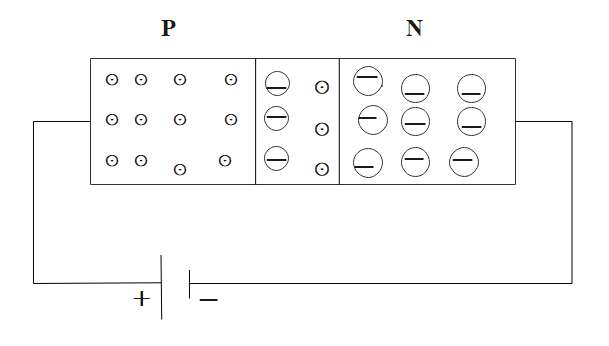
Thus, we know that holes from p-type diffuse into the n-type, and vice versa that is the n-type diffuse into the p-type. This happens due to the concentration gradient, which is responsible for the formation of a depletion region which in turn results in the rise of diffusion current flowing from p to n side.
So, the correct answer is “Option B”.
Note: In the state of equilibrium, there is no current in a p-n junction. A difference of potential develops across the junction of the two regions due to loss of electrons by the n-region and subsequent gain by the p-region. Then the polarity of the potential opposes the further flow of carriers to maintain the state of equilibrium. This is known as barrier potential.
Complete step by step answer:
In an n-type semiconductor, the concentration of electrons is more than that of the holes. While in a p-type semiconductor, the concentration of holes is more than that of the electrons.
During the formation of a p-n junction diffusion and drift are the two processes taking place. When a p-n junction is formed, holes diffuse from the p-side to the n-side while electrons diffuse from the n-side to the p-side. This result due to the concentration gradient across p and n sides, which gives rise to a diffusion current across the junction.
Diffusion current is considered while describing many semiconductor devices. Diffusion current dominates the current near the depletion region of a p-n junction. Depletion region is defined as the insulating within a conductive, doped semiconductor material where the mobile charge carriers have been forced away by an electric field or in simple terms have been diffused away.
Thus, we know that holes from p-type diffuse into the n-type, and vice versa that is the n-type diffuse into the p-type. This happens due to the concentration gradient, which is responsible for the formation of a depletion region which in turn results in the rise of diffusion current flowing from p to n side.
So, the correct answer is “Option B”.
Note: In the state of equilibrium, there is no current in a p-n junction. A difference of potential develops across the junction of the two regions due to loss of electrons by the n-region and subsequent gain by the p-region. Then the polarity of the potential opposes the further flow of carriers to maintain the state of equilibrium. This is known as barrier potential.
Recently Updated Pages
Master Class 12 Economics: Engaging Questions & Answers for Success

Master Class 12 English: Engaging Questions & Answers for Success
Master Class 12 Social Science: Engaging Questions & Answers for Success
Master Class 12 Maths: Engaging Questions & Answers for Success
Master Class 12 Physics: Engaging Questions & Answers for Success
Master Class 12 Business Studies: Engaging Questions & Answers for Success
Trending doubts
Which are the Top 10 Largest Countries of the World?
Draw a labelled sketch of the human eye class 12 physics CBSE
Differentiate between homogeneous and heterogeneous class 12 chemistry CBSE
Why is the cell called the structural and functional class 12 biology CBSE
Draw ray diagrams each showing i myopic eye and ii class 12 physics CBSE
Which is the correct genotypic ratio of mendel dihybrid class 12 biology CBSE