




The diagram shows two arcs, A and B. Arc A is part of the circle with centre O and radius OP. Arc B is part of the circle with centre M and radius PM, where M is the midpoint of PQ. Show that the area enclosed by the two arcs is equal to $25\left( {\sqrt 3 - \dfrac{\pi }{6}} \right)c{m^2}.$
Answer
 Verified
624.6k+ views
Hint- In this question, the radius of two arcs is given to us. We have to find the area enclosed by the two arcs, using a simple formula for area of semicircle and formula for area of segment of circle. Subtract both segments to get the required answer.
Complete step-by-step solution -
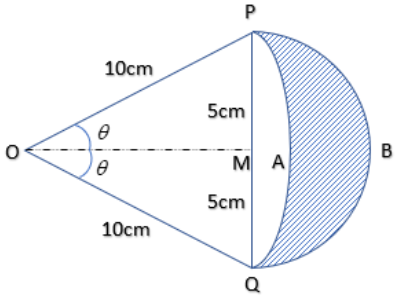
Area enclosed by arc B and chord PQ = Area of semicircle of radius 5cm $ = \dfrac{1}{2} \times \pi \times {(5cm)^2} = \dfrac{{25\pi }}{2}c{m^2}$
Let $\angle MOQ = \angle MOP = \theta $
Now, in $\Delta PMO,$
We know that, $\sin \theta = \dfrac{P}{H}$ where P = perpendicular and H = Hypotenuse in a right-angled triangle.
$\sin \theta = \dfrac{{PM}}{{OP}} = \dfrac{{5cm}}{{10cm}} = \dfrac{1}{2}$
$\therefore \theta = {\sin ^{ - 1}}\left( {\dfrac{1}{2}} \right)$
We know that ${\sin ^{ - 1}}\left( {\dfrac{1}{2}} \right) = {30^0}$
$ \Rightarrow \theta = {30^0}$
Area of segment of circle of radius 10cm containing angle $(2\theta = {60^0})$
$ = \dfrac{{\pi {r^2}\theta }}{{360}} = \dfrac{{\pi {{(10)}^2} \times {{60}^0}}}{{{{360}^0}}} = \dfrac{{100\pi }}{6}$
Area of \[\Delta POQ = \dfrac{{\sqrt 3 {{\left( {side} \right)}^2}}}{4} = \dfrac{{\sqrt 3 {{\left( {10cm} \right)}^2}}}{4} = \dfrac{{\sqrt 3 \times 100c{m^2}}}{4} = 25\sqrt 3 c{m^2}\]
Area enclosed by two arcs = Area enclosed by the arc B and chord PQ + area of $\Delta POQ$ - Area enclosed by arc A of radius 10cm
$ = \dfrac{{25\pi }}{2}c{m^2} + 25\sqrt 3 c{m^2} - \dfrac{{100\pi }}{6}c{m^2} = 25\sqrt 3 c{m^2} - \dfrac{{25\pi }}{6}c{m^2} = 25\left( {\sqrt 3 - \dfrac{\pi }{6}} \right)c{m^2}$
Hence, it has been showed that the area enclosed by the two arcs is equal to $25\left( {\sqrt 3 - \dfrac{\pi }{6}} \right)c{m^2}.$
Note- For these types of questions, always try to solve by analyzing the figure and whenever equilateral triangle shows appearance use its properties like area, internal angles etc. where area of equilateral triangle is \[\dfrac{{\sqrt 3 {{\left( {side} \right)}^2}}}{4}\] . Also, keep in mind that area of segment of circle containing an angle $\theta $ is $\dfrac{{\pi {r^2}\theta }}{{360}}$ and area of semicircle is equal to $\dfrac{{\pi {r^2}}}{2}$.
Complete step-by-step solution -
Area enclosed by arc B and chord PQ = Area of semicircle of radius 5cm $ = \dfrac{1}{2} \times \pi \times {(5cm)^2} = \dfrac{{25\pi }}{2}c{m^2}$
Let $\angle MOQ = \angle MOP = \theta $
Now, in $\Delta PMO,$
We know that, $\sin \theta = \dfrac{P}{H}$ where P = perpendicular and H = Hypotenuse in a right-angled triangle.
$\sin \theta = \dfrac{{PM}}{{OP}} = \dfrac{{5cm}}{{10cm}} = \dfrac{1}{2}$
$\therefore \theta = {\sin ^{ - 1}}\left( {\dfrac{1}{2}} \right)$
We know that ${\sin ^{ - 1}}\left( {\dfrac{1}{2}} \right) = {30^0}$
$ \Rightarrow \theta = {30^0}$
Area of segment of circle of radius 10cm containing angle $(2\theta = {60^0})$
$ = \dfrac{{\pi {r^2}\theta }}{{360}} = \dfrac{{\pi {{(10)}^2} \times {{60}^0}}}{{{{360}^0}}} = \dfrac{{100\pi }}{6}$
Area of \[\Delta POQ = \dfrac{{\sqrt 3 {{\left( {side} \right)}^2}}}{4} = \dfrac{{\sqrt 3 {{\left( {10cm} \right)}^2}}}{4} = \dfrac{{\sqrt 3 \times 100c{m^2}}}{4} = 25\sqrt 3 c{m^2}\]
Area enclosed by two arcs = Area enclosed by the arc B and chord PQ + area of $\Delta POQ$ - Area enclosed by arc A of radius 10cm
$ = \dfrac{{25\pi }}{2}c{m^2} + 25\sqrt 3 c{m^2} - \dfrac{{100\pi }}{6}c{m^2} = 25\sqrt 3 c{m^2} - \dfrac{{25\pi }}{6}c{m^2} = 25\left( {\sqrt 3 - \dfrac{\pi }{6}} \right)c{m^2}$
Hence, it has been showed that the area enclosed by the two arcs is equal to $25\left( {\sqrt 3 - \dfrac{\pi }{6}} \right)c{m^2}.$
Note- For these types of questions, always try to solve by analyzing the figure and whenever equilateral triangle shows appearance use its properties like area, internal angles etc. where area of equilateral triangle is \[\dfrac{{\sqrt 3 {{\left( {side} \right)}^2}}}{4}\] . Also, keep in mind that area of segment of circle containing an angle $\theta $ is $\dfrac{{\pi {r^2}\theta }}{{360}}$ and area of semicircle is equal to $\dfrac{{\pi {r^2}}}{2}$.
Recently Updated Pages
Master Class 10 Social Science: Engaging Questions & Answers for Success

Master Class 10 Science: Engaging Questions & Answers for Success
Master Class 10 Maths: Engaging Questions & Answers for Success
Master Class 10 General Knowledge: Engaging Questions & Answers for Success
Master Class 10 Computer Science: Engaging Questions & Answers for Success
Class 10 Question and Answer - Your Ultimate Solutions Guide
Trending doubts
What is the full form of PNG A Petrol Natural Gas B class 10 chemistry CBSE
Explain the Treaty of Vienna of 1815 class 10 social science CBSE
In cricket, how many legal balls are there in a standard over?
Why is there a time difference of about 5 hours between class 10 social science CBSE
Who Won 36 Oscar Awards? Record Holder Revealed
What is the median of the first 10 natural numbers class 10 maths CBSE