




PQ is a tangent to a circle with centre O at the point P. If \[\vartriangle OPQ\] is an isosceles triangle with P as a vertex , then \[\angle OQP\] is equal to
a) \[{30^ \circ }\]
b) \[{45^ \circ }\]
c) \[{60^ \circ }\]
d) \[{90^ \circ }\]
Answer
 Verified
569.7k+ views
Hint: We are given that PQ is a tangent to a circle with centre O at the point P. Let us consider OP to be the radius of the circle. Then, as PQ is tangent at point P, we know the tangent makes a right angle with the radius. Hence, \[\angle OPQ = {90^ \circ }\]. Also, we are given that \[\vartriangle OPQ\] is an isosceles triangle. We will understand this using a diagram.
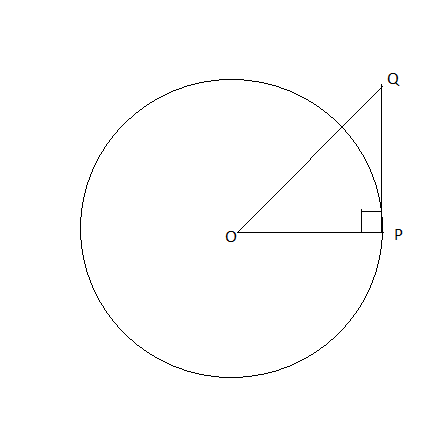
In the given figure, OP is the radius of the circle and PQ is tangent at point P. Hence, \[\angle OPQ = {90^ \circ }\]. Since \[\vartriangle OPQ\] is an isosceles triangle, we have two sides of this triangle are equal. Let us consider \[OP = PQ\]. Now, we will use the property of an isosceles triangle that angles opposite to equal sides are equal. After that we will use the angle sum property of a triangle i.e. Sum of angles in a triangle is equal to \[{180^ \circ }\] and find the required angle.
Complete step-by-step solution:
Since PQ is a tangent at point P and OP is the radius of the circle.
We see it through a figure.
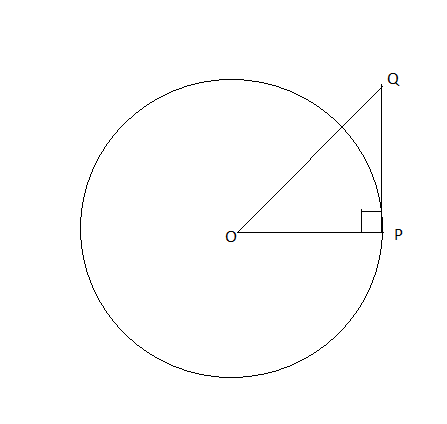
We know, tangent makes a right angle with the radius and So,
\[\angle OPQ = {90^ \circ } - - - - - (1)\]
As \[\vartriangle OPQ\] is an isosceles triangle with \[OP = PQ\].
We know, Angles opposite to equal sides are equal.
Angle opposite to \[PQ\] is \[\angle QOP\].
Angle opposite to \[OP\] is \[\angle OQP\].
Hence, \[\angle OQP = \angle QOP - - - - - (2)\]
In \[\vartriangle OPQ\], using Angle Sum Property
\[\angle OPQ + \angle OQP + \angle QOP = {180^ \circ } - - - - - (3)\]
Using (1) and (2) in (3)
\[{90^ \circ } + \angle OQP + \angle OQP = {180^ \circ }\]
\[ \Rightarrow {90^ \circ } + 2\angle OQP = {180^ \circ }\]
Subtracting \[{90^ \circ }\] both the sides, we get
\[ \Rightarrow {90^ \circ } + 2\angle OQP - {90^ \circ } = {180^ \circ } - {90^ \circ }\]
Clubbing the like terms on left hand side
\[ \Rightarrow 2\angle OQP + ({90^ \circ } - {90^ \circ }) = {180^ \circ } - {90^ \circ }\]
Solving the left and the right hand side
\[ \Rightarrow 2\angle OQP + {0^ \circ } = {90^ \circ }\]
\[ \Rightarrow 2\angle OQP = {90^ \circ }\]
Dividing both the sides by \[2\].
\[\dfrac{{2\angle OQP}}{2} = \dfrac{{{{90}^ \circ }}}{2}\]
\[\angle OQP = {45^ \circ }\]
Hence, we got \[\angle OQP = {45^ \circ }\].
Therefore, the correct option is (b).
Note: We need to be very thorough with the properties of circles and triangles. Once we interpret the given question, we need to think of the steps of solving the problem. While solving, we need to take care of the calculations. We have to read the question carefully and then draw the figure and then apply the properties. Each and every detail in the question needs to be read very carefully. While solving, we have to take care of each and every step.
In the given figure, OP is the radius of the circle and PQ is tangent at point P. Hence, \[\angle OPQ = {90^ \circ }\]. Since \[\vartriangle OPQ\] is an isosceles triangle, we have two sides of this triangle are equal. Let us consider \[OP = PQ\]. Now, we will use the property of an isosceles triangle that angles opposite to equal sides are equal. After that we will use the angle sum property of a triangle i.e. Sum of angles in a triangle is equal to \[{180^ \circ }\] and find the required angle.
Complete step-by-step solution:
Since PQ is a tangent at point P and OP is the radius of the circle.
We see it through a figure.
We know, tangent makes a right angle with the radius and So,
\[\angle OPQ = {90^ \circ } - - - - - (1)\]
As \[\vartriangle OPQ\] is an isosceles triangle with \[OP = PQ\].
We know, Angles opposite to equal sides are equal.
Angle opposite to \[PQ\] is \[\angle QOP\].
Angle opposite to \[OP\] is \[\angle OQP\].
Hence, \[\angle OQP = \angle QOP - - - - - (2)\]
In \[\vartriangle OPQ\], using Angle Sum Property
\[\angle OPQ + \angle OQP + \angle QOP = {180^ \circ } - - - - - (3)\]
Using (1) and (2) in (3)
\[{90^ \circ } + \angle OQP + \angle OQP = {180^ \circ }\]
\[ \Rightarrow {90^ \circ } + 2\angle OQP = {180^ \circ }\]
Subtracting \[{90^ \circ }\] both the sides, we get
\[ \Rightarrow {90^ \circ } + 2\angle OQP - {90^ \circ } = {180^ \circ } - {90^ \circ }\]
Clubbing the like terms on left hand side
\[ \Rightarrow 2\angle OQP + ({90^ \circ } - {90^ \circ }) = {180^ \circ } - {90^ \circ }\]
Solving the left and the right hand side
\[ \Rightarrow 2\angle OQP + {0^ \circ } = {90^ \circ }\]
\[ \Rightarrow 2\angle OQP = {90^ \circ }\]
Dividing both the sides by \[2\].
\[\dfrac{{2\angle OQP}}{2} = \dfrac{{{{90}^ \circ }}}{2}\]
\[\angle OQP = {45^ \circ }\]
Hence, we got \[\angle OQP = {45^ \circ }\].
Therefore, the correct option is (b).
Note: We need to be very thorough with the properties of circles and triangles. Once we interpret the given question, we need to think of the steps of solving the problem. While solving, we need to take care of the calculations. We have to read the question carefully and then draw the figure and then apply the properties. Each and every detail in the question needs to be read very carefully. While solving, we have to take care of each and every step.
Recently Updated Pages
A Paragraph on Pollution in about 100-150 Words

What is BLO What is the full form of BLO class 8 social science CBSE
10 examples of friction in our daily life
Draw a diagram of nephron and explain its structur class 11 biology CBSE
Write structures of the following compounds i 2 Chloro3methylpentane class 11 chemistry CBSE
XIX+XXX A 49 B 51 C 55 D 44 class 5 maths CBSE
Trending doubts
Explain the Treaty of Vienna of 1815 class 10 social science CBSE
Which is the Lowest Point of Earth?
1 GB equals how many MB?
10 examples of evaporation in daily life with explanations
What is the full form of POSCO class 10 social science CBSE
Make a sketch of the human nerve cell What function class 10 biology CBSE