



The diagram shows a trapezium $ ABCD $ in which $ AD = 7cm $ and $ AB = (4 + \sqrt 5 )cm $ . $ AX $ is perpendicular to $ DC $ with $ DX = 2cm $ and $ XC = xcm $ . Given that the area of trapezium ABCD is $ 15(15 + \sqrt 2 )c{m^2}, $ obtain an expression for $ x $ in the form of $ a + b\sqrt 5 ? $
Answer
 Verified
606k+ views
Hint: As we know that a trapezium is a quadrilateral having two parallel sides of unequal length and the other two sides are non- parallel. The parallel sides of a trapezium are called bases and the non parallel sides are called the legs. The area of the trapezium is $ \dfrac{1}{2} \times $ ( Sum of parallel sides) $ \times $ ( Distance between them).
Complete step by step solution:
First we will draw the diagram according to the questions:
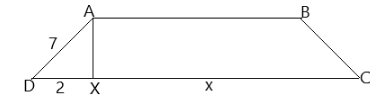
In the above figure we can see that $ AB = 4 + \sqrt 5 $ and $ DC = 2 + x $ . The triangle $ ADX $ is a right angled triangle, so to find the value of AX we will apply the Pythagoras theorem.
We have $ AX = \sqrt {A{D^2} - D{X^2}} $ , by putting the values in the expression we have
$
AX = \sqrt {{7^2} - {2^2}} \\
\Rightarrow \sqrt {49 - 4} \;
$ .
It gives us the value $ AX = \sqrt {45} = 3\sqrt {5.} $
We have been given that the area of the trapezium is $ 15(15 + \sqrt 2 )c{m^2}. $ Now the area of the trapezium is $ \dfrac{1}{2} \times $ ( Sum of parallel sides) $ \times $ ( Distance between them).
So we can write
$ 15(\sqrt 5 + 2) = \dfrac{1}{2} \times \left( {4 + \sqrt 5 + 2 + x} \right) \times 3\sqrt 5 $ .
We will solve it now by isolating the term $ x $ .
Therefore: $ \left( {6 + \sqrt 5 + x} \right)3\sqrt 5 = 2 \times 15\left( {\sqrt 5 + 2} \right) $ . Now we will transfer the $ 3\sqrt 5 $ to the right hand side of the equation,
$ x + 6 + \sqrt 5 = 30\dfrac{{\sqrt 5 + 2}}{{3\sqrt 5 }} $ .
Taking the common factor out $ x + 6 + \sqrt 5 = 10\left( {1 + \dfrac{2}{5}\sqrt 5 } \right) $ , transfer all the terms except the variable to the right hand side
$
x = 10 + \dfrac{{20}}{5} \times \sqrt 5 - 6 - \sqrt 5 \\
\Rightarrow 4 + 3\sqrt 5 \;
$ .
Hence the required answer is $ 4 + 3\sqrt 5 . $
So, the correct answer is “ $ 4 + 3\sqrt 5 $ ”.
Note: Before solving this kind of question we should know all the properties and the formulas of the trapezium. We should note that the question says that the AX is perpendicular so that makes the angle $ {90^ \circ } $ , hence it forms the right angled triangle. We should be careful while solving to avoid the calculation mistakes.
Complete step by step solution:
First we will draw the diagram according to the questions:
In the above figure we can see that $ AB = 4 + \sqrt 5 $ and $ DC = 2 + x $ . The triangle $ ADX $ is a right angled triangle, so to find the value of AX we will apply the Pythagoras theorem.
We have $ AX = \sqrt {A{D^2} - D{X^2}} $ , by putting the values in the expression we have
$
AX = \sqrt {{7^2} - {2^2}} \\
\Rightarrow \sqrt {49 - 4} \;
$ .
It gives us the value $ AX = \sqrt {45} = 3\sqrt {5.} $
We have been given that the area of the trapezium is $ 15(15 + \sqrt 2 )c{m^2}. $ Now the area of the trapezium is $ \dfrac{1}{2} \times $ ( Sum of parallel sides) $ \times $ ( Distance between them).
So we can write
$ 15(\sqrt 5 + 2) = \dfrac{1}{2} \times \left( {4 + \sqrt 5 + 2 + x} \right) \times 3\sqrt 5 $ .
We will solve it now by isolating the term $ x $ .
Therefore: $ \left( {6 + \sqrt 5 + x} \right)3\sqrt 5 = 2 \times 15\left( {\sqrt 5 + 2} \right) $ . Now we will transfer the $ 3\sqrt 5 $ to the right hand side of the equation,
$ x + 6 + \sqrt 5 = 30\dfrac{{\sqrt 5 + 2}}{{3\sqrt 5 }} $ .
Taking the common factor out $ x + 6 + \sqrt 5 = 10\left( {1 + \dfrac{2}{5}\sqrt 5 } \right) $ , transfer all the terms except the variable to the right hand side
$
x = 10 + \dfrac{{20}}{5} \times \sqrt 5 - 6 - \sqrt 5 \\
\Rightarrow 4 + 3\sqrt 5 \;
$ .
Hence the required answer is $ 4 + 3\sqrt 5 . $
So, the correct answer is “ $ 4 + 3\sqrt 5 $ ”.
Note: Before solving this kind of question we should know all the properties and the formulas of the trapezium. We should note that the question says that the AX is perpendicular so that makes the angle $ {90^ \circ } $ , hence it forms the right angled triangle. We should be careful while solving to avoid the calculation mistakes.
Recently Updated Pages
Master Class 10 Computer Science: Engaging Questions & Answers for Success

Master Class 12 Physics: Engaging Questions & Answers for Success
Master Class 12 Social Science: Engaging Questions & Answers for Success
Master Class 12 English: Engaging Questions & Answers for Success
Master Class 12 Maths: Engaging Questions & Answers for Success
Master Class 12 Business Studies: Engaging Questions & Answers for Success
Trending doubts
Fill the blanks with the suitable prepositions 1 The class 9 english CBSE
Difference Between Plant Cell and Animal Cell
What is the full form of pH?
What is pollution? How many types of pollution? Define it
What is the Full Form of ICSE / ISC ?
On an outline map of India show its neighbouring c class 9 social science CBSE