




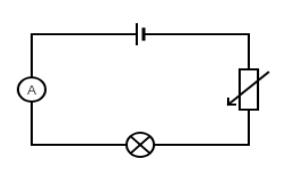
The diagram shows a circuit containing a cell, an ammeter, a lamp and a variable resistor. The resistance of the variable resistor is increased. What happens to the ammeter reading and what happens to the brightness of the lamp.
Ammeter reading Lamp brightness A. Decreases Decreases B Decreases Increases C Increases Decreases D. Increases Increases
| Ammeter reading | Lamp brightness | |
| A. | Decreases | Decreases |
| B | Decreases | Increases |
| C | Increases | Decreases |
| D. | Increases | Increases |
Answer
 Verified
608.1k+ views
Hint: We need to investigate the current in the circuit using Kirchhoff’s voltage rule. The reduction of power supplied to the lamp corresponds to decrease in brightness, and increase in power causes increase in brightness. Using this we can find the correct answer.
Formula used: In this solution we will be using the following formulae;
$ P = IV $ where $ P $ is the power supplied to a load such as a lamp, $ I $ is the current flowing through the load, and $ V $ is the potential difference across it.
$ \sum V = 0 $ where $ V $ is the potential difference across each element of the loop.
Complete step by step solution:
A variable resistor is simply a resistor whose resistance value can easily be changed. The voltage drop across it is as in a normal resistor. Hence, on applying Kirchhoff’s voltage law across the loop, we have
$ E - Ir - IR = 0 $ where $ E $ is the voltage value of the cell, $ r $ is the resistance due to the lamp, and $ R $ is the resistance value of the variable resistor.
The equation by factoring $ I $ can become
$ E - I(r + R) = 0 $
To investigate the effect of $ R $ on $ I $ we must make $ I $ subject to the formula. Hence
$ E = I(r + R) $
$ \Rightarrow I = \dfrac{E}{{r + R}} $
This informs us that an increase in the value of resistance $ R $ reduces the current $ I $ .
Also, from $ P = IV $ we see that if the current reduces, the power consumed by the lamp reduces, thus, the brightness also decreases.
Therefore, when the resistance of the variable resistor $ R $ increases, the current reduces and thus, the brightness reduces
Hence, the correct option is A.
Note:
In application, variable resistors are used in situations where resistance in a circuit needs to be easily reduced. A few appliances that use variable resistors include volume dials of radios and standing fan controllers.
Formula used: In this solution we will be using the following formulae;
$ P = IV $ where $ P $ is the power supplied to a load such as a lamp, $ I $ is the current flowing through the load, and $ V $ is the potential difference across it.
$ \sum V = 0 $ where $ V $ is the potential difference across each element of the loop.
Complete step by step solution:
A variable resistor is simply a resistor whose resistance value can easily be changed. The voltage drop across it is as in a normal resistor. Hence, on applying Kirchhoff’s voltage law across the loop, we have
$ E - Ir - IR = 0 $ where $ E $ is the voltage value of the cell, $ r $ is the resistance due to the lamp, and $ R $ is the resistance value of the variable resistor.
The equation by factoring $ I $ can become
$ E - I(r + R) = 0 $
To investigate the effect of $ R $ on $ I $ we must make $ I $ subject to the formula. Hence
$ E = I(r + R) $
$ \Rightarrow I = \dfrac{E}{{r + R}} $
This informs us that an increase in the value of resistance $ R $ reduces the current $ I $ .
Also, from $ P = IV $ we see that if the current reduces, the power consumed by the lamp reduces, thus, the brightness also decreases.
Therefore, when the resistance of the variable resistor $ R $ increases, the current reduces and thus, the brightness reduces
Hence, the correct option is A.
Note:
In application, variable resistors are used in situations where resistance in a circuit needs to be easily reduced. A few appliances that use variable resistors include volume dials of radios and standing fan controllers.
Recently Updated Pages
Master Class 12 Business Studies: Engaging Questions & Answers for Success

Master Class 12 Biology: Engaging Questions & Answers for Success
Master Class 12 Chemistry: Engaging Questions & Answers for Success
Class 12 Question and Answer - Your Ultimate Solutions Guide
Master Class 11 English: Engaging Questions & Answers for Success
Master Class 11 Social Science: Engaging Questions & Answers for Success
Trending doubts
Which are the Top 10 Largest Countries of the World?
Draw a labelled sketch of the human eye class 12 physics CBSE
Differentiate between homogeneous and heterogeneous class 12 chemistry CBSE
Why is the cell called the structural and functional class 12 biology CBSE
Draw ray diagrams each showing i myopic eye and ii class 12 physics CBSE
Which is the correct genotypic ratio of mendel dihybrid class 12 biology CBSE