




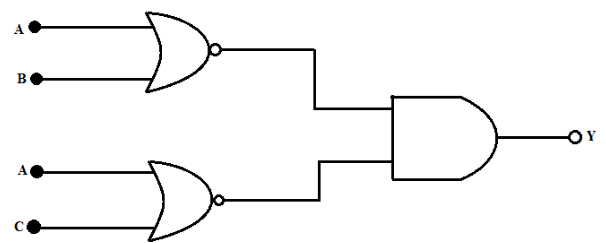
The diagram of the logic gate circuit is given below. The output Y of the circuit is represented by
(A) \[A \cdot \left( {B + C} \right)\]
(B) \[A \cdot \left( {B \cdot C} \right)\]
(C) \[A + \left( {B \cdot C} \right)\]
(D) \[A + \left( {B + C} \right)\]
Answer
 Verified
608.4k+ views
Hint: In the above logic gate, the output of two or gates is given to the input of AND gate. Use laws of boolean algebra to simplify the boolean expression. Use annulment law which gives, \[1 + C = 1\].
Complete step by step answer:
We can see in the above logic gate circuit, the output of both the OR gates is given to the input of AND gate.
We know the output of an OR gate is the sum of inputs. Therefore, the output of upper OR gate is,
\[{Y_1} = A + B\]
Also, the output of lower OR gate is,
\[{Y_2} = A + C\]
Now, we know that the output of the AND gate is the multiplication of the inputs. Therefore, we can write the output of AND gate as,
\[Y = {Y_1} \cdot {Y_2}\]
\[ \Rightarrow Y = \left( {A + B} \right) \cdot \left( {A + C} \right)\]
\[ \Rightarrow Y = A \cdot A + A \cdot C + A \cdot B + B \cdot C\]
We know the identity, \[A \cdot A = A\]. Therefore, the above Boolean expression becomes,
\[Y = A + A \cdot C + A \cdot B + B \cdot C\]
\[ \Rightarrow Y = A\left( {1 + C} \right) + A \cdot B + B \cdot C\]
We know the identity, \[1 + C = 1\]. Therefore, the above Boolean expression becomes,
\[Y = A + A \cdot B + B \cdot C\]
\[ \Rightarrow Y = A\left( {1 + B} \right) + B \cdot C\]
\[ \therefore Y = A + B \cdot C\]
So, the correct answer is option (C).
Additional information:
We will explain the laws of Boolean algebra in brief as follows.
Commutative law: On interchanging of two operands for the output of OR and AND gate does not change the results. For example, \[A + B = B + A\] and \[A \cdot B = B \cdot A\].
Distributive law: According to distributive law, if we multiply the two variables and add another variable to it, the result will be the multiplication of addition of the individual variables. For example, \[A + BC = \left( {A + B} \right)\left( {A + C} \right)\].
Note:While solving these types of questions, students should remember all the boolean laws for the simplification of the boolean expression. Students should also remember De Morgan’s law if the NOT gate is present in the logic circuit. In the solution, we have used commutative law to write \[B \cdot A = A \cdot B\].
Complete step by step answer:
We can see in the above logic gate circuit, the output of both the OR gates is given to the input of AND gate.
We know the output of an OR gate is the sum of inputs. Therefore, the output of upper OR gate is,
\[{Y_1} = A + B\]
Also, the output of lower OR gate is,
\[{Y_2} = A + C\]
Now, we know that the output of the AND gate is the multiplication of the inputs. Therefore, we can write the output of AND gate as,
\[Y = {Y_1} \cdot {Y_2}\]
\[ \Rightarrow Y = \left( {A + B} \right) \cdot \left( {A + C} \right)\]
\[ \Rightarrow Y = A \cdot A + A \cdot C + A \cdot B + B \cdot C\]
We know the identity, \[A \cdot A = A\]. Therefore, the above Boolean expression becomes,
\[Y = A + A \cdot C + A \cdot B + B \cdot C\]
\[ \Rightarrow Y = A\left( {1 + C} \right) + A \cdot B + B \cdot C\]
We know the identity, \[1 + C = 1\]. Therefore, the above Boolean expression becomes,
\[Y = A + A \cdot B + B \cdot C\]
\[ \Rightarrow Y = A\left( {1 + B} \right) + B \cdot C\]
\[ \therefore Y = A + B \cdot C\]
So, the correct answer is option (C).
Additional information:
We will explain the laws of Boolean algebra in brief as follows.
Commutative law: On interchanging of two operands for the output of OR and AND gate does not change the results. For example, \[A + B = B + A\] and \[A \cdot B = B \cdot A\].
Distributive law: According to distributive law, if we multiply the two variables and add another variable to it, the result will be the multiplication of addition of the individual variables. For example, \[A + BC = \left( {A + B} \right)\left( {A + C} \right)\].
Note:While solving these types of questions, students should remember all the boolean laws for the simplification of the boolean expression. Students should also remember De Morgan’s law if the NOT gate is present in the logic circuit. In the solution, we have used commutative law to write \[B \cdot A = A \cdot B\].
Recently Updated Pages
Master Class 12 Economics: Engaging Questions & Answers for Success

Master Class 12 English: Engaging Questions & Answers for Success
Master Class 12 Social Science: Engaging Questions & Answers for Success
Master Class 12 Maths: Engaging Questions & Answers for Success
Master Class 12 Physics: Engaging Questions & Answers for Success
Master Class 12 Business Studies: Engaging Questions & Answers for Success
Trending doubts
Which are the Top 10 Largest Countries of the World?
Draw a labelled sketch of the human eye class 12 physics CBSE
Differentiate between homogeneous and heterogeneous class 12 chemistry CBSE
Sulphuric acid is known as the king of acids State class 12 chemistry CBSE
Why is the cell called the structural and functional class 12 biology CBSE
Draw ray diagrams each showing i myopic eye and ii class 12 physics CBSE