




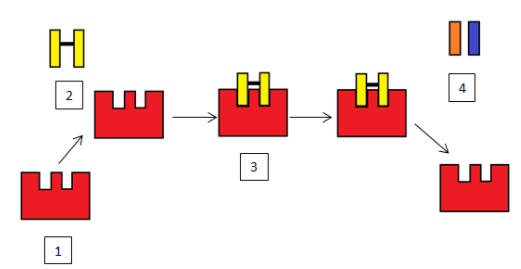
The diagram below shows one theory of enzyme action. Describe and explain what is happening at each stage. What enzyme theory does it represent?
Answer
 Verified
586.8k+ views
Hint: Enzymes are chemical catalysts. Enzymes are able to influence the rate of a chemical reaction. Enzymes act on a substrate and convert them into specific products. They themselves are not altered by the chemical reaction. Most enzymes are composed of proteins but certain nucleic acids i.e. ribozymes also have the ability to catalyze certain reactions.
Complete answer:
Two theories were proposed to explain how enzymes act on a substrate.
The lock and key model was given by Emile Fisher. This theory states that enzymes act like a lock and the substrate like a key. This key (substrate) is an exact fit for the lock (enzyme). The substrate binds to the enzyme at the active site.
A bond formation occurs between the enzyme and the substrate at the active site. This leads to the formation of an enzyme-substrate complex. This complex is a temporary complex. The enzyme-substrate complex dissociates to form the product.
The above diagram describes the lock and key mechanism. In the first stage, we see the free enzyme. The second stage shows the substrate moving towards the enzyme. In the third stage, a temporary enzyme-substrate complex is formed. The substrate exactly fits into the active site of the enzyme and forms a bond with the enzyme.
At stage four, the temporary enzyme-substrate complex dissociates to give two different products. We can see that initially, the substrate was a dimer. The enzyme acted on the substrate and broke it down into two different products.
Note: The second theory, the induced fit theory is more acceptable. This theory was given by Koshland. However, the active site of the enzyme is not an exact fit for the enzyme. As soon as the substrate binds to the enzyme it induces the enzyme to take the shape of the substrate.
Complete answer:
Two theories were proposed to explain how enzymes act on a substrate.
The lock and key model was given by Emile Fisher. This theory states that enzymes act like a lock and the substrate like a key. This key (substrate) is an exact fit for the lock (enzyme). The substrate binds to the enzyme at the active site.
A bond formation occurs between the enzyme and the substrate at the active site. This leads to the formation of an enzyme-substrate complex. This complex is a temporary complex. The enzyme-substrate complex dissociates to form the product.
The above diagram describes the lock and key mechanism. In the first stage, we see the free enzyme. The second stage shows the substrate moving towards the enzyme. In the third stage, a temporary enzyme-substrate complex is formed. The substrate exactly fits into the active site of the enzyme and forms a bond with the enzyme.
At stage four, the temporary enzyme-substrate complex dissociates to give two different products. We can see that initially, the substrate was a dimer. The enzyme acted on the substrate and broke it down into two different products.
Note: The second theory, the induced fit theory is more acceptable. This theory was given by Koshland. However, the active site of the enzyme is not an exact fit for the enzyme. As soon as the substrate binds to the enzyme it induces the enzyme to take the shape of the substrate.
Recently Updated Pages
Master Class 11 Social Science: Engaging Questions & Answers for Success

Master Class 11 English: Engaging Questions & Answers for Success
Master Class 11 Maths: Engaging Questions & Answers for Success
Master Class 11 Chemistry: Engaging Questions & Answers for Success
Master Class 11 Biology: Engaging Questions & Answers for Success
Master Class 11 Physics: Engaging Questions & Answers for Success
Trending doubts
Differentiate between an exothermic and an endothermic class 11 chemistry CBSE
One Metric ton is equal to kg A 10000 B 1000 C 100 class 11 physics CBSE
Difference Between Prokaryotic Cells and Eukaryotic Cells
There are 720 permutations of the digits 1 2 3 4 5 class 11 maths CBSE
Draw a diagram of a plant cell and label at least eight class 11 biology CBSE
1 Quintal is equal to a 110 kg b 10 kg c 100kg d 1000 class 11 physics CBSE