




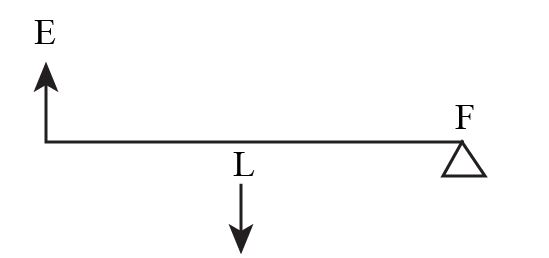
The diagram below shows a lever in use. Without changing the dimensions of the lever, if the load is shifted towards the fulcrum what happens to the mechanical advantage of the lever?
Answer
 Verified
609k+ views
Hint: We all know that leverage is helpful in various mechanical engineering fields just to reduce the effort required from either side which can be implemented by increasing the distance from the fulcrum or pivot.
Complete Step-by-step Solution
We are all familiar with the concept that Mechanical advantage is the force multiplication technique. It is the relation which tells us what is the value of the input force that is applied by the machine and what value of the effort we get as an output from the machine.
Refer to the figure given below:
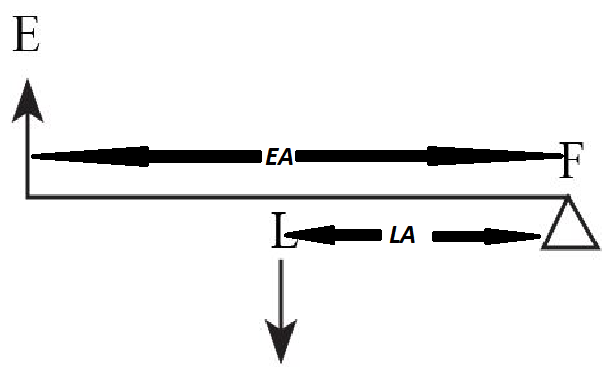
The diagram shows that the load $L$ is between the effort $E$ and fulcrum $F$. Taking the moment of forces through the fulcrum $F$. Hence it comes out to be,
$E \times EA = L \times L$
$\dfrac{{EA}}{{LA}} = \dfrac{L}{E}$
Here $LA$ is the load arm and $EA$ is the effort arm.
We know that Mechanical advantage is given by,
$MA = \dfrac{{EA}}{{LA}}$
Here $MA$ is the mechanical advantage.
Therefore, if the load $L$ is moved towards, the fulcrum so the load arm decreases, and hence the Mechanical Advantage increases.
Therefore, the mechanical advantage increases.
Note:
Mechanical advantage is the calculation of the amplification of the force that is achieved by a mechanical tool or device. Mechanical advantage should not be confused with efficiency as a mechanical advantage could be greater than one but efficiency can’t be greater than one. Efficiency is the ratio of output energy obtained to the input energy supplied but Mechanical advantage is the ratio of output effort i.e. force to the input effort.
Complete Step-by-step Solution
We are all familiar with the concept that Mechanical advantage is the force multiplication technique. It is the relation which tells us what is the value of the input force that is applied by the machine and what value of the effort we get as an output from the machine.
Refer to the figure given below:
The diagram shows that the load $L$ is between the effort $E$ and fulcrum $F$. Taking the moment of forces through the fulcrum $F$. Hence it comes out to be,
$E \times EA = L \times L$
$\dfrac{{EA}}{{LA}} = \dfrac{L}{E}$
Here $LA$ is the load arm and $EA$ is the effort arm.
We know that Mechanical advantage is given by,
$MA = \dfrac{{EA}}{{LA}}$
Here $MA$ is the mechanical advantage.
Therefore, if the load $L$ is moved towards, the fulcrum so the load arm decreases, and hence the Mechanical Advantage increases.
Therefore, the mechanical advantage increases.
Note:
Mechanical advantage is the calculation of the amplification of the force that is achieved by a mechanical tool or device. Mechanical advantage should not be confused with efficiency as a mechanical advantage could be greater than one but efficiency can’t be greater than one. Efficiency is the ratio of output energy obtained to the input energy supplied but Mechanical advantage is the ratio of output effort i.e. force to the input effort.
Recently Updated Pages
Master Class 11 English: Engaging Questions & Answers for Success

Master Class 11 Maths: Engaging Questions & Answers for Success
Class 11 Question and Answer - Your Ultimate Solutions Guide
Master Class 11 Biology: Engaging Questions & Answers for Success
Master Class 11 Physics: Engaging Questions & Answers for Success
Master Class 11 Accountancy: Engaging Questions & Answers for Success
Trending doubts
Differentiate between an exothermic and an endothermic class 11 chemistry CBSE
One Metric ton is equal to kg A 10000 B 1000 C 100 class 11 physics CBSE
There are 720 permutations of the digits 1 2 3 4 5 class 11 maths CBSE
In what year Guru Nanak Dev ji was born A15 April 1469 class 11 social science CBSE
Difference Between Prokaryotic Cells and Eukaryotic Cells
Draw a diagram of a plant cell and label at least eight class 11 biology CBSE