



The device used to provide electricity in the instruments of artificial satellites is ___________.
Answer
 Verified
665.4k+ views
Hint: When an artificial satellite is high up in space at distances of approximately 36000 km above the earth’s surface, usage of electric sources that are replaceable such as primary batteries is not practical since there is no means to recharge them. Moreover, they account for a huge payload. Hence, there is a need to use an electric source in the artificial satellites which is self-sustaining.
Complete step by step solution:
The sun is the best source of energy that can be tapped to run the systems on artificial satellites in space. This can be done by implementing a semiconductor device called Solar Cell or PV Cell.
This is a rough diagram of the solar cell, also called Photovoltaic cells.
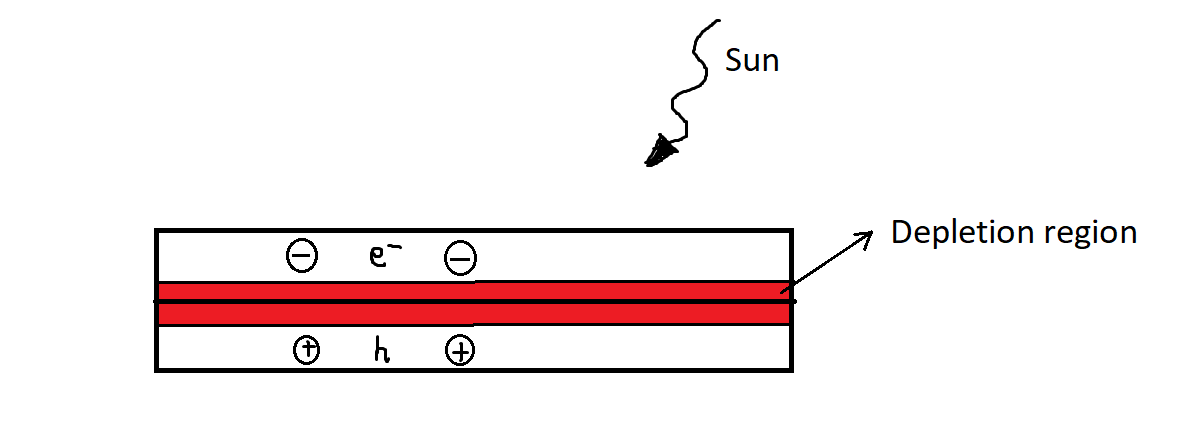
The photovoltaic cell consists of a layer of 2 semiconductors stacked upon one another as shown. The top face of the semiconductor is exposed to solar radiation.
When solar radiation is incident on the top face of the PV cell, the photons excite the electrons in the PV cell and cause it to move to the higher energy state. When it moves to the higher energy state, the electrons concentration increases in one layer and thus, the semiconductors turn into N-type semiconductor and the other layer in the bottom turns into P-type semiconductor due to lack of electrons and excess of holes.
When, n-type and p-type semiconductors are, hence formed, there occurs a depletion region at the junction of the two layers. This depletion layer contains both positive and negative layers and provides the electric potential and acts as an electric cell. This is how solar energy is converted into electrical energy.
Note:
The most common material for commercial solar cell construction is Silicon, but others include Gallium Arsenide, Cadmium Telluride, and Copper Indium Gallium Selenide.
Complete step by step solution:
The sun is the best source of energy that can be tapped to run the systems on artificial satellites in space. This can be done by implementing a semiconductor device called Solar Cell or PV Cell.
This is a rough diagram of the solar cell, also called Photovoltaic cells.
The photovoltaic cell consists of a layer of 2 semiconductors stacked upon one another as shown. The top face of the semiconductor is exposed to solar radiation.
When solar radiation is incident on the top face of the PV cell, the photons excite the electrons in the PV cell and cause it to move to the higher energy state. When it moves to the higher energy state, the electrons concentration increases in one layer and thus, the semiconductors turn into N-type semiconductor and the other layer in the bottom turns into P-type semiconductor due to lack of electrons and excess of holes.
When, n-type and p-type semiconductors are, hence formed, there occurs a depletion region at the junction of the two layers. This depletion layer contains both positive and negative layers and provides the electric potential and acts as an electric cell. This is how solar energy is converted into electrical energy.
Note:
The most common material for commercial solar cell construction is Silicon, but others include Gallium Arsenide, Cadmium Telluride, and Copper Indium Gallium Selenide.
Recently Updated Pages
Master Class 8 English: Engaging Questions & Answers for Success

Master Class 8 Science: Engaging Questions & Answers for Success
Master Class 8 Maths: Engaging Questions & Answers for Success
Master Class 7 English: Engaging Questions & Answers for Success
Master Class 7 Maths: Engaging Questions & Answers for Success
Class 7 Question and Answer - Your Ultimate Solutions Guide
Trending doubts
What is BLO What is the full form of BLO class 8 social science CBSE
Name the states through which the Tropic of Cancer class 8 social science CBSE
Which Indian state shares the longest international class 8 social science CBSE
Citizens of India can vote at the age of A 18 years class 8 social science CBSE
Full form of STD, ISD and PCO
What are the methods of reducing friction. Explain