




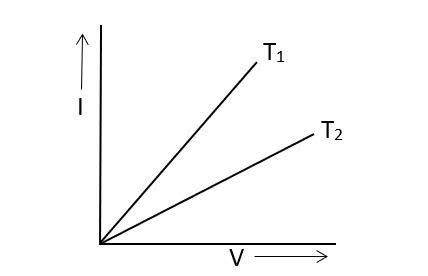
The current I and voltage V graphs for a given metallic wire of two different temperatures $T_1$ and $T_2$ which has been shown in the following figure. It is concluded that:
Answer
 Verified
635.7k+ views
Hint: The inverse of the slope of the given graph gives us the resistance of a material at that point. We can thus understand the dependence of temperature on molecular level. As the two temperatures are different, their resistances will also be different.
Complete step by step answer:
In the given graph, the x-axis represents the voltage (V) and the y-axis represents the current (I). The graph has been plotted for a metallic wire at two different temperatures. If we take the inverse of the slope of the graph at any point, we will get the resistance of the wire.
According to Ohm’s law, we have $V=IR$, where V is the voltage, I is the current and R is the resistance. Upon rearranging the equation, we get $R=\dfrac{V}{I}\implies \dfrac{1}{R}=\dfrac{I}{V}$, which is the slope of the graph given.
From the graph, we can see that the slope of the graph at temperature $T_1$ is greater than that at temperature $T_2$. Now, we know that the resistivity of a metal increases, with increase in temperature and hence it’s resistance also increases. Since the material of the wire is the same, the resistance will be less at temperature $T_1$ than at $T_2$.
Hence, we can say that $T_2 > T_1$.
Note:
The movement or say bouncing of electrons and their frequency of collisions increases with the increase of temperature. The resistivity increases with temperature rise in case of metals. While in the case of insulators, the resistivity decreases with increase in temperature.
Complete step by step answer:
In the given graph, the x-axis represents the voltage (V) and the y-axis represents the current (I). The graph has been plotted for a metallic wire at two different temperatures. If we take the inverse of the slope of the graph at any point, we will get the resistance of the wire.
According to Ohm’s law, we have $V=IR$, where V is the voltage, I is the current and R is the resistance. Upon rearranging the equation, we get $R=\dfrac{V}{I}\implies \dfrac{1}{R}=\dfrac{I}{V}$, which is the slope of the graph given.
From the graph, we can see that the slope of the graph at temperature $T_1$ is greater than that at temperature $T_2$. Now, we know that the resistivity of a metal increases, with increase in temperature and hence it’s resistance also increases. Since the material of the wire is the same, the resistance will be less at temperature $T_1$ than at $T_2$.
Hence, we can say that $T_2 > T_1$.
Note:
The movement or say bouncing of electrons and their frequency of collisions increases with the increase of temperature. The resistivity increases with temperature rise in case of metals. While in the case of insulators, the resistivity decreases with increase in temperature.
Recently Updated Pages
Master Class 12 Business Studies: Engaging Questions & Answers for Success

Master Class 12 Chemistry: Engaging Questions & Answers for Success
Master Class 12 Biology: Engaging Questions & Answers for Success
Class 12 Question and Answer - Your Ultimate Solutions Guide
Master Class 11 English: Engaging Questions & Answers for Success
Master Class 11 Social Science: Engaging Questions & Answers for Success
Trending doubts
Which are the Top 10 Largest Countries of the World?
Draw a labelled sketch of the human eye class 12 physics CBSE
Differentiate between homogeneous and heterogeneous class 12 chemistry CBSE
Differentiate between Pyramid of energy and pyramid class 12 biology CBSE
Why is the cell called the structural and functional class 12 biology CBSE
Draw the diagram of the pyramid of energy Explain In class 12 biology CBSE