




The correct statement about the following disaccharide is :
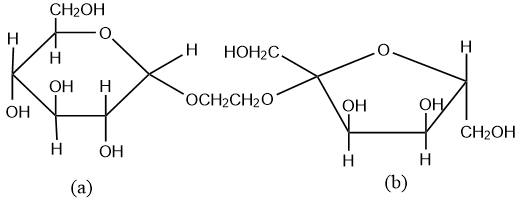
(A) Ring (a) is pyranose with $\alpha $- glycosidic link
(B) Ring (a) is furanose with $\alpha $- glycosidic link
(C) Ring (b) is furanose with $\alpha $- glycosidic link
(D) Ring (b) is pyranose with $\beta $- glycosidic link
Answer
 Verified
609.3k+ views
Hint: A disaccharide is the sugar formed when two monosaccharides are joined by glycosidic linkage. Like monosaccharides, disaccharides are soluble in water. A glycosidic linkage or bond is a type of covalent bond that joins a carbohydrate molecule to another group, which may or may not be another carbohydrate.
Complete step by step answer:
1,4 glycosidic bonds are formed due to condensation reactions between a hydroxyl oxygen atom on carbon-4 on one sugar and the $\alpha $-anomeric form of C-1 on the other.There are two types of glycosidic bond- 1,4 $\alpha $ glycosidic bonds and 1,4 beta glycosidic bonds.
1,4 $\alpha $ glycosidic bonds are formed when the OH on the carbon-1 is below the glucose ring ; while 1,4 beta glycosidic bonds are formed when the OH is above the plane.
The ring (i) is pyranose with $\alpha $ glycosidic linkage. The six membered cyclic structure of glucose is called pyranose structure, in analogy with pyran which is a cyclic organic compound with one oxygen and five carbon atoms in the ring. The ring (i) is pyranose with $\alpha $ glycosidic linkage which means the oxide linkage which connects the monosaccharide units in polysaccharide below the plane.
So, the correct answer is “Option A”.
Note: A glycosidic linkage is formed between the hemiacetal or hemiketal group of a saccharide and the hydroxyl group of some compound such as an alcohol. The five membered cyclic structure of carbohydrates is called pyranose structure.
Complete step by step answer:
1,4 glycosidic bonds are formed due to condensation reactions between a hydroxyl oxygen atom on carbon-4 on one sugar and the $\alpha $-anomeric form of C-1 on the other.There are two types of glycosidic bond- 1,4 $\alpha $ glycosidic bonds and 1,4 beta glycosidic bonds.
1,4 $\alpha $ glycosidic bonds are formed when the OH on the carbon-1 is below the glucose ring ; while 1,4 beta glycosidic bonds are formed when the OH is above the plane.
The ring (i) is pyranose with $\alpha $ glycosidic linkage. The six membered cyclic structure of glucose is called pyranose structure, in analogy with pyran which is a cyclic organic compound with one oxygen and five carbon atoms in the ring. The ring (i) is pyranose with $\alpha $ glycosidic linkage which means the oxide linkage which connects the monosaccharide units in polysaccharide below the plane.
So, the correct answer is “Option A”.
Note: A glycosidic linkage is formed between the hemiacetal or hemiketal group of a saccharide and the hydroxyl group of some compound such as an alcohol. The five membered cyclic structure of carbohydrates is called pyranose structure.
Recently Updated Pages
Master Class 12 Business Studies: Engaging Questions & Answers for Success

Master Class 12 Chemistry: Engaging Questions & Answers for Success
Master Class 12 Biology: Engaging Questions & Answers for Success
Class 12 Question and Answer - Your Ultimate Solutions Guide
Master Class 11 English: Engaging Questions & Answers for Success
Master Class 11 Social Science: Engaging Questions & Answers for Success
Trending doubts
Which are the Top 10 Largest Countries of the World?
Draw a labelled sketch of the human eye class 12 physics CBSE
Differentiate between homogeneous and heterogeneous class 12 chemistry CBSE
Differentiate between Pyramid of energy and pyramid class 12 biology CBSE
Why is the cell called the structural and functional class 12 biology CBSE
Draw the diagram of the pyramid of energy Explain In class 12 biology CBSE