




The coordinates of the point that is two thirds away from (-4, 3) to (5, 7) is
A. $\left( \dfrac{17}{2},3 \right)$
B. $\left( 2,\dfrac{17}{3} \right)$
C. $\left( 2,\dfrac{3}{17} \right)$
D. $\left( 3,\dfrac{2}{17} \right)$
Answer
 Verified
596.7k+ views
Hint: In order to solve this question, we should know the section formula, that is , if a point, $\left( x,y \right)$ divides a line joining $\left( {{x}_{1}},{{y}_{1}} \right)$ and $\left( {{x}_{2}},{{y}_{2}} \right)$ in the ratio $m:n$, then $x=\dfrac{m{{x}_{2}}+n{{x}_{1}}}{m+n}$ and $y=\dfrac{m{{y}_{2}}+n{{y}_{1}}}{m+n}$. By using this concept, we can solve this question.
Complete step by step answer:
In this question, we have been asked to find the coordinates of the point which is two-thirds away from (-4, 3) to (5, 7). Now let us consider the point which is two thirds away from (-4, 3) to (5, 7) to be $\left( x,y \right)$. So, we can say that $\left( x,y \right)$ is two third away from (-4, 3) to (5, 7). Now if we consider the length of the points (-4, 3) to (5, 7) to be L, then length from (-4, 3) to $\left( x,y \right)$ will become $\dfrac{2}{3}L$, because $\left( x,y \right)$ is two thirds away from (-4, 3) to (5, 7). So, the length of $\left( x,y \right)$ to (5, 7) will become $L-\dfrac{2L}{3}=\dfrac{L}{3}$. Therefore we can say $\left( x,y \right)$ is intersecting (-4, 3) and (5, 7) in the ratio of $\left( \dfrac{2}{3}:\dfrac{1}{3} \right)$ which is the same as (2 : 1). Hence, to find the value of $\left( x,y \right)$, we will apply section formula, which states that if a point, $\left( x,y \right)$ divides a line joining $\left( {{x}_{1}},{{y}_{1}} \right)$ and $\left( {{x}_{2}},{{y}_{2}} \right)$ in the ratio $m:n$, then $x=\dfrac{m{{x}_{2}}+n{{x}_{1}}}{m+n}$ and $y=\dfrac{m{{y}_{2}}+n{{y}_{1}}}{m+n}$.
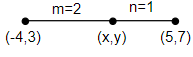
So, for the values of m = 2 and n = 1 and $\left( {{x}_{1}},{{y}_{1}} \right)$ as (-4, 3) and $\left( {{x}_{2}},{{y}_{2}} \right)$ as (5, 7), we can write the values of x, y as,
$x=\dfrac{2\times 5+1\times \left( -4 \right)}{2+1}$ and $y=\dfrac{2\times 7+1\times 3}{2+1}$
Now, we will simplify it further to get the value of x and y. So, we get,
$\begin{align}
& x=\dfrac{10-4}{3}\text{ }and\text{ }y=\dfrac{14+3}{3} \\
& \Rightarrow x=\dfrac{6}{3}\text{ }and\text{ }y=\dfrac{17}{3} \\
& \Rightarrow x=2\text{ }and\text{ }y=\dfrac{17}{3} \\
\end{align}$
Hence, we get the coordinates of the point, that is two third away from (-4, 3) to (5, 7) is $\left( x,y \right)$ as $\left( 2,\dfrac{3}{17} \right)$. Therefore, option B is the correct answer.
Note: While solving this question, the possible mistakes we can make is to consider $\dfrac{2}{3}$ as 2 : 3 = m : n, which would be totally incorrect. Here, the word two thirds represents that if the length of the segment is three, then $\left( x,y \right)$ is 2 units away from (-4, 3) in the direction of (5, 7).
Complete step by step answer:
In this question, we have been asked to find the coordinates of the point which is two-thirds away from (-4, 3) to (5, 7). Now let us consider the point which is two thirds away from (-4, 3) to (5, 7) to be $\left( x,y \right)$. So, we can say that $\left( x,y \right)$ is two third away from (-4, 3) to (5, 7). Now if we consider the length of the points (-4, 3) to (5, 7) to be L, then length from (-4, 3) to $\left( x,y \right)$ will become $\dfrac{2}{3}L$, because $\left( x,y \right)$ is two thirds away from (-4, 3) to (5, 7). So, the length of $\left( x,y \right)$ to (5, 7) will become $L-\dfrac{2L}{3}=\dfrac{L}{3}$. Therefore we can say $\left( x,y \right)$ is intersecting (-4, 3) and (5, 7) in the ratio of $\left( \dfrac{2}{3}:\dfrac{1}{3} \right)$ which is the same as (2 : 1). Hence, to find the value of $\left( x,y \right)$, we will apply section formula, which states that if a point, $\left( x,y \right)$ divides a line joining $\left( {{x}_{1}},{{y}_{1}} \right)$ and $\left( {{x}_{2}},{{y}_{2}} \right)$ in the ratio $m:n$, then $x=\dfrac{m{{x}_{2}}+n{{x}_{1}}}{m+n}$ and $y=\dfrac{m{{y}_{2}}+n{{y}_{1}}}{m+n}$.
So, for the values of m = 2 and n = 1 and $\left( {{x}_{1}},{{y}_{1}} \right)$ as (-4, 3) and $\left( {{x}_{2}},{{y}_{2}} \right)$ as (5, 7), we can write the values of x, y as,
$x=\dfrac{2\times 5+1\times \left( -4 \right)}{2+1}$ and $y=\dfrac{2\times 7+1\times 3}{2+1}$
Now, we will simplify it further to get the value of x and y. So, we get,
$\begin{align}
& x=\dfrac{10-4}{3}\text{ }and\text{ }y=\dfrac{14+3}{3} \\
& \Rightarrow x=\dfrac{6}{3}\text{ }and\text{ }y=\dfrac{17}{3} \\
& \Rightarrow x=2\text{ }and\text{ }y=\dfrac{17}{3} \\
\end{align}$
Hence, we get the coordinates of the point, that is two third away from (-4, 3) to (5, 7) is $\left( x,y \right)$ as $\left( 2,\dfrac{3}{17} \right)$. Therefore, option B is the correct answer.
Note: While solving this question, the possible mistakes we can make is to consider $\dfrac{2}{3}$ as 2 : 3 = m : n, which would be totally incorrect. Here, the word two thirds represents that if the length of the segment is three, then $\left( x,y \right)$ is 2 units away from (-4, 3) in the direction of (5, 7).
Recently Updated Pages
Master Class 12 Economics: Engaging Questions & Answers for Success

Master Class 12 Physics: Engaging Questions & Answers for Success
Master Class 12 English: Engaging Questions & Answers for Success
Master Class 12 Social Science: Engaging Questions & Answers for Success
Master Class 12 Maths: Engaging Questions & Answers for Success
Master Class 12 Business Studies: Engaging Questions & Answers for Success
Trending doubts
Which are the Top 10 Largest Countries of the World?
What are the major means of transport Explain each class 12 social science CBSE
Draw a labelled sketch of the human eye class 12 physics CBSE
Why cannot DNA pass through cell membranes class 12 biology CBSE
Differentiate between insitu conservation and exsitu class 12 biology CBSE
Draw a neat and well labeled diagram of TS of ovary class 12 biology CBSE