




The convex side of a thin plano-convex lens with radius of curvature $ 60cm $ is silvered to obtain a concave mirror. An object is located at a distance of $ 30cm $ in front of this mirror. The distance of the image from the mirror is ( $ \mu = 1.5 $ ):
(A) $ 12cm $
(B) $ - 60cm $
(C) $ 60cm $
(D) $ 20cm $
Answer
 Verified
556.8k+ views
Hint :Find the focal length of the plano-convex lens and then calculate the equivalent focal length of the mirror-lens system to get the image distance from the mirror. To find the focal length of the plano-convex lens, use the lens maker’s formula. It is given by, $ \dfrac{1}{f} = (\mu - 1)(\dfrac{1}{{{r_1}}} - \dfrac{1}{{{r_2}}}) $ where, $ f $ is focal length of the lens, $ \mu $ is the refractive index of the lens, $ {r_1} $ is the radius of curvature of the first surface of the lens and $ {r_2} $ is the radius of curvature of the second surface of the lens .The equivalent focal length of a system with $ N $ optical devices is, $ \dfrac{1}{F} = \dfrac{1}{{{f_1}}} + \dfrac{1}{{{f_2}}} + \dfrac{1}{{{f_3}}} + .... + \dfrac{1}{{{f_N}}} $ .
Complete Step By Step Answer:
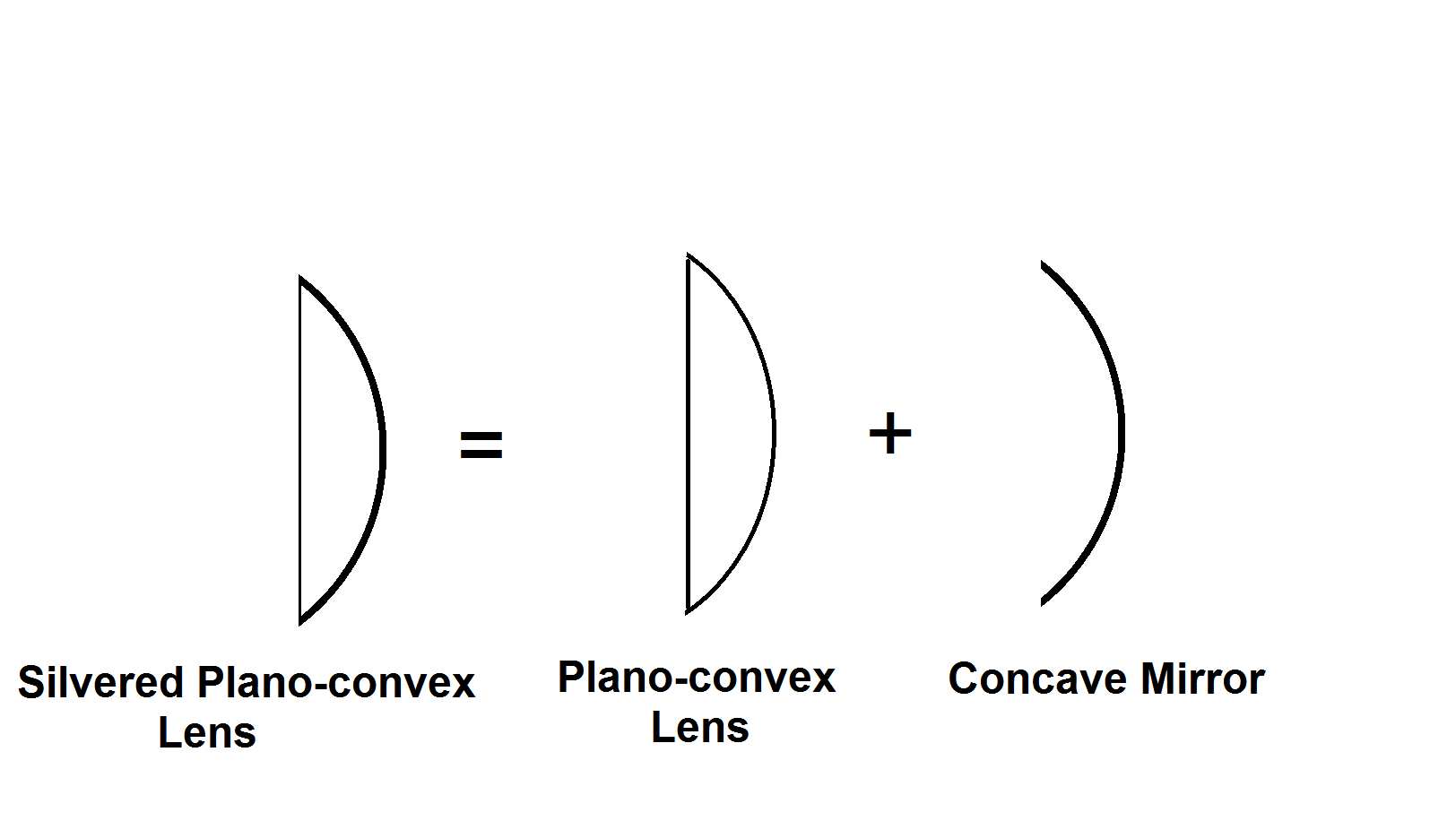
We have here a thin silvered plano-convex lens. So, we can see that the lens becomes a combination of a plano-convex lens and a concave mirror.
Now, to find the image distance first we have to find the focal length of the plano- convex lens using lens maker’s formula. Lens Maker’s formula is given by, $ \dfrac{1}{f} = (\mu - 1)(\dfrac{1}{{{r_1}}} - \dfrac{1}{{{r_2}}}) $ where, $ f $ is focal length of the lens, $ \mu $ is the refractive index of the lens, $ {r_1} $ is the radius of curvature of the first surface of the lens and $ {r_2} $ is the radius of curvature of the second surface of the lens.
Here, we have $ \mu = 1.5 $ , $ {r_1} = \infty $ and $ {r_2} = - 60cm $ .
Putting the values we get,
$ \dfrac{1}{{{f_l}}} = (1.5 - 1)(\dfrac{1}{\infty } - \dfrac{1}{{ - 60}}) $
Simplifying we have,
$ {f_l} = \dfrac{{60}}{{0.5}} = 120 $
Now, the light passes through this plano- convex lens of focal length $ {f_l} = 120cm $ and reflects back from the silvered surface then again passes through the lens to form an image.
So, the equivalent focal length of this mirror- lens system will be,
$ \dfrac{1}{F} = \dfrac{1}{{{f_l}}} + \dfrac{1}{{{f_l}}} + \dfrac{1}{{{f_m}}} $ where, $ {f_m} $ is the focal length of the silvered surface (mirror).
Putting the values, $ {f_l} = - 120cm $ and $ {f_m} = - 30cm $ we get ,
$ \dfrac{1}{F} = \dfrac{1}{{ - 120}} + \dfrac{1}{{ - 120}} + \dfrac{1}{{ - 30}} $
Or, $ \dfrac{1}{F} = - \dfrac{1}{{60}} - \dfrac{1}{{30}} $
Or, $ \dfrac{1}{F} = - \dfrac{3}{{60}} $
So, $ F = - 20 $
So, the lens and mirror will act as an concave mirror having focal length of $ 20cm $
Now, from mirror’s formula we know, $ \dfrac{1}{v} + \dfrac{1}{u} = \dfrac{1}{f} $ where, $ v $ is the image distance, $ u $ is the object distance and $ f $ is the focal length of the mirror.
So, putting the values $ u = - 30cm $ and $ u = - 30cm $ , we get,
$ \dfrac{1}{v} + \dfrac{1}{{ - 30}} = \dfrac{1}{{ - 20}} $
Or, $ \dfrac{1}{v} = \dfrac{1}{{30}} - \dfrac{1}{{20}} = \dfrac{{ - 1}}{{60}} $
Or, $ v = - 60 $
So, the image of the object will be at a distance of $ 60cm $ from mirror in the left side.( $ v = - 60cm $ )
Hence, option (B) is correct.
Note :
$ \bullet $ The positive sign convention of mirror or lens is as follows: distance to the left of the mirror/lens is always negative and distance to the right of the mirror/lens is always positive.
$ \bullet $ Similar result will be obtained if only the silvered mirror is placed in water just under the surface or the curved surface of the mirror is filled with water. Then the water will act as a plano-convex lens.
Complete Step By Step Answer:
We have here a thin silvered plano-convex lens. So, we can see that the lens becomes a combination of a plano-convex lens and a concave mirror.
Now, to find the image distance first we have to find the focal length of the plano- convex lens using lens maker’s formula. Lens Maker’s formula is given by, $ \dfrac{1}{f} = (\mu - 1)(\dfrac{1}{{{r_1}}} - \dfrac{1}{{{r_2}}}) $ where, $ f $ is focal length of the lens, $ \mu $ is the refractive index of the lens, $ {r_1} $ is the radius of curvature of the first surface of the lens and $ {r_2} $ is the radius of curvature of the second surface of the lens.
Here, we have $ \mu = 1.5 $ , $ {r_1} = \infty $ and $ {r_2} = - 60cm $ .
Putting the values we get,
$ \dfrac{1}{{{f_l}}} = (1.5 - 1)(\dfrac{1}{\infty } - \dfrac{1}{{ - 60}}) $
Simplifying we have,
$ {f_l} = \dfrac{{60}}{{0.5}} = 120 $
Now, the light passes through this plano- convex lens of focal length $ {f_l} = 120cm $ and reflects back from the silvered surface then again passes through the lens to form an image.
So, the equivalent focal length of this mirror- lens system will be,
$ \dfrac{1}{F} = \dfrac{1}{{{f_l}}} + \dfrac{1}{{{f_l}}} + \dfrac{1}{{{f_m}}} $ where, $ {f_m} $ is the focal length of the silvered surface (mirror).
Putting the values, $ {f_l} = - 120cm $ and $ {f_m} = - 30cm $ we get ,
$ \dfrac{1}{F} = \dfrac{1}{{ - 120}} + \dfrac{1}{{ - 120}} + \dfrac{1}{{ - 30}} $
Or, $ \dfrac{1}{F} = - \dfrac{1}{{60}} - \dfrac{1}{{30}} $
Or, $ \dfrac{1}{F} = - \dfrac{3}{{60}} $
So, $ F = - 20 $
So, the lens and mirror will act as an concave mirror having focal length of $ 20cm $
Now, from mirror’s formula we know, $ \dfrac{1}{v} + \dfrac{1}{u} = \dfrac{1}{f} $ where, $ v $ is the image distance, $ u $ is the object distance and $ f $ is the focal length of the mirror.
So, putting the values $ u = - 30cm $ and $ u = - 30cm $ , we get,
$ \dfrac{1}{v} + \dfrac{1}{{ - 30}} = \dfrac{1}{{ - 20}} $
Or, $ \dfrac{1}{v} = \dfrac{1}{{30}} - \dfrac{1}{{20}} = \dfrac{{ - 1}}{{60}} $
Or, $ v = - 60 $
So, the image of the object will be at a distance of $ 60cm $ from mirror in the left side.( $ v = - 60cm $ )
Hence, option (B) is correct.
Note :
$ \bullet $ The positive sign convention of mirror or lens is as follows: distance to the left of the mirror/lens is always negative and distance to the right of the mirror/lens is always positive.
$ \bullet $ Similar result will be obtained if only the silvered mirror is placed in water just under the surface or the curved surface of the mirror is filled with water. Then the water will act as a plano-convex lens.
Recently Updated Pages
Master Class 12 Economics: Engaging Questions & Answers for Success

Master Class 12 English: Engaging Questions & Answers for Success
Master Class 12 Social Science: Engaging Questions & Answers for Success
Master Class 12 Maths: Engaging Questions & Answers for Success
Master Class 12 Physics: Engaging Questions & Answers for Success
Master Class 9 General Knowledge: Engaging Questions & Answers for Success
Trending doubts
Which are the Top 10 Largest Countries of the World?
Draw a labelled sketch of the human eye class 12 physics CBSE
Differentiate between homogeneous and heterogeneous class 12 chemistry CBSE
Sulphuric acid is known as the king of acids State class 12 chemistry CBSE
Why is the cell called the structural and functional class 12 biology CBSE
Draw ray diagrams each showing i myopic eye and ii class 12 physics CBSE