




The conventional direction of flow of current is:
A. Negative terminal to positive terminal of the cell.
B. Positive terminal to negative terminal of cell.
C. Opposite to direction of flow of electrons.
D. In the direction of flow of electrons.
Answer
 Verified
527.4k+ views
Hint: The flow of electric current is due to the flow of electrons through a conducting material. It may be some wire or a conducting slab. Whenever there is a difference in potential between any two points then there is flow of electrons which causes the flow of electric current. The conventional direction is basically from higher potential to lower potential.
Complete answer:
The electric current flows through the circuit when an electrochemical cell or some power source is connected in the circuit and there must be a difference in potential in the circuit. In electrochemical we know that the anode is a negative terminal and cathode is a positive terminal due to oxidation and reduction reactions respectively at each electrode.
Thus electrons from anode flow to cathode and thus the flow of electric current in the external process takes place from cathode to anode. Thus conventional electric current flows from the positive terminal of the cell to the negative terminal (cathode to anode). Also we can say that this electric current flows in the direction opposite to the direction of flow of electrons.
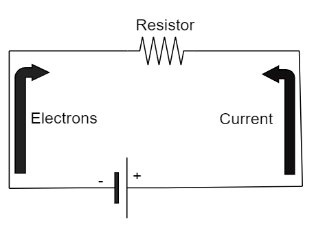
Therefore the correct options are B and C.
Note: Generally we assume that the flow of electrons gives us the direction of flow of electric current but conventionally electric current flows in opposite direction of flow of electrons. This is because of the difference in potential throughout the conducting material and it is the property of electrons to flow from high potential to low potential just like water flows from higher altitude to lower altitude.
Complete answer:
The electric current flows through the circuit when an electrochemical cell or some power source is connected in the circuit and there must be a difference in potential in the circuit. In electrochemical we know that the anode is a negative terminal and cathode is a positive terminal due to oxidation and reduction reactions respectively at each electrode.
Thus electrons from anode flow to cathode and thus the flow of electric current in the external process takes place from cathode to anode. Thus conventional electric current flows from the positive terminal of the cell to the negative terminal (cathode to anode). Also we can say that this electric current flows in the direction opposite to the direction of flow of electrons.
Therefore the correct options are B and C.
Note: Generally we assume that the flow of electrons gives us the direction of flow of electric current but conventionally electric current flows in opposite direction of flow of electrons. This is because of the difference in potential throughout the conducting material and it is the property of electrons to flow from high potential to low potential just like water flows from higher altitude to lower altitude.
Recently Updated Pages
Master Class 12 Business Studies: Engaging Questions & Answers for Success

Master Class 12 Chemistry: Engaging Questions & Answers for Success
Master Class 12 Biology: Engaging Questions & Answers for Success
Class 12 Question and Answer - Your Ultimate Solutions Guide
Master Class 9 General Knowledge: Engaging Questions & Answers for Success
Master Class 9 Maths: Engaging Questions & Answers for Success
Trending doubts
Which are the Top 10 Largest Countries of the World?
Draw a labelled sketch of the human eye class 12 physics CBSE
Differentiate between homogeneous and heterogeneous class 12 chemistry CBSE
Sulphuric acid is known as the king of acids State class 12 chemistry CBSE
Why is the cell called the structural and functional class 12 biology CBSE
A dentist uses a small mirror that gives a magnification class 12 physics CBSE