




The concept of the hotspot was first introduced by:
A. Mayer
B. Simpson
C. Myers
D. David
Answer
 Verified
611.1k+ views
Hint: He was a British ecologist.
Complete answer: Norman Myers was a British ecologist who published a seminal paper in 1988 identifying 10 tropical forest “hotspots”. They are large areas of forests that contain exceptional concentrations of plant endemism and that are experiencing very high rates of habitat loss.
1. Hotspots are home to endemic plants and animals. Endemism means that the organism is present nowhere else on earth and is limited to that specific niche.
2. Endemic animals/ plants are the most susceptible to endangerment and extinction.
These are also known as biodiversity hotspots. It currently accounts for 2.3% of the Earth's land surface. 3. Currently, there are 36 biodiversity hotspots existing in the world.
For an area to be recognized as a hotspot, it must meet the following two strict criteria.
4. It must contain at least 1,500 species of vascular plants found nowhere else on Earth (endemic species) and at least 70 percent of its primary native/ endemic vegetation.
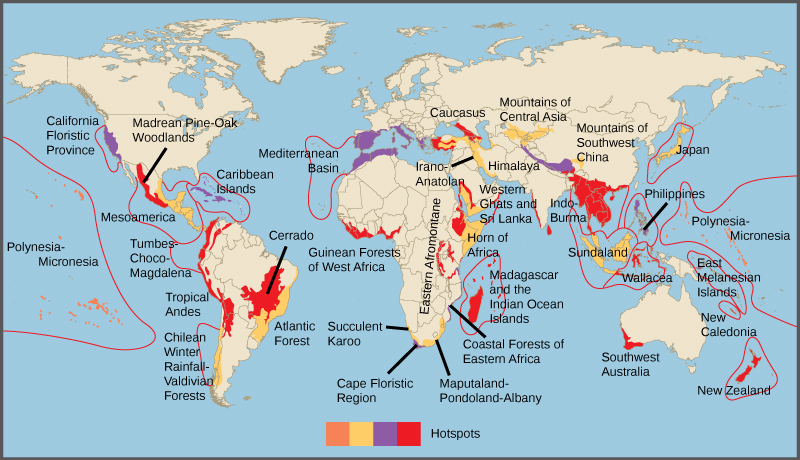
India hosts 4 biodiversity hotspots:
1. The Himalayas.
2. The Western Ghats.
3. The Indo-Burma region.
4. The Sundaland (Includes the Nicobar group of Islands).
So, the correct answer is “Option A”.
Note: 1. In the western ghats, there are more than 6000 vascular plants belonging to more than 2500 genus. 3000 plants out of these are endemic. The region is also home to around 450 species of birds, 140 mammals, 260 reptiles, and 175 amphibians.
2. The Himalayan hotspot is a region comprising Bhutan, Northeast India, and Southern, Central, and Eastern Nepal. It has some of the tallest peaks in the world. There are about 163 endangered species in this region including one-horned rhinoceros, wild Asian water buffalo, and 45 mammals, 50 birds, 12 amphibians, 17 reptiles, 3 invertebrate, and 36 plant species.
Complete answer: Norman Myers was a British ecologist who published a seminal paper in 1988 identifying 10 tropical forest “hotspots”. They are large areas of forests that contain exceptional concentrations of plant endemism and that are experiencing very high rates of habitat loss.
1. Hotspots are home to endemic plants and animals. Endemism means that the organism is present nowhere else on earth and is limited to that specific niche.
2. Endemic animals/ plants are the most susceptible to endangerment and extinction.
These are also known as biodiversity hotspots. It currently accounts for 2.3% of the Earth's land surface. 3. Currently, there are 36 biodiversity hotspots existing in the world.
For an area to be recognized as a hotspot, it must meet the following two strict criteria.
4. It must contain at least 1,500 species of vascular plants found nowhere else on Earth (endemic species) and at least 70 percent of its primary native/ endemic vegetation.
India hosts 4 biodiversity hotspots:
1. The Himalayas.
2. The Western Ghats.
3. The Indo-Burma region.
4. The Sundaland (Includes the Nicobar group of Islands).
So, the correct answer is “Option A”.
Note: 1. In the western ghats, there are more than 6000 vascular plants belonging to more than 2500 genus. 3000 plants out of these are endemic. The region is also home to around 450 species of birds, 140 mammals, 260 reptiles, and 175 amphibians.
2. The Himalayan hotspot is a region comprising Bhutan, Northeast India, and Southern, Central, and Eastern Nepal. It has some of the tallest peaks in the world. There are about 163 endangered species in this region including one-horned rhinoceros, wild Asian water buffalo, and 45 mammals, 50 birds, 12 amphibians, 17 reptiles, 3 invertebrate, and 36 plant species.
Recently Updated Pages
Master Class 12 Business Studies: Engaging Questions & Answers for Success

Master Class 12 Biology: Engaging Questions & Answers for Success
Master Class 12 Chemistry: Engaging Questions & Answers for Success
Class 12 Question and Answer - Your Ultimate Solutions Guide
Master Class 11 Social Science: Engaging Questions & Answers for Success
Master Class 11 English: Engaging Questions & Answers for Success
Trending doubts
Which is more stable and why class 12 chemistry CBSE
Which are the Top 10 Largest Countries of the World?
Draw a labelled sketch of the human eye class 12 physics CBSE
Differentiate between homogeneous and heterogeneous class 12 chemistry CBSE
What are the major means of transport Explain each class 12 social science CBSE
Sulphuric acid is known as the king of acids State class 12 chemistry CBSE