




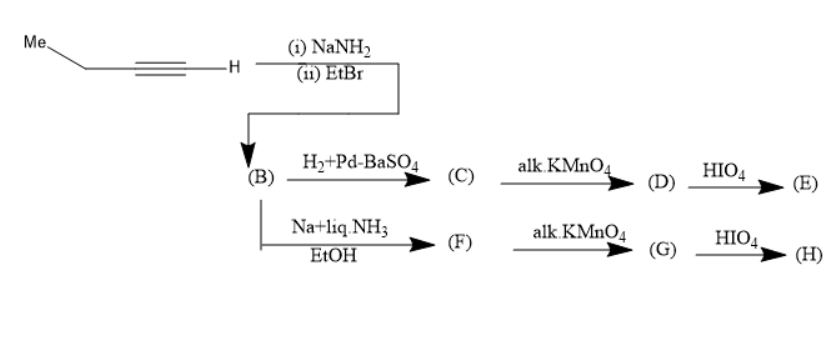
The compound (F) is
A)
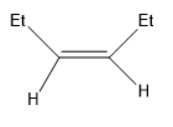
B)
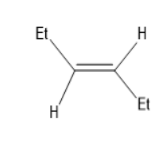
C)
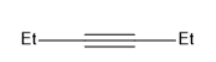
D) Both A and B
Answer
 Verified
549.6k+ views
Hint: Alkynes on treatment with sodamide and alkyl halides gives alkyl substituted alkynes.
The alkyne on reduction with hydrogen forms alkenes while treatment with sodium in liquid ammonia forms trans alkenes. Alkenes with alkaline potassium permanganate forms diols, and diols treated with periodic acid form carbonyl compounds.
Complete answer: Given compound is \[1\]- Butyne (A).
When this compound is treated with \[NaN{H_2}\] and \[EtBr\] forms ethyl substituted alkyne \[B\].
\[B\] has the molecular formula of \[\left( {{C_2}{H_5}} \right)C \equiv C\left( {{C_2}{H_5}} \right)\]
When \[B\] is treated with \[Na + liq.N{H_3}\]in \[EtOH\] forms trans alkene \[\left( F \right)\].
\[\left( F \right)\] has the molecular formula of \[\left( {Et} \right)CH = CH\left( {Et} \right)\].
In the compound \[\left( F \right)\]the two ethyl groups are attached to the double bonded carbons at opposite sides. Thus, it is a trans alkene.
The compound \[B\] on treated with hydrogen gas in presence of palladium in Barium sulphate \[\left( {{H_2},Pd + BaS{O_4}} \right)\] forms cis alkenes, further treatment with alkaline potassium permanganate \[\left( {alk.KMn{O_4}} \right)\] forms cis diols, on further treatment of cis-diols with periodic acid \[\left( {HI{O_4}} \right)\] forms two molecules of propionaldehyde.
The compound \[B\]on treated with hydrogen gas in presence of palladium in Barium sulphate \[\left( {{H_2},Pd + BaS{O_4}} \right)\] forms trans alkenes, further treatment with alkaline potassium permanganate \[\left( {alk.KMn{O_4}} \right)\] forms trans diols, on further treatment of trans-diols with periodic acid \[\left( {HI{O_4}} \right)\] forms two molecules of propionaldehyde.
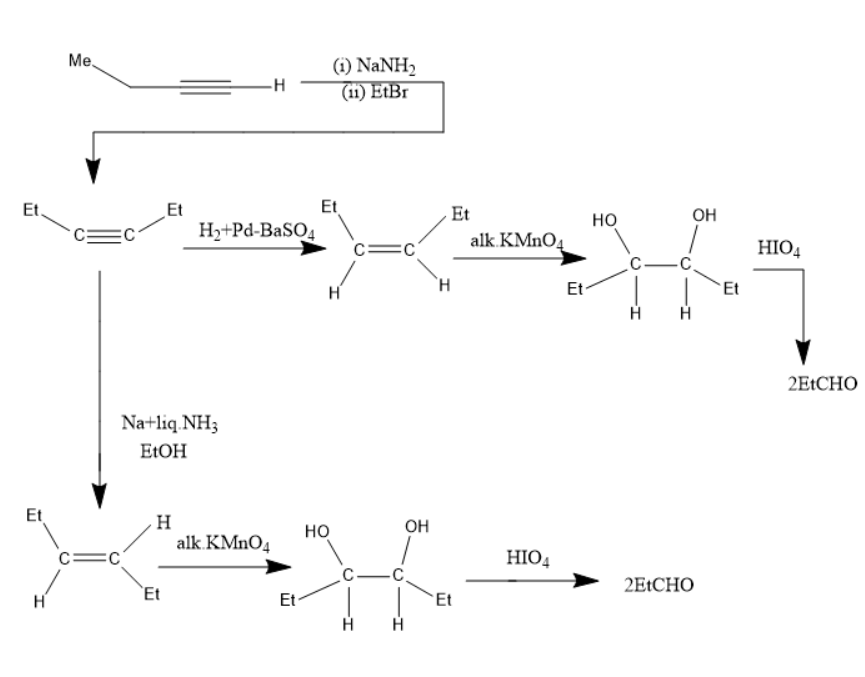
Thus, the compound \[F\] will be a trans alkene in which the two ethyl groups are oppositely attached to the double bonded carbon.
Sodium in liquid ammonia directs the alkynes to form trans alkenes.
Thus, Option (B) is the correct One.
Note:
Both sodium in liquid ammonia and hydrogen gas are used for the reduction of alkynes to alkenes.
But, the formation of products were geometrical isomers.
In both the cases, only gain of hydrogen takes place which can be termed as reduction.
The alkyne on reduction with hydrogen forms alkenes while treatment with sodium in liquid ammonia forms trans alkenes. Alkenes with alkaline potassium permanganate forms diols, and diols treated with periodic acid form carbonyl compounds.
Complete answer: Given compound is \[1\]- Butyne (A).
When this compound is treated with \[NaN{H_2}\] and \[EtBr\] forms ethyl substituted alkyne \[B\].
\[B\] has the molecular formula of \[\left( {{C_2}{H_5}} \right)C \equiv C\left( {{C_2}{H_5}} \right)\]
When \[B\] is treated with \[Na + liq.N{H_3}\]in \[EtOH\] forms trans alkene \[\left( F \right)\].
\[\left( F \right)\] has the molecular formula of \[\left( {Et} \right)CH = CH\left( {Et} \right)\].
In the compound \[\left( F \right)\]the two ethyl groups are attached to the double bonded carbons at opposite sides. Thus, it is a trans alkene.
The compound \[B\] on treated with hydrogen gas in presence of palladium in Barium sulphate \[\left( {{H_2},Pd + BaS{O_4}} \right)\] forms cis alkenes, further treatment with alkaline potassium permanganate \[\left( {alk.KMn{O_4}} \right)\] forms cis diols, on further treatment of cis-diols with periodic acid \[\left( {HI{O_4}} \right)\] forms two molecules of propionaldehyde.
The compound \[B\]on treated with hydrogen gas in presence of palladium in Barium sulphate \[\left( {{H_2},Pd + BaS{O_4}} \right)\] forms trans alkenes, further treatment with alkaline potassium permanganate \[\left( {alk.KMn{O_4}} \right)\] forms trans diols, on further treatment of trans-diols with periodic acid \[\left( {HI{O_4}} \right)\] forms two molecules of propionaldehyde.
Thus, the compound \[F\] will be a trans alkene in which the two ethyl groups are oppositely attached to the double bonded carbon.
Sodium in liquid ammonia directs the alkynes to form trans alkenes.
Thus, Option (B) is the correct One.
Note:
Both sodium in liquid ammonia and hydrogen gas are used for the reduction of alkynes to alkenes.
But, the formation of products were geometrical isomers.
In both the cases, only gain of hydrogen takes place which can be termed as reduction.
Recently Updated Pages
Basicity of sulphurous acid and sulphuric acid are

Master Class 12 Economics: Engaging Questions & Answers for Success
Master Class 12 Biology: Engaging Questions & Answers for Success
Master Class 11 English: Engaging Questions & Answers for Success
Master Class 11 Physics: Engaging Questions & Answers for Success
Master Class 11 Computer Science: Engaging Questions & Answers for Success
Trending doubts
Draw a labelled sketch of the human eye class 12 physics CBSE
The chemical formula of tear gas is A CO Cl 2 B C 10 class 12 chemistry CBSE
Draw ray diagrams each showing i myopic eye and ii class 12 physics CBSE
Which are the Top 10 Largest Countries of the World?
Differentiate between homogeneous and heterogeneous class 12 chemistry CBSE
Which is the correct genotypic ratio of mendel dihybrid class 12 biology CBSE