




The complex $ \left[ {Ni{{\left( {dmg} \right)}_2}} \right] $ , (where $ dmg $ is dimethylglyoxime):
(A) Has a square planar geometry and is paramagnetic in nature
(B) Has a square planar geometry and is diamagnetic in nature
(C) Has a tetrahedral geometry and is paramagnetic in nature
(D) Has a tetrahedral geometry and is diamagnetic in nature
Answer
 Verified
545.4k+ views
Hint: to determine the shape of the complex we have to first look at the ligand. If the given ligand is strong then it will pair the unpaired electrons of the element whereas if the given ligand is weak there will be no change in the electrons of the element.
Complete answer:
To answer this question we have to write the electronic configuration of nickel then we will write the electronic configuration of nickel $ \left( {II} \right) $ ion then we will write the electronic configuration of $ \left[ {Ni{{\left( {dmg} \right)}_2}} \right] $ which are as follows:
$ Ni = \;3{d^8}\;4{s^2} $
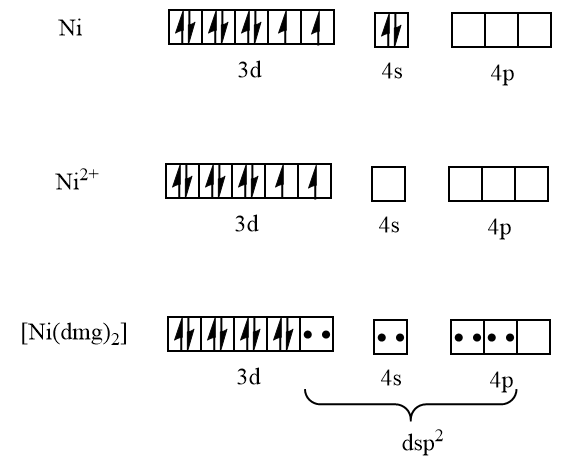
Here the coordination number is four and it has $ ds{p^2} $ hybridization. From the diagram it is clear that all electrons here are paired thus it is diamagnetic in nature. And nickel with coordination number four and $ ds{p^2} $ hybridization has the square planar geometry which is:
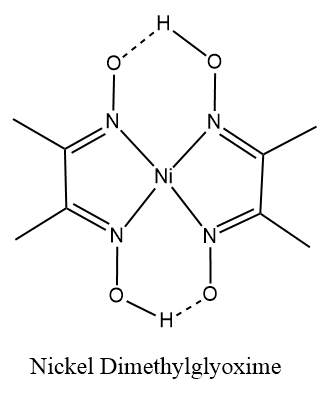
Thus, the complex $ \left[ {Ni{{\left( {dmg} \right)}_2}} \right] $ has square planar geometry and is diamagnetic in nature.
Therefore, option $ \left( b \right) $ is correct.
Note:
Here the $ dmg $ which is dimethylglyoxime, is a polydentate ligand. The polydentate ligands are those in which the numbers of donor atoms are two or more than two atoms. They form bonds to a central metal atom or ion. In other words they are the ligands which are attached with the central metal ion or atom by bonds from two or more donor atoms.
Complete answer:
To answer this question we have to write the electronic configuration of nickel then we will write the electronic configuration of nickel $ \left( {II} \right) $ ion then we will write the electronic configuration of $ \left[ {Ni{{\left( {dmg} \right)}_2}} \right] $ which are as follows:
$ Ni = \;3{d^8}\;4{s^2} $
Here the coordination number is four and it has $ ds{p^2} $ hybridization. From the diagram it is clear that all electrons here are paired thus it is diamagnetic in nature. And nickel with coordination number four and $ ds{p^2} $ hybridization has the square planar geometry which is:
Thus, the complex $ \left[ {Ni{{\left( {dmg} \right)}_2}} \right] $ has square planar geometry and is diamagnetic in nature.
Therefore, option $ \left( b \right) $ is correct.
Note:
Here the $ dmg $ which is dimethylglyoxime, is a polydentate ligand. The polydentate ligands are those in which the numbers of donor atoms are two or more than two atoms. They form bonds to a central metal atom or ion. In other words they are the ligands which are attached with the central metal ion or atom by bonds from two or more donor atoms.
Recently Updated Pages
Which of the following graphs shows the variation of class 12 physics CBSE

Draw a labelled diagram of the human male reproductive class 12 biology CBSE
Describe the experiment to compare the emf of two cells class 12 physics CBSE
What is standard hydrogen electrode
What is conventional current and electric current class 12 physics CBSE
2Bromopentane is treated with an alcoholic KOH solution class 12 chemistry CBSE
Trending doubts
Draw a labelled sketch of the human eye class 12 physics CBSE
Which are the Top 10 Largest Countries of the World?
A member of Simon commission later became Prime Minister class 12 social science CBSE
Draw ray diagrams each showing i myopic eye and ii class 12 physics CBSE
Give one example of a reptile that is viviparous class 12 biology CBSE
Which is the correct genotypic ratio of mendel dihybrid class 12 biology CBSE