




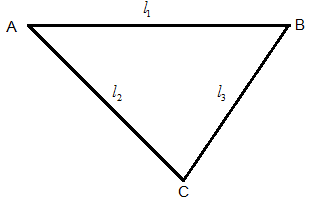
The compensated pendulum of a clock consists of an isosceles triangular frame of base length \[{l_1}\] and expansivity \[{\alpha _1}\] and slides of length \[{l_2}\] and expansivity \[{\alpha _2}\]. The pendulum is supported, as shown in Figure. Find the ratio \[\dfrac{{{l_1}}}{{{l_2}}}\] so that the length of the pendulum may remain unchanged at all temperatures.
A. \[\dfrac{{{l_1}}}{{{l_2}}} = 2\sqrt {\dfrac{{{a_2}}}{{{a_1}}}} \]
B. \[\dfrac{{{l_1}}}{{{l_2}}} = \dfrac{{{a_2}}}{{{a_1}}}\]
C. \[\dfrac{{{l_1}}}{{{l_2}}} = \dfrac{{{a_2}}}{{2{a_1}}}\]
D. \[\dfrac{{{l_1}}}{{{l_2}}} = \dfrac{{2{a_2}}}{{{a_1}}}\]
Answer
 Verified
618k+ views
Hint: Three basic thermal expansions are linear expansion, superficial expansion and cubical expansion. Here, in the question we need to determine the ratio \[\dfrac{{{l_1}}}{{{l_2}}}\] so that the length of the pendulum may remain unchanged at all temperatures. For this the amount a material expands or contracts per unit length due to a one-degree change in temperature.
Complete step by step answer:
Let C be the base of the triangle,
Now draw a perpendicular bisector on the side AB from the vertex C
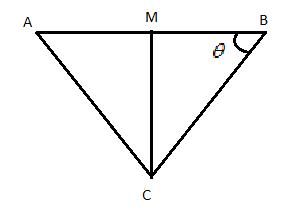
Here \[\cos \theta = \dfrac{{BM}}{{BC}} = \dfrac{{\dfrac{1}{2}BM}}{{BC}} = \dfrac{{{l_1}}}{{2{l_2}}}\]
Now when the triangle expands,
Let A’B’C be the new triangle and draw a perpendicular AN from A to A’C
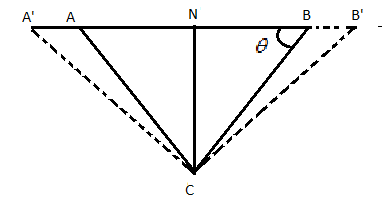
Here AA’=x increase in the length of AB\[ = \dfrac{1}{2}{l_1}{\alpha _1}t\], where t is the increase in temperature and
A’N= increase in the length of AB\[ = {l_2}{\alpha _2}t\]
Since the change in angle after the expansion is very small, hence we can write
\[\angle BAC = \angle B'A'C = \theta \]
Hence
\[\cos \theta = \dfrac{{A'N}}{{AA'}} - - (i)\]
Where \[\cos \theta = \dfrac{{{l_1}}}{{2{l_2}}}\]
Hence substituting the value in equation (i), we get
\[\dfrac{{{l_1}}}{{2{l_2}}} = \dfrac{{{l_2}{\alpha _2}t}}{{\dfrac{1}{2}{l_1}{\alpha _1}t}}\]
By solving
\[
\dfrac{{{l_1}}}{{2{l_2}}} = \dfrac{{2{l_2}{\alpha _2}}}{{{l_1}{\alpha _1}}} \\
{\left( {\dfrac{{{l_1}}}{{{l_2}}}} \right)^2} = 4\dfrac{{{\alpha _2}}}{{{\alpha _1}}} \\
\dfrac{{{l_1}}}{{{l_2}}} = \sqrt {4\dfrac{{{\alpha _2}}}{{{\alpha _1}}}} \\
= 2\sqrt {\dfrac{{{\alpha _2}}}{{{\alpha _1}}}} \\
\]
Hence the ratio \[\dfrac{{{l_1}}}{{{l_2}}}\]so that the length of the pendulum may remain unchanged at all temperatures \[ = 2\sqrt {\dfrac{{{\alpha _2}}}{{{\alpha _1}}}} \]
So, the correct answer is “Option A”.
Note:
Expansion corresponds to change in length, area and volume of the substance where linear expansivity is the increase in the length of a substance for per unit length of the substance for one degree Celsius rise in temperature.
Complete step by step answer:
Let C be the base of the triangle,
Now draw a perpendicular bisector on the side AB from the vertex C
Here \[\cos \theta = \dfrac{{BM}}{{BC}} = \dfrac{{\dfrac{1}{2}BM}}{{BC}} = \dfrac{{{l_1}}}{{2{l_2}}}\]
Now when the triangle expands,
Let A’B’C be the new triangle and draw a perpendicular AN from A to A’C
Here AA’=x increase in the length of AB\[ = \dfrac{1}{2}{l_1}{\alpha _1}t\], where t is the increase in temperature and
A’N= increase in the length of AB\[ = {l_2}{\alpha _2}t\]
Since the change in angle after the expansion is very small, hence we can write
\[\angle BAC = \angle B'A'C = \theta \]
Hence
\[\cos \theta = \dfrac{{A'N}}{{AA'}} - - (i)\]
Where \[\cos \theta = \dfrac{{{l_1}}}{{2{l_2}}}\]
Hence substituting the value in equation (i), we get
\[\dfrac{{{l_1}}}{{2{l_2}}} = \dfrac{{{l_2}{\alpha _2}t}}{{\dfrac{1}{2}{l_1}{\alpha _1}t}}\]
By solving
\[
\dfrac{{{l_1}}}{{2{l_2}}} = \dfrac{{2{l_2}{\alpha _2}}}{{{l_1}{\alpha _1}}} \\
{\left( {\dfrac{{{l_1}}}{{{l_2}}}} \right)^2} = 4\dfrac{{{\alpha _2}}}{{{\alpha _1}}} \\
\dfrac{{{l_1}}}{{{l_2}}} = \sqrt {4\dfrac{{{\alpha _2}}}{{{\alpha _1}}}} \\
= 2\sqrt {\dfrac{{{\alpha _2}}}{{{\alpha _1}}}} \\
\]
Hence the ratio \[\dfrac{{{l_1}}}{{{l_2}}}\]so that the length of the pendulum may remain unchanged at all temperatures \[ = 2\sqrt {\dfrac{{{\alpha _2}}}{{{\alpha _1}}}} \]
So, the correct answer is “Option A”.
Note:
Expansion corresponds to change in length, area and volume of the substance where linear expansivity is the increase in the length of a substance for per unit length of the substance for one degree Celsius rise in temperature.
Recently Updated Pages
Master Class 11 English: Engaging Questions & Answers for Success

Master Class 11 Social Science: Engaging Questions & Answers for Success
Master Class 11 Maths: Engaging Questions & Answers for Success
Master Class 11 Biology: Engaging Questions & Answers for Success
Master Class 11 Physics: Engaging Questions & Answers for Success
Master Class 11 Chemistry: Engaging Questions & Answers for Success
Trending doubts
One Metric ton is equal to kg A 10000 B 1000 C 100 class 11 physics CBSE
Difference Between Prokaryotic Cells and Eukaryotic Cells
Two of the body parts which do not appear in MRI are class 11 biology CBSE
Find the value of the expression given below sin 30circ class 11 maths CBSE
Draw a diagram of a plant cell and label at least eight class 11 biology CBSE
10 examples of friction in our daily life