




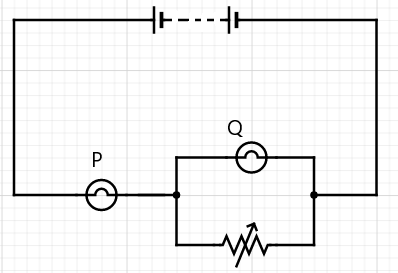
The circuit shown in the figure contains a battery, a rheostat and two identical lamps. What will happen to the brightness of the lamps if the resistance of the rheostat is increased?
(A) Lamp $ P $ Less bright, Lamp $ Q $ Brighter
(B) Lamp $ P $ Less brighter, Lamp $ Q $ Less Brighter
(C) Lamp $ P $ Brighter, Lamp $ Q $ Less Brighter
(D) Lamp $ P $ No change, Lamp $ Q $ Brighter
Answer
 Verified
528.9k+ views
Hint: In order to analyze the change in the rheostat values, we will consider the two extreme cases, first being the one where the value of the rheostat is zero and the other when the resistance of the rheostat is very large. Then see the trend of variation of resistance from zero to a large value.
When rheostat resistance is zero, $ Q $ gets short-circuited while when resistance is very large, there is no current flowing.
Complete step by step solution:
In the case (i), the value of the rheostat is zero, this makes $ Q $ short-circuited thus supplying zero current to $ Q $ , and the circuit essentially becomes a battery connected in series with the lamp $ P $ .
In the case (ii), the value of the rheostat becomes very large, almost no current flows through it, so the currents that are flowing through the lamps $ P $ and $ Q $ are almost equal. The circuit eventually becomes a battery connected in series with the lamps $ P $ and $ Q $ .
So, if the resistance is increased in steps through the rheostat from zero to a very large resistance, the lamp $ P $ becomes less and less brighter while the lamp $ Q $ becomes brighter.
Hence, option (A) is correct.
Note:
You may also consider solving this question by taking the resistance values in the increasing order and then analyzing the effect that the change in resistance has, but that is needless because it is very clear from taking the minimum and the maximum values which gives the required trend.
When rheostat resistance is zero, $ Q $ gets short-circuited while when resistance is very large, there is no current flowing.
Complete step by step solution:
In the case (i), the value of the rheostat is zero, this makes $ Q $ short-circuited thus supplying zero current to $ Q $ , and the circuit essentially becomes a battery connected in series with the lamp $ P $ .
In the case (ii), the value of the rheostat becomes very large, almost no current flows through it, so the currents that are flowing through the lamps $ P $ and $ Q $ are almost equal. The circuit eventually becomes a battery connected in series with the lamps $ P $ and $ Q $ .
So, if the resistance is increased in steps through the rheostat from zero to a very large resistance, the lamp $ P $ becomes less and less brighter while the lamp $ Q $ becomes brighter.
Hence, option (A) is correct.
Note:
You may also consider solving this question by taking the resistance values in the increasing order and then analyzing the effect that the change in resistance has, but that is needless because it is very clear from taking the minimum and the maximum values which gives the required trend.
Recently Updated Pages
Master Class 12 Economics: Engaging Questions & Answers for Success

Master Class 12 Physics: Engaging Questions & Answers for Success
Master Class 12 English: Engaging Questions & Answers for Success
Master Class 12 Social Science: Engaging Questions & Answers for Success
Master Class 12 Maths: Engaging Questions & Answers for Success
Master Class 12 Business Studies: Engaging Questions & Answers for Success
Trending doubts
Which are the Top 10 Largest Countries of the World?
What are the major means of transport Explain each class 12 social science CBSE
Draw a labelled sketch of the human eye class 12 physics CBSE
Why cannot DNA pass through cell membranes class 12 biology CBSE
Differentiate between insitu conservation and exsitu class 12 biology CBSE
Draw a neat and well labeled diagram of TS of ovary class 12 biology CBSE