




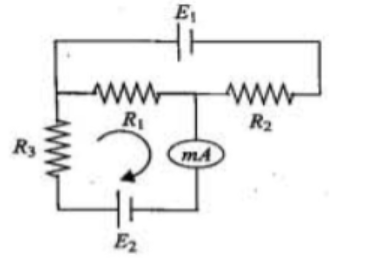
The circuit contains three resistors ${R_1} = 100\Omega ,{R_2} = 50\Omega $ and ${R_3} = 20\Omega $ and cells of emf ${E_1} = 2V$ and${E_2}$. The ammeter indicates a current of 50 mA. Determine the currents in the resistors and the emf of the second cell. The internal resistance of the ammeter and of the cells should be neglected.
Answer
 Verified
657.6k+ views
Hint: In this question we will firstly learn what a resistor is by going through its definition and the concept behind it. Then we will solve the given problem by using our knowledge and the formulas required. We will be solving our query with a good and easy technique so that we can easily approach our solution.
Step-By-Step answer:
An electrical component which is used for controlling voltage and temperature is known as a resistor. Current’s flow is reduced by the use or help of a resistor, it is its main purpose and also to lower down the voltage in any particular portion of the surface. Copper wires are used to make a resistor which is coiled around a rod made of ceramic. Resistor’s outer part is coated with the insulating paint. The unit of resistor is $\Omega $ (read as ohm). Every resistor has 2 terminals and 1 connection. Resistors have different shapes as well as different sizes.
There are two types of resistors: - Linear resistor and non-linear resistor.
Now, it is given,
\[{E_1} = 2V\]
${R_1} = 100\Omega $
${R_2} = 50\Omega $
${R_3} = 20\Omega $
According to Kirchhoff’s law in loop ABCDA:
$
- {E_1} + \left( {I + 0.5} \right){R_1} + I{R_2} = 0 \\
\therefore - 2 + \left( {I + 0.5} \right)\left( {100} \right) + I\left( {50} \right) = 0 \\
$
According to Kirchhoff loop law in BGE FB:
$
- {E_2} + \left( {0.05} \right){R_3} + \left( {I + 0.05} \right){R_1} = 0 \\
\therefore - {E_2} + \left( {0.05} \right)\left( {20} \right) + \left( { - 0.02 + 0.05} \right)\left( {100} \right) = 0 \\
\Rightarrow {E_2} = 4V \\
$
Hence, current flowing through -
${R_{1,}}{I_1} = 0.05 - 0.02 = 0.03A = 30mA$ Towards right.
NOTE: Resistors like surface mount and through-hole are available in common types. Resistors can be static, special, standard resistor or pack of variable resistor. Resistance can be calculated through the resistor’s color pattern but the value of resistor may not be displayed outside. Resistors are also used in transmitters, modulators and demodulators, amplifiers, oscillators etc.
Step-By-Step answer:
An electrical component which is used for controlling voltage and temperature is known as a resistor. Current’s flow is reduced by the use or help of a resistor, it is its main purpose and also to lower down the voltage in any particular portion of the surface. Copper wires are used to make a resistor which is coiled around a rod made of ceramic. Resistor’s outer part is coated with the insulating paint. The unit of resistor is $\Omega $ (read as ohm). Every resistor has 2 terminals and 1 connection. Resistors have different shapes as well as different sizes.
There are two types of resistors: - Linear resistor and non-linear resistor.
Now, it is given,
\[{E_1} = 2V\]
${R_1} = 100\Omega $
${R_2} = 50\Omega $
${R_3} = 20\Omega $
According to Kirchhoff’s law in loop ABCDA:
$
- {E_1} + \left( {I + 0.5} \right){R_1} + I{R_2} = 0 \\
\therefore - 2 + \left( {I + 0.5} \right)\left( {100} \right) + I\left( {50} \right) = 0 \\
$
According to Kirchhoff loop law in BGE FB:
$
- {E_2} + \left( {0.05} \right){R_3} + \left( {I + 0.05} \right){R_1} = 0 \\
\therefore - {E_2} + \left( {0.05} \right)\left( {20} \right) + \left( { - 0.02 + 0.05} \right)\left( {100} \right) = 0 \\
\Rightarrow {E_2} = 4V \\
$
Hence, current flowing through -
${R_{1,}}{I_1} = 0.05 - 0.02 = 0.03A = 30mA$ Towards right.
NOTE: Resistors like surface mount and through-hole are available in common types. Resistors can be static, special, standard resistor or pack of variable resistor. Resistance can be calculated through the resistor’s color pattern but the value of resistor may not be displayed outside. Resistors are also used in transmitters, modulators and demodulators, amplifiers, oscillators etc.
Recently Updated Pages
Explain the structure of megasporangium class 12 biology CBSE

Why is chloroform kept in dark coloured bottles class 12 chemistry CBSE
Derive the balancing condition of a Wheatstone bri class 12 physics CBSE
Draw VI characteristics of a pn junction diode Explain class 12 physics CBSE
Is it possible to carry pride in ones language too class 12 english CBSE
In a population at Hardy Weinberg equilibrium the allele class 12 biology CBSE
Trending doubts
Draw a labelled sketch of the human eye class 12 physics CBSE
Which are the Top 10 Largest Countries of the World?
Draw ray diagrams each showing i myopic eye and ii class 12 physics CBSE
Which is the correct genotypic ratio of mendel dihybrid class 12 biology CBSE
Differentiate between homogeneous and heterogeneous class 12 chemistry CBSE
Which animal never drinks water in its entire life class 12 biology CBSE