




The circle with centre (2, 3) and intersecting \[{{\rm{x}}^2}{\rm{ + }}{{\rm{y}}^2}{\rm{ - 4x + 2y - 7 = 0}}\] orthogonally has the radius.
A) 1
B) 2
C) 3
D) 4
Answer
 Verified
594k+ views
Hint:
Here we have to find out the radius of the circle. Firstly we will find out the radius and the centre of the intersecting circle. Then we will apply Pythagoras theorem to find out the radius of the circle as we will know the centre to centre distance and also the radius of the intersecting circle. So by that we will be able to find out the radius of the circle.
Complete step by step solution:
Equation of the intersecting circle is \[{{\rm{x}}^2}{\rm{ + }}{{\rm{y}}^2}{\rm{ - 4x + 2y - 7 = 0}}\]………. (1)
We know that circle with centre (p, q) and radius r have a equation of \[{{\rm{(x - p)}}^2}{\rm{ + (y - q}}{{\rm{)}}^2}{\rm{ = }}{{\rm{r}}^2}\]………. (2)
We can write the equation (1) as \[{{\rm{x}}^2}{\rm{ + 4 - 4x + }}{{\rm{y}}^2}{\rm{ + 1 + 2y}} - 12 = 0\]
Above equation can be written as \[{{\rm{(x - 2)}}^2}{\rm{ + (y + 1}}{{\rm{)}}^2}{\rm{ = (}}\sqrt {12} {)^2}\] if we will compare this equation with the equation (2) we get the centre of the circle as (2, -1) and radius as \[\sqrt {12} \]
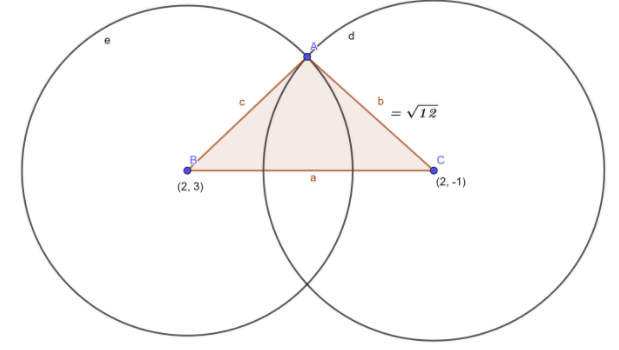
Now we have to find out the distance between the centers i.e. BC.
\[{\rm{BC = }}\sqrt {{{(2 - 2)}^2} + {{( - 1 - 3)}^2}} {\rm{ = }}\sqrt {0 + {{( - 4)}^2}} {\rm{ = }}\sqrt {16} {\rm{ = 4}}\]
Now we have to apply Pythagoras theorem in the right triangle ABC to get the value of the radius of the other circle.
Therefore, \[{\rm{B}}{{\rm{C}}^2}{\rm{ = A}}{{\rm{B}}^2}{\rm{ + A}}{{\rm{C}}^2}\] where,\[{\rm{BC = 4}}\],\[{\rm{AC = }}\sqrt {12} \] and we have to find the value of AB, we get
\[ \Rightarrow 16 = {\rm{A}}{{\rm{B}}^2}{\rm{ + }}12\]
\[ \Rightarrow {\rm{A}}{{\rm{B}}^2}{\rm{ = 4}}\]
\[ \Rightarrow {\rm{AB = }}\sqrt {\rm{4}} {\rm{ = 2}}\]
Hence, the radius of the circle is equal to 2 units.
So, option B is correct.
Note:
Two circles are said to be orthogonal if the tangents to the both circles at the point of intersection makes \[{90^0}\] angle with each other i.e. perpendicular to each other then circles are aid that they are orthogonal to each other. Any symmetrical shape can intersect any other symmetric shape orthogonally. We should know the basic equation of the circle having centre (p, q) and radius r have a equation of \[{{\rm{(x - p)}}^2}{\rm{ + (y - q}}{{\rm{)}}^2}{\rm{ = }}{{\rm{r}}^2}\].
Pythagoras theorem stated that In a right angled triangle the square of the long side is equal to the sum of the squares of the other two sides.
Here we have to find out the radius of the circle. Firstly we will find out the radius and the centre of the intersecting circle. Then we will apply Pythagoras theorem to find out the radius of the circle as we will know the centre to centre distance and also the radius of the intersecting circle. So by that we will be able to find out the radius of the circle.
Complete step by step solution:
Equation of the intersecting circle is \[{{\rm{x}}^2}{\rm{ + }}{{\rm{y}}^2}{\rm{ - 4x + 2y - 7 = 0}}\]………. (1)
We know that circle with centre (p, q) and radius r have a equation of \[{{\rm{(x - p)}}^2}{\rm{ + (y - q}}{{\rm{)}}^2}{\rm{ = }}{{\rm{r}}^2}\]………. (2)
We can write the equation (1) as \[{{\rm{x}}^2}{\rm{ + 4 - 4x + }}{{\rm{y}}^2}{\rm{ + 1 + 2y}} - 12 = 0\]
Above equation can be written as \[{{\rm{(x - 2)}}^2}{\rm{ + (y + 1}}{{\rm{)}}^2}{\rm{ = (}}\sqrt {12} {)^2}\] if we will compare this equation with the equation (2) we get the centre of the circle as (2, -1) and radius as \[\sqrt {12} \]
Now we have to find out the distance between the centers i.e. BC.
\[{\rm{BC = }}\sqrt {{{(2 - 2)}^2} + {{( - 1 - 3)}^2}} {\rm{ = }}\sqrt {0 + {{( - 4)}^2}} {\rm{ = }}\sqrt {16} {\rm{ = 4}}\]
Now we have to apply Pythagoras theorem in the right triangle ABC to get the value of the radius of the other circle.
Therefore, \[{\rm{B}}{{\rm{C}}^2}{\rm{ = A}}{{\rm{B}}^2}{\rm{ + A}}{{\rm{C}}^2}\] where,\[{\rm{BC = 4}}\],\[{\rm{AC = }}\sqrt {12} \] and we have to find the value of AB, we get
\[ \Rightarrow 16 = {\rm{A}}{{\rm{B}}^2}{\rm{ + }}12\]
\[ \Rightarrow {\rm{A}}{{\rm{B}}^2}{\rm{ = 4}}\]
\[ \Rightarrow {\rm{AB = }}\sqrt {\rm{4}} {\rm{ = 2}}\]
Hence, the radius of the circle is equal to 2 units.
So, option B is correct.
Note:
Two circles are said to be orthogonal if the tangents to the both circles at the point of intersection makes \[{90^0}\] angle with each other i.e. perpendicular to each other then circles are aid that they are orthogonal to each other. Any symmetrical shape can intersect any other symmetric shape orthogonally. We should know the basic equation of the circle having centre (p, q) and radius r have a equation of \[{{\rm{(x - p)}}^2}{\rm{ + (y - q}}{{\rm{)}}^2}{\rm{ = }}{{\rm{r}}^2}\].
Pythagoras theorem stated that In a right angled triangle the square of the long side is equal to the sum of the squares of the other two sides.
Recently Updated Pages
Master Class 12 Social Science: Engaging Questions & Answers for Success

Master Class 12 Physics: Engaging Questions & Answers for Success
Master Class 12 Maths: Engaging Questions & Answers for Success
Master Class 12 Economics: Engaging Questions & Answers for Success
Master Class 12 Chemistry: Engaging Questions & Answers for Success
Master Class 12 Business Studies: Engaging Questions & Answers for Success
Trending doubts
Which are the Top 10 Largest Countries of the World?
Draw a labelled sketch of the human eye class 12 physics CBSE
Explain the structure of megasporangium class 12 biology CBSE
What are the major means of transport Explain each class 12 social science CBSE
How many chromosomes are found in human ovum a 46 b class 12 biology CBSE
The diagram of the section of a maize grain is given class 12 biology CBSE