




The cilia and flagella arise from
(A)Basal bodies
(B)Basal granules
(C)Blepharoplasts
(D)All of the above
Answer
 Verified
647.4k+ views
Hint: The cilia and flagella arise from one part and that one part has its three different names and all are starting with the same letter and the term is related to the base.
Complete answer:
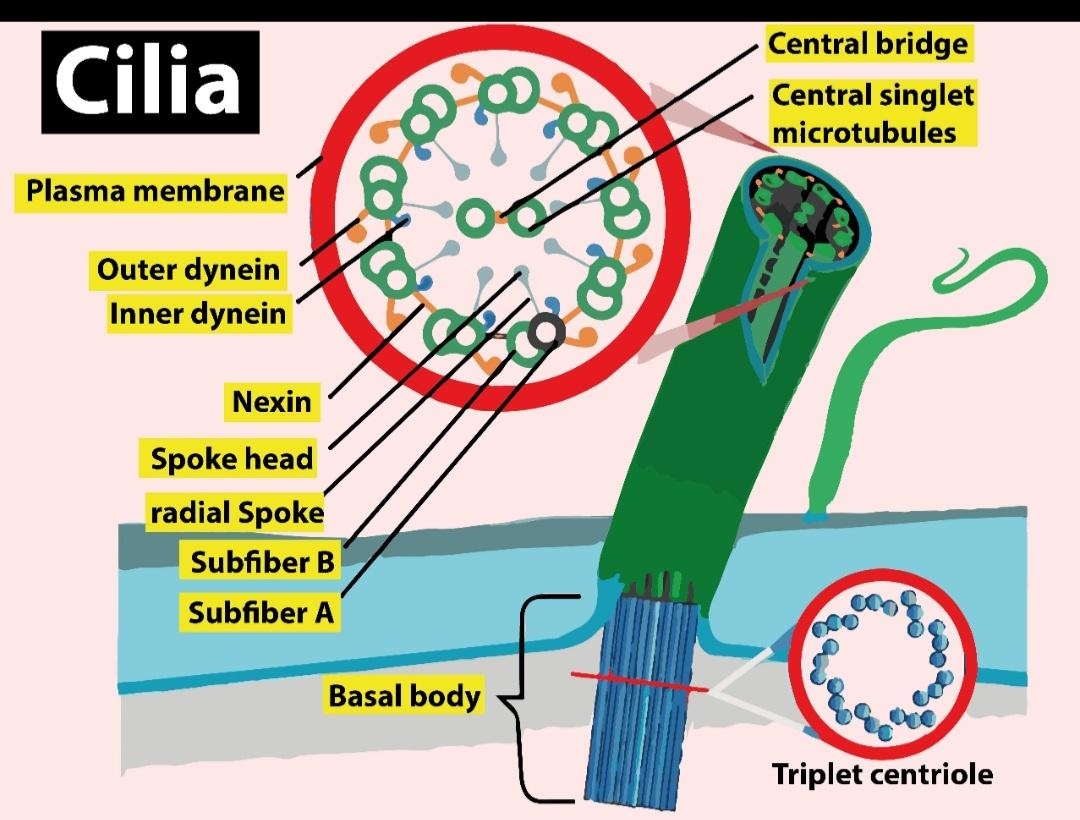
The cilia and flagella arise from the basal body. Another name of the basal body is basal granule, kinetosome, and in older cytological literature it is also known as blepharoplast. The basal body is a protein structure found at the base of a eukaryotic cilium or flagellum. The basal body serves as a site for the growth of the axoneme microtubules.
Additional Information: Cilia and flagella are the projections that come out from the cell. They're made from microtubules and are covered by an extension of the cell wall. they're motile and designed either to move the cell itself or to move substances over or around the cell. The first purpose of cilia in mammalian cells is to move fluid, mucous, or cells over their surface. Cilia and flagella have an equivalent internal structure. The main difference is in their length. Cilia and flagella can move just because of the interactions of a set of microtubules inside. These sets of microtubules are called an "axoneme".Two of these microtubules join to form one doublet in the cilia or flagella This is shown in the middle panel. It was seen that one of the tubules is incomplete.
So, the correct answer is ‘All of the above’.
Note: Like the Cilia and Flagella, Centrioles are also made of microtubules. The basic difference is that they contain 9 sets of triplets and no doublet in the center. Centrioles come in pairs and each of them is organized at right angles to the other.
Complete answer:
The cilia and flagella arise from the basal body. Another name of the basal body is basal granule, kinetosome, and in older cytological literature it is also known as blepharoplast. The basal body is a protein structure found at the base of a eukaryotic cilium or flagellum. The basal body serves as a site for the growth of the axoneme microtubules.
Additional Information: Cilia and flagella are the projections that come out from the cell. They're made from microtubules and are covered by an extension of the cell wall. they're motile and designed either to move the cell itself or to move substances over or around the cell. The first purpose of cilia in mammalian cells is to move fluid, mucous, or cells over their surface. Cilia and flagella have an equivalent internal structure. The main difference is in their length. Cilia and flagella can move just because of the interactions of a set of microtubules inside. These sets of microtubules are called an "axoneme".Two of these microtubules join to form one doublet in the cilia or flagella This is shown in the middle panel. It was seen that one of the tubules is incomplete.
So, the correct answer is ‘All of the above’.
Note: Like the Cilia and Flagella, Centrioles are also made of microtubules. The basic difference is that they contain 9 sets of triplets and no doublet in the center. Centrioles come in pairs and each of them is organized at right angles to the other.
Recently Updated Pages
Write structures of the following compounds i 2 Chloro3methylpentane class 11 chemistry CBSE

What is BLO What is the full form of BLO class 8 social science CBSE
Explain the Treaty of Vienna of 1815 class 10 social science CBSE
A Paragraph on Pollution in about 100-150 Words
XIX+XXX A 49 B 51 C 55 D 44 class 5 maths CBSE
If x a + bt + ct2 where x is in meters and t is in class 11 physics CBSE
Trending doubts
One Metric ton is equal to kg A 10000 B 1000 C 100 class 11 physics CBSE
What do you mean by retardation What is its SI uni class 11 physics CBSE
Draw a diagram of nephron and explain its structur class 11 biology CBSE
10 examples of friction in our daily life
Difference between physical and chemical change class 11 chemistry CBSE
Proton was discovered by A Thomson B Rutherford C Chadwick class 11 chemistry CBSE