




The Chipko movement started from
(a)Reni in Garhwal
(b)Arbori forest
(c)Khejrali village
(d)None of the above
Answer
 Verified
631.5k+ views
Hint: In this movement, the people protected trees by hugging them. The villagers of some remote areas like high up in the Himalayan were first involved in this movement and later it spread to the other parts.
Complete answer:
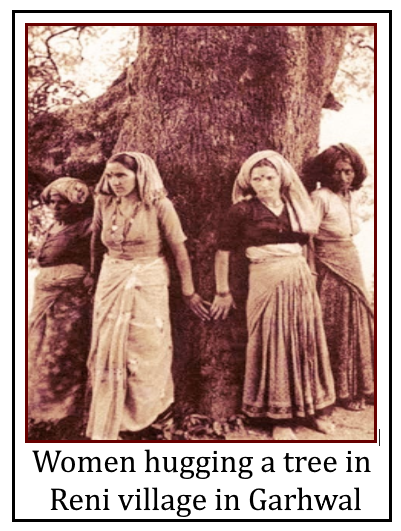
The Chipko Movement or Andolan was the result of a grassroots level effort to end all the alienation of people from their forests. The movement originated from an incident in a remote village called Reni in Garhwal, high up in the Himalayas during the early 1970s. There was a dispute between the local villagers and a logging contractor who had been allowed to fell trees in a forest close to the village. On a particular day, the contractor’s workers appeared in the forest to cut the trees while the menfolk were absent. Undeterred, the women of the village reached the forest quickly and clasped the tree trunks thus preventing the workers from felling the trees. Thus thwarted, the contractor had to withdraw. The Chipko Movement quickly spread across communities and media, and forced the government, to whom the forest belongs, to rethink their priorities in the use of forest produce.
Additional Information: -The Chipko Movement was a socio-ecological movement that followed non-violent methods to protect trees from cutting down. It was a forest conservation movement.
-The two main objectives behind this movement were to prevent the construction of private mills in the forest area and to protect the forests from the process of deforestation.
So, the correct answer is ‘Reni in Garhwal’.
Note: -One of the important Chipko leaders, Sunderlal Bahuguna, took a 5,000-kilometre trans-Himalaya foot march in the year 1981–83, spreading the message of ChipkoAndolan to a far greater area.
-Blackbucks, chinkaras, vultures, partridges, peacocks, and even the endangered Great Indian Bustard, find the Bishnoi village a haven. Bishnois protect them from poachers and they also actively participate in helping them lead a life.
-The government of India has recently instituted an “Amrita Devi Bishnoi National Award for Wildlife Conservation” in the memory of Amrita Devi Bishnoi.
Complete answer:
The Chipko Movement or Andolan was the result of a grassroots level effort to end all the alienation of people from their forests. The movement originated from an incident in a remote village called Reni in Garhwal, high up in the Himalayas during the early 1970s. There was a dispute between the local villagers and a logging contractor who had been allowed to fell trees in a forest close to the village. On a particular day, the contractor’s workers appeared in the forest to cut the trees while the menfolk were absent. Undeterred, the women of the village reached the forest quickly and clasped the tree trunks thus preventing the workers from felling the trees. Thus thwarted, the contractor had to withdraw. The Chipko Movement quickly spread across communities and media, and forced the government, to whom the forest belongs, to rethink their priorities in the use of forest produce.
Additional Information: -The Chipko Movement was a socio-ecological movement that followed non-violent methods to protect trees from cutting down. It was a forest conservation movement.
-The two main objectives behind this movement were to prevent the construction of private mills in the forest area and to protect the forests from the process of deforestation.
So, the correct answer is ‘Reni in Garhwal’.
Note: -One of the important Chipko leaders, Sunderlal Bahuguna, took a 5,000-kilometre trans-Himalaya foot march in the year 1981–83, spreading the message of ChipkoAndolan to a far greater area.
-Blackbucks, chinkaras, vultures, partridges, peacocks, and even the endangered Great Indian Bustard, find the Bishnoi village a haven. Bishnois protect them from poachers and they also actively participate in helping them lead a life.
-The government of India has recently instituted an “Amrita Devi Bishnoi National Award for Wildlife Conservation” in the memory of Amrita Devi Bishnoi.
Recently Updated Pages
Master Class 11 English: Engaging Questions & Answers for Success

Master Class 11 Social Science: Engaging Questions & Answers for Success
Master Class 11 Maths: Engaging Questions & Answers for Success
Master Class 11 Biology: Engaging Questions & Answers for Success
Master Class 11 Physics: Engaging Questions & Answers for Success
Master Class 11 Chemistry: Engaging Questions & Answers for Success
Trending doubts
One Metric ton is equal to kg A 10000 B 1000 C 100 class 11 physics CBSE
Difference Between Prokaryotic Cells and Eukaryotic Cells
Find the value of the expression given below sin 30circ class 11 maths CBSE
Difference between physical and chemical change class 11 chemistry CBSE
Two of the body parts which do not appear in MRI are class 11 biology CBSE
Draw a diagram of a plant cell and label at least eight class 11 biology CBSE