




The chemical released by B cells after recognition of hapten-carrier complex is known as-
A. Antibodies
B. Lymphokines
C. Antigen
D. All of the above
Answer
 Verified
585.6k+ views
Hint:B cells are mature lymphocyte cells that act with the antigens.
Antigens are those substances that act with the antibodies produced in the body. There are many types of antigens. Hapten can only act with antibodies but cannot induce the production of antibodies.
Complete answer:
1. Antigens are macromolecules. These can be protein, nucleic acid, nucleoprotein, lipoprotein, glycoprotein, or polysaccharide. B-cells act with such antigens.
2. A hapten is also called partial antigen because it has not the character of immunogenicity. Immunogenicity is called the ability of an antigen to induce antibody production in the body or proliferation of T-cells or both. Hapten lacks this character but when it binds with a carrier complex inside the body it can induce antibody production by B cells.
3. B-cells secrete antibodies. Antibodies are glycoprotein in chemical nature. These are made by 4 chains of protein. On the membrane of B cells, more than 100000 molecules of antibodies are found that act with the antigens. Antibodies act as adaptor molecules for antigens.
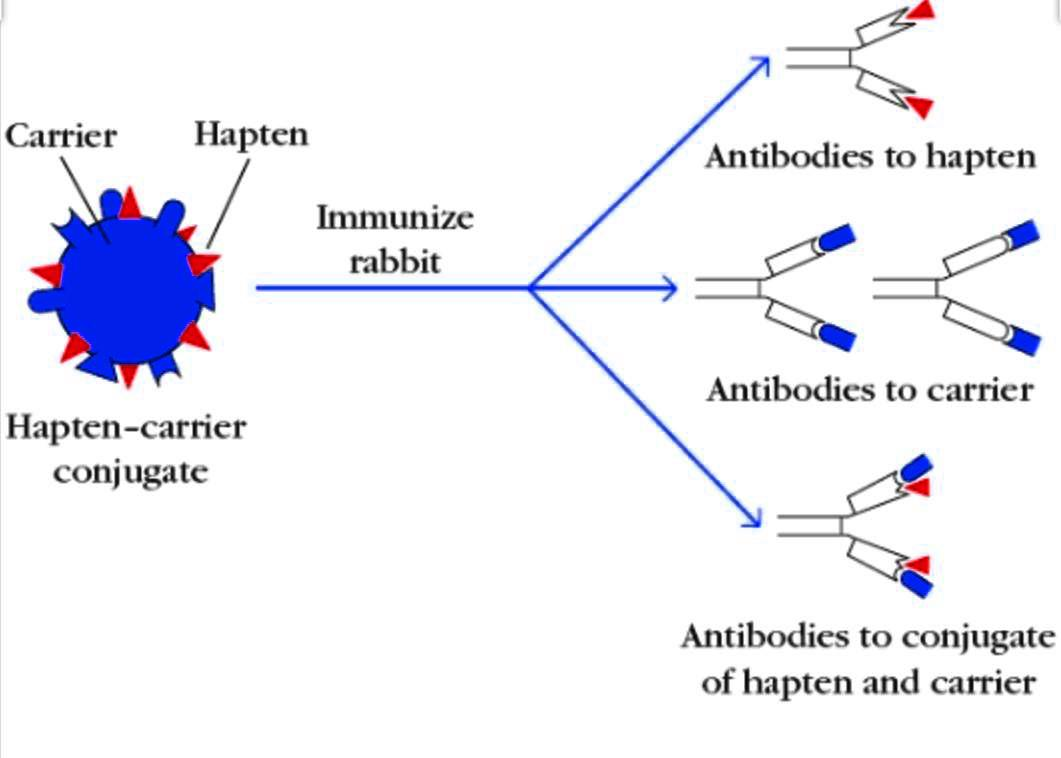
4. B cells can recognize the antigen by its shape. Some specific regions of antigen are responsible for antibody production called an epitope. The number of epitopes on an antigen is called valency. Antigens can be mono, bi, or multivalent. Hapten has less number of epitopes.
So the correct answer is option A) that is Antibodies.
Note: Maturation of B cells takes place in the bone marrow. B cells die after 1-2 weeks. B cells divide and form plasma cells and memory cells.
Plasma cells are a factory of protein. It produces 2000 types of antibodies during its lifespan.
Antigens are those substances that act with the antibodies produced in the body. There are many types of antigens. Hapten can only act with antibodies but cannot induce the production of antibodies.
Complete answer:
1. Antigens are macromolecules. These can be protein, nucleic acid, nucleoprotein, lipoprotein, glycoprotein, or polysaccharide. B-cells act with such antigens.
2. A hapten is also called partial antigen because it has not the character of immunogenicity. Immunogenicity is called the ability of an antigen to induce antibody production in the body or proliferation of T-cells or both. Hapten lacks this character but when it binds with a carrier complex inside the body it can induce antibody production by B cells.
3. B-cells secrete antibodies. Antibodies are glycoprotein in chemical nature. These are made by 4 chains of protein. On the membrane of B cells, more than 100000 molecules of antibodies are found that act with the antigens. Antibodies act as adaptor molecules for antigens.
4. B cells can recognize the antigen by its shape. Some specific regions of antigen are responsible for antibody production called an epitope. The number of epitopes on an antigen is called valency. Antigens can be mono, bi, or multivalent. Hapten has less number of epitopes.
So the correct answer is option A) that is Antibodies.
Note: Maturation of B cells takes place in the bone marrow. B cells die after 1-2 weeks. B cells divide and form plasma cells and memory cells.
Plasma cells are a factory of protein. It produces 2000 types of antibodies during its lifespan.
Recently Updated Pages
Master Class 12 Business Studies: Engaging Questions & Answers for Success

Master Class 12 Biology: Engaging Questions & Answers for Success
Master Class 12 Chemistry: Engaging Questions & Answers for Success
Class 12 Question and Answer - Your Ultimate Solutions Guide
Master Class 11 Social Science: Engaging Questions & Answers for Success
Master Class 11 English: Engaging Questions & Answers for Success
Trending doubts
Which is more stable and why class 12 chemistry CBSE
Which are the Top 10 Largest Countries of the World?
Draw a labelled sketch of the human eye class 12 physics CBSE
Differentiate between homogeneous and heterogeneous class 12 chemistry CBSE
What are the major means of transport Explain each class 12 social science CBSE
Sulphuric acid is known as the king of acids State class 12 chemistry CBSE