




The characteristic of sound which helps to distinguish between a man’s voice and a woman’s voice is:
A). Pitch
B). Amplitude
C). Loudness
D). Frequency
Answer
 Verified
654.6k+ views
Hint: Recall that sound is produced by vibrations passing through the medium of its propagation. Thus, sound waves have a characteristic amplitude and frequency attributed to them, which determines the kind of sound it produces. Now, we know that larger amplitudes produce louder sounds, but the loudness of a sound cannot be used to distinguish between a man and a woman’s voice. So, think in terms of how frequency comes into play in this distinction.
Complete step-by-step solution:
Let us begin by understanding the nature of sound.
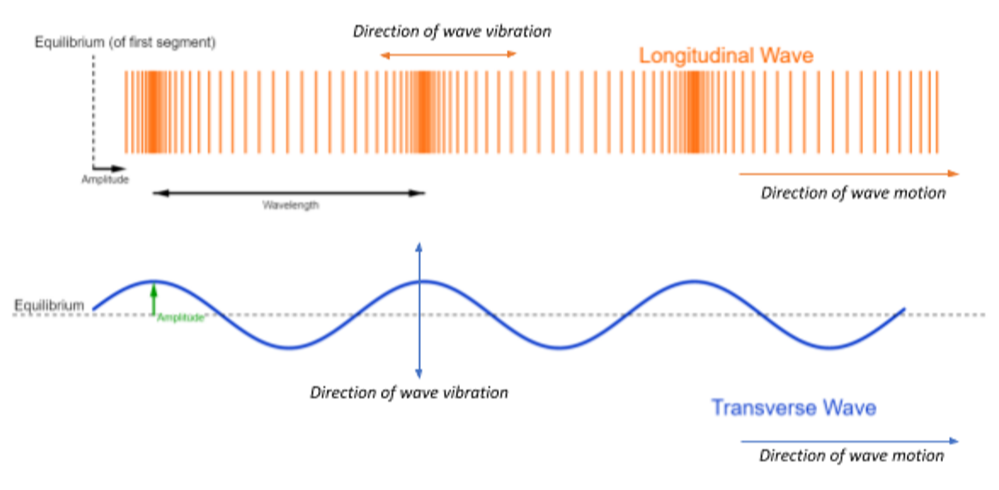
Sound is produced as a result of compressions and rarefactions propagating through the medium. These vibrations propagate in the same direction as the sound produced, and are called longitudinal waves or sound waves. They are also mechanical waves, owing to the nature of their propagation described before.
The amplitude and frequency of the vibrations of a sound wave characterize the kind of sound it produces.
Now, the amplitude of vibrations of the sound waves determines the loudness of the sound. A large-amplitude produces a loud sound whereas if the amplitude of vibration is small it produces a feeble or a weak sound.
The frequency, however, determines the shrillness of the sound. The higher the frequency of vibrations, the shriller the sound.
Now, we can distinguish a man’s voice and a woman’s voice without even seeing them since the frequency of vibrations of the sound produced by the man’s voice is lower than the frequency of vibrations produced by the woman’s voice. Thus, the woman’s voice is shriller than the man’s voice.
This shrillness, in physical terms, is nothing but the characteristic pitch of the sound. A man’s voice is flat and has a low pitch whereas a woman’s voice is shrill and hence has a higher pitch.
Thus, even if the man’s voice and the woman’s voice are equally loud, we can distinguish them from the pitch of their vibrations which is proportional to the frequency of vibrations of the sound produced.
Thus, the correct choice would be (A). Pitch
Note: It is important to understand the distinction between longitudinal and transverse waves.
In longitudinal waves, the particles of the medium move parallel to the propagation of the wave, thus acting in one dimension, whereas in transverse waves, the particles of the medium move perpendicular to the direction of propagation of the wave, thus acting in two dimensions.
Longitudinal waves are made of compressions and rarefactions propagating through the medium, whereas transverse waves are made of crests and troughs propagating through the medium.
Sound waves and compressions moving along a slinky are examples of longitudinal waves, whereas vibrations on a string and ripples on the water surface are examples of transverse waves.
Complete step-by-step solution:
Let us begin by understanding the nature of sound.
Sound is produced as a result of compressions and rarefactions propagating through the medium. These vibrations propagate in the same direction as the sound produced, and are called longitudinal waves or sound waves. They are also mechanical waves, owing to the nature of their propagation described before.
The amplitude and frequency of the vibrations of a sound wave characterize the kind of sound it produces.
Now, the amplitude of vibrations of the sound waves determines the loudness of the sound. A large-amplitude produces a loud sound whereas if the amplitude of vibration is small it produces a feeble or a weak sound.
The frequency, however, determines the shrillness of the sound. The higher the frequency of vibrations, the shriller the sound.
Now, we can distinguish a man’s voice and a woman’s voice without even seeing them since the frequency of vibrations of the sound produced by the man’s voice is lower than the frequency of vibrations produced by the woman’s voice. Thus, the woman’s voice is shriller than the man’s voice.
This shrillness, in physical terms, is nothing but the characteristic pitch of the sound. A man’s voice is flat and has a low pitch whereas a woman’s voice is shrill and hence has a higher pitch.
Thus, even if the man’s voice and the woman’s voice are equally loud, we can distinguish them from the pitch of their vibrations which is proportional to the frequency of vibrations of the sound produced.
Thus, the correct choice would be (A). Pitch
Note: It is important to understand the distinction between longitudinal and transverse waves.
In longitudinal waves, the particles of the medium move parallel to the propagation of the wave, thus acting in one dimension, whereas in transverse waves, the particles of the medium move perpendicular to the direction of propagation of the wave, thus acting in two dimensions.
Longitudinal waves are made of compressions and rarefactions propagating through the medium, whereas transverse waves are made of crests and troughs propagating through the medium.
Sound waves and compressions moving along a slinky are examples of longitudinal waves, whereas vibrations on a string and ripples on the water surface are examples of transverse waves.
Recently Updated Pages
If x a + bt + ct2 where x is in meters and t is in class 11 physics CBSE

A car covers the first half distance between two places class 11 physics CBSE
The resultant of two vectors overrightarrow P and overrightarrow class 11 physics CBSE
Find the value of cos 135 class 11 maths CBSE
A mass M is held in place by an applied force F and class 11 physics CBSE
A solution of glucose in water is labelled as 10 dfracwv class 11 chemistry CBSE
Trending doubts
One Metric ton is equal to kg A 10000 B 1000 C 100 class 11 physics CBSE
Find the value of the expression given below sin 30circ class 11 maths CBSE
What do you mean by retardation What is its SI uni class 11 physics CBSE
Draw a diagram of nephron and explain its structur class 11 biology CBSE
10 examples of friction in our daily life
Difference between physical and chemical change class 11 chemistry CBSE